




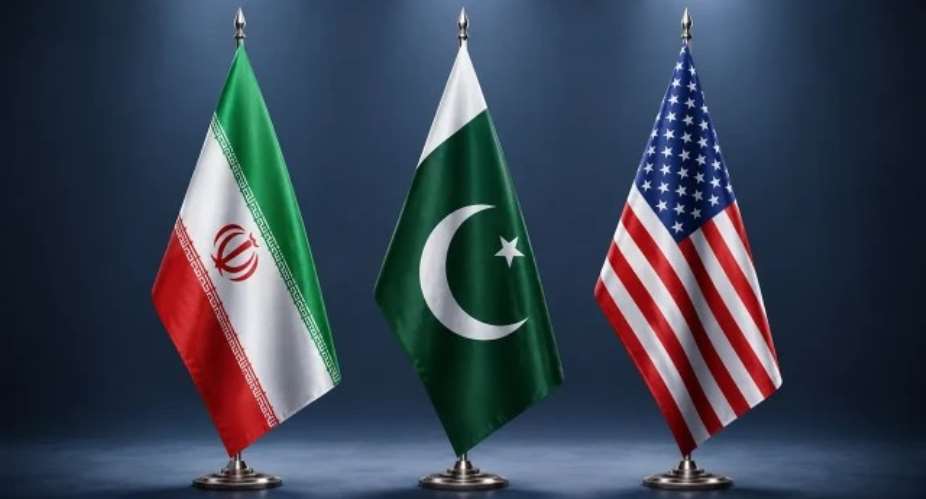
Pakistan's diplomatic position appears to be entering one of its most delicate phases in recent years. What initially seemed to be a conflict limited to the United States and Iran is gradually expanding into a broader regional confrontation, forcing many states to reconsider their strategic choices. After six consecutive days of American bombing inside Iran and the continued military response by the Houthis against Saudi Arabia, Pakistan may find itself moving from the role of mediator toward that of a potential participant in a wider regional security framework.
For months, Islamabad attempted to maintain balanced relations with all major actors. Pakistan consistently called for restraint, dialogue, and reconciliation while avoiding direct involvement in the conflict. However, regional defence commitments and strategic partnerships may eventually place Islamabad under increasing pressure. If Saudi Arabia invokes defence cooperation against Houthi attacks, Pakistan could face difficult decisions regarding its military and diplomatic responsibilities. Since the Houthis are widely regarded as being closely aligned with Iran's Islamic Revolutionary Guard Corps (IRGC), any Pakistani military involvement against them would inevitably carry implications for Pakistan-Iran relations.
Such a development would represent more than another military confrontation. It would symbolise the further fragmentation of the Muslim world. If Pakistan, another major Muslim state, enters a conflict involving an Iranian proxy, one must ask whether any meaningful concept of Muslim strategic unity ever truly existed. The divisions that have surfaced during recent crises suggest that political interests, national security calculations, and regional rivalries continue to outweigh religious solidarity.
Recent diplomatic developments have also raised important questions. Turkey's growing regional activism and President Recep Tayyip Erdoğan's visible engagement alongside President Donald Trump during last week's summit have been interpreted by many observers as a signal that regional alliances are evolving. Simultaneously, Iran appears to be facing mounting economic constraints, prolonged sanctions, and increasing diplomatic isolation. The question naturally arises: what strategic options remain available to Tehran?
Iran still possesses considerable leverage despite its economic difficulties. The Strait of Hormuz remains one of the world's most critical energy chokepoints, while the Houthis retain the capability to disrupt maritime traffic through the Bab-el-Mandeb Strait. Any prolonged disruption in either corridor would significantly affect global energy markets, increasing oil prices and creating severe economic pressure on Europe and the wider international community. These maritime realities provide Iran with strategic leverage even while under military and economic pressure.
This changing environment also raises another possibility. Washington may be attempting to reshape its regional security architecture. The Gulf monarchies, particularly Saudi Arabia and the United Arab Emirates, have invested enormous financial resources over the past decade in regional security arrangements. Yet repeated conflicts have exposed limitations in those frameworks. If confidence in the existing Gulf-centred order continues to weaken, the United States may increasingly look toward countries such as Turkey and Pakistan as more active regional security partners.
Pakistan's strategic importance cannot be ignored. It possesses one of the world's largest armed forces, nuclear capability, extensive counterterrorism experience, and a unique ability to maintain dialogue with competing regional actors. Together with Turkey, Pakistan could potentially contribute to a new regional security framework. Recent praise directed toward both President Erdoğan and Pakistan's Chief of Army Staff, Field Marshal Asim Munir, by President Trump has naturally generated speculation regarding future strategic cooperation, although such interpretations remain speculative and should be approached with caution.
Nevertheless, Pakistan must carefully evaluate the costs of any deeper military commitment. A defence partnership should never be viewed as a one-sided obligation. If Pakistan were expected to support Saudi Arabia during a regional conflict, an equally important question deserves attention: would Saudi Arabia provide similar military support if Pakistan faced aggression elsewhere, particularly from India? The answer remains uncertain. Defence agreements are strongest when obligations, expectations, and strategic interests are genuinely reciprocal.
Pakistan's greatest contribution may not lie on the battlefield but at the negotiating table. Rather than becoming another participant in an expanding regional war, Islamabad should utilise its diplomatic credibility to encourage a new regional dialogue. Any future Muslim security architecture should emerge through regional consensus, not through external approval or great-power competition. Iran has demonstrated that it remains an influential regional actor whose interests cannot simply be ignored. Sustainable peace will require engagement with Tehran rather than permanent confrontation.
Ultimately, Pakistan stands at a strategic crossroads. It can either become another member of an expanding war coalition or position itself as a credible architect of a new regional order built upon diplomacy, mutual security, and South Asian consensus. In an era where wars are becoming increasingly costly and alliances increasingly fragile, Pakistan's greatest strength may be its ability to build bridges rather than battle lines.

 NPP inaugurates nine-member committee to oversee September 19 national executive...
 Political parties should have 5% parliamentary representation before contesting ...
 Ashanti NPP sets August 15 poll to elect new regional Chairman to replace impris...
 GRIDCo races to restore power after nationwide transmission system disturbance
 Gabonese President Nguema pays homage to Dr Kwame Nkrumah
 Parliament endorses GRA deal to roll out Fiscal Electronic Device policy
 [VIDEO] 'Some people are planning to shoot Sharaf Mahama' — Dr Power Man
 Ibrahim Mahama steps in to support evacuation of Ghanaians from South Africa ami...
 Appeal judges will decide Wontumi case based on record, not public commentary – ...
 Otumfuo approved the date for my father’s funeral — Adwoa Safo

