




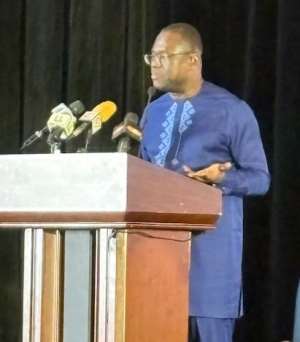
The Executive Chairman of the Jospong Group of Companies, Dr. Joseph Siaw Agyepong, has called for a holistic and all-embracing approach to the National Sanitation Day exercise, stressing that achieving a clean Ghana will require the active participation of every citizen, institution, and community.
Speaking ahead of this Saturday’s nationwide cleanup, Dr. Siaw Agyepong said sanitation cannot be left to a few people while others look on and expressed concern over the attitude of some residents who stand aloof while others clean their communities, streets, and the frontage of shops and homes.
"This is unfortunate," he said. "On Saturday there must be a change. We must all get involved. Cleanliness is a shared responsibility, not the duty of assembly workers or volunteers alone."
Dr. Siaw Agyepong stated his support for the Media Coalition Against Open Defecation (M-CODe), a nationwide accountability activation to monitor how Metropolitan, Municipal, and District Chief Executives (MMDCEs) are delivering on the government's new directive that makes sanitation a Key Performance Indicator.
Under the theme "Institutionalizing Sanitation Performance," the exercise marks the first phase of M-CODe's revitalization agenda with support from World Vision Ghana, seeking to position the media as an accountability bridge between government, traditional authorities, local assemblies, and citizens in the national push to achieve a clean environment and end open defecation.
The first phase of the activation will be rolled out through M-CODe regional branches in the Upper East, Northern, Western, Greater Accra, Upper West, and Ashanti regions. A second phase covering the remaining regions will follow.
Dr. Siaw Agyepong noted that the national sanitation drive must go beyond ceremonial cleanups and address attitudes, systems, and infrastructure together and stressed a "holistic and all-embracing" model as one that brings together households, market women, transport operators, schools, churches, mosques, traditional authorities, MMDAs, and the private sector.
"When we say holistic, we mean every space matters. Your home, your shop, your street, your market, your school. When we say all-embracing, we mean every person matters. The young and old, leaders and followers," he stated.
He argued that Ghana’s ambition to end open defecation and improve urban hygiene will not be realized by government action alone. It will require a culture shift where citizens take ownership of their immediate environment every week, not just on National Sanitation Day.
The Jospong Group Executive Chairman lamented the growing trend of bystander apathy during community cleaning exercises, adding, "It is disheartening to see a few people sweeping and collecting waste while others stand by watching from their shops or in front of their houses. That mindset must end this Saturday."
He called on Metropolitan, Municipal and District Assemblies to intensify public education and enforcement and urged traditional leaders to use community durbars to reinforce communal responsibility.
Dr. Siaw Agyepong further urged the media to sustain advocacy and highlight best practices so that communities can learn from each other and replicate success.
Reaffirming the Jospong Group’s commitment, Dr. Siaw Agyepong said the company will continue to support the national sanitation agenda through waste management infrastructure, logistics, and public awareness campaigns across the country.
He noted that the group's operations in over 25 African countries have shown that clean cities are possible when leadership, private sector innovation, and citizen participation align.
"If we embrace this collective spirit, we will not only have cleaner communities on Saturdays but also healthier families, stronger local economies, and a Ghana we can all be proud of," he added.
Dr. Siaw Agyepong concluded with a direct appeal: "Let this Saturday be different. Step out. Pick a broom. Clean your frontage. Encourage your neighbor. A clean Ghana begins with me and you."
The National Convenor of M-CODe, Mr. Francis Ameyibor, said the goal is not to witch-hunt but to create transparency. “When citizens and traditional leaders track performance together, MMDCES are more likely to deliver."
Mr. Ameyibor further encouraged traditional councils across the country to establish a Sanitation Monitoring Committee that will meet monthly with the municipal assembly to review progress and map up strategies to deal with sanitation issues.
The intervention seeks to position the media as the accountability bridge between government, traditional authority, local assembly, and citizens across the country, with a sharp focus on ending open defecation (OD), Mr. Ameyibor, explained.
Mr. Ameyibor explained that now that sanitation is a KPI, the focus shifts from just talking about it to making sure it happens, and the media's job, as outlined by M-CODE, is to make sure that budgets are actually used, that laws are enforced, and that local leaders are actively doing their jobs.
Mr. Ameyibor, therefore, appealed to state and non-state actors, development partners, media outlets, traditional and religious leaders, environmental service providers, and the general public to support M-CODe with funds and logistics to ensure the success of the project in the best interest of everyone living in Ghana.
“Sanitation as a KPI is a bold step. This media-led accountability week ensures that commitments translate into measurable results for the most vulnerable communities,” said Mr. Yaw Attah Arhin, WASH Technical Specialist at World Vision Ghana.
Mr. Attah Arhin stressed that the week is designed to deliver three immediate outcomes: increased public awareness that sanitation is now a measurable MMDCE performance metric, not a discretionary activity.
National Sanitation Day was instituted to mobilize Ghanaians for regular communal cleaning and to raise awareness on proper waste disposal and environmental hygiene.
The government has also made sanitation a Key Performance Indicator for MMDCEs to ensure measurable delivery at the local level.
Public health experts say poor sanitation contributes to cholera outbreaks, malaria, and flooding in urban areas. They stress that consistent community action combined with proper waste infrastructure remains critical to breaking the cycle.
 Mid-Year Budget Review: 'GH¢30bn in promised projects remain unexecuted' — Oppon...
 'This is the first mid-year review that failed to account for programmes executi...
 Police arrest 'fake' pastor over alleged marriage scam and intimate image blackm...
 'Ato Forson is spending prudently, not recklessly' — Titus Beyuo
 Zenith University College Law Faculty ranks among Ghana's top five at Supreme Co...
 Mid-Year Budget Review: 'The Finance Minister was loudly silent on the 24-hour e...
 GES sets August 15 for dispatch of teacher promotion letters
 Mahama welcomes Gabon's President for three-day bilateral talks on trade, securi...
 Multiple deaths in Japan mall collapse after 7.1-magnitude earthquake
 Anglican Church leader visits slave trade project on Africa tour

