




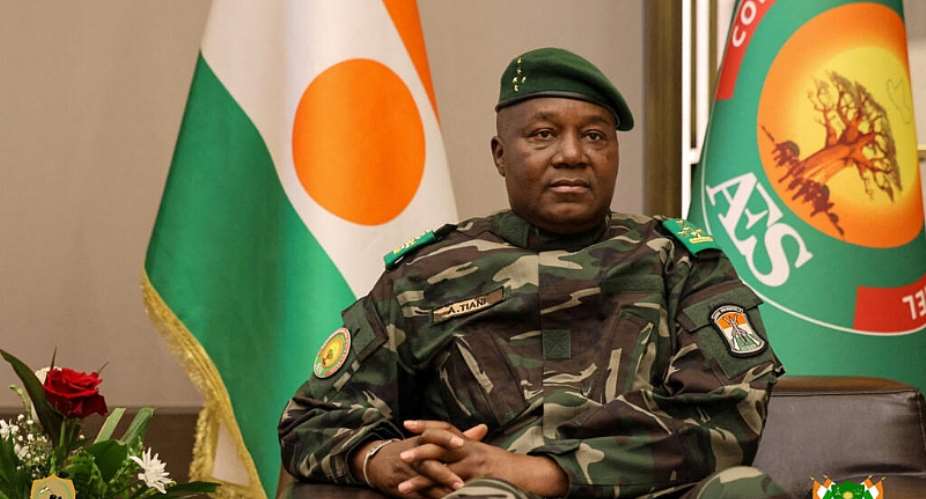
Three years after Niger's military coup, insecurity has worsened and civic freedoms have been sharply restricted, despite strong economic growth driven by oil, according to former Nigerien ambassador Kiari Liman-Tinguiri.
President Mohamed Bazoum was overthrown on 26 July 2023 and remains detained in Niamey with his wife. Niger has since been governed by the National Council for the Safeguarding of the Fatherland, led by General Abdourahamane Tiani.
Tiani was formally sworn in last year as president for a renewable five-year term, while political parties have been dissolved and the authorities have tightened their control over the media and civil society.
Liman-Tinguiri, an economist who served as Niger's ambassador to the US under Bazoum, said the military had initially justified its takeover by citing insecurity and poor governance.
Three years later, he argued, the situation had deteriorated.
“Unfortunately, the reality is that the situation has undeniably worsened compared with 2023,” he told RFI.
Latest Niamey airport attack tests Niger junta as terror groups 'adapt'
Rising violence
Citing publicly available data from the Armed Conflict Location and Event Data project, known as ACLED, Liman-Tinguiri pointed to increases in security incidents, deaths and attacks against Niger's armed forces.
Jihadist violence has also spread geographically, he said.
“There has been a rise in the number of security incidents, fatalities and attacks against the armed forces,” he said. “There has also been a geographical spread of jihadist violence.”
Niger has faced repeated attacks by armed groups linked to Al-Qaeda and the Islamic State, particularly near its borders with Mali and Burkina Faso.
The three military-led countries have strengthened their security ties through the Alliance of Sahel States, after withdrawing from the Economic Community of West African States, Ecowas.
But Liman-Tinguiri said Niger's western Tillabéri region had become the area worst affected by militant violence in the central Sahel.
“That is where the highest number of deaths has occurred,” he said. “No other region, neither in Mali nor in Burkina Faso, has seen anything like this.”
He said the military's ability to remain in power did not necessarily reflect successful governance.
“I don't think remaining in power is linked to performance,” he said. “It has more to do with the apathy of the elite. People have come to terms with the situation.”
How a disinformation network is destabilising the Alliance of Sahel States
Political freedoms restricted
All political parties in Niger were dissolved in 2025, effectively bringing organised party politics to a halt.
But Liman-Tinguiri said this was only one part of a much wider crackdown.
“There is an extreme curtailment of civic space in Niger,” he said.
He pointed to arbitrary arrests, restrictions on freedom of expression, bans affecting international media and tighter controls on non-governmental organisations.
“Freedom of expression has been completely suppressed,” he said. “Court rulings are being flouted, non-governmental organisations have been dissolved and subjected to an unprecedented system of control.”
“In short, it is an authoritarian regime. That is the reality.”
Liman-Tinguiri also expressed concern over Bazoum's continued detention and lack of access to normal communication.
“I hope he is well, but President Bazoum has no means of communication,” he said. “His situation is worrying.”
Bazoum has now been detained for longer than he served as president, Liman-Tinguiri noted. He called for the former leader's release, along with other detainees including former interior minister Hamadou Adamou Souley and civil society activist Moussa Tchangari.
Niger military junta seizes control of French uranium operations
Economic breathing room
Niger's economy has avoided the collapse predicted by some observers after the coup, regional sanctions and a sharp reduction in foreign aid.
Growth reached between 9 percent and 10 percent in 2024 and was estimated at around 7 percent in 2025, Liman-Tinguiri said.
Much of that expansion has come from oil, which accounts for approximately 9 percent of gross domestic product, while agriculture is the second-largest contributor.
However, he said the growth could not be credited entirely to the military authorities.
The Niger–Benin oil pipeline and related investments had already been negotiated and were close to becoming operational when the coup took place.
“Turning oil-driven growth into poverty reduction or improved living standards – that requires public policy,” he said.
Relations with neighbouring Benin remain tense, with the land border at Malanville closed even though Nigerien oil continues to pass through Beninese territory.
Niamey has expressed fears that French forces could operate from Benin, but Liman-Tinguiri rejected the argument.
“You cannot claim sovereignty for yourself and then decide who is allowed to enter other countries' territory,” he said.
This has been adapted from an original interview in French by RFI's Magali Lagrange

 Two Ghanaians killed in South Africa xenophobic attacks — Ablakwa
 Ibrahim Mahama not interested neither has he made an attempt at buying VALCO — A...
 Court gives Wontumi, State 30 days to conclude plea bargain talks in GH¢30m EXIM...
 No evacuated Ghanaian from South Africa is on wanted list Ablakwa — Foreign Aff...
 20-year sentence for Chairman Wontumi raises serious questions of fairness - Pet...
 Vote-buying weakens democracy, impoverishes voters — Chief Justice Baffoe-Bonnie
 VALCO workers protest alleged plans to privatise state-owned aluminium company
 63% Ghanaians support establishment of tribunals – Global InfoAnalytics poll
 Parents who send children abroad too early to study don't love them, they will l...
 Doctors remove motorbike key from farmer's skull after attempting to separate fi...

