




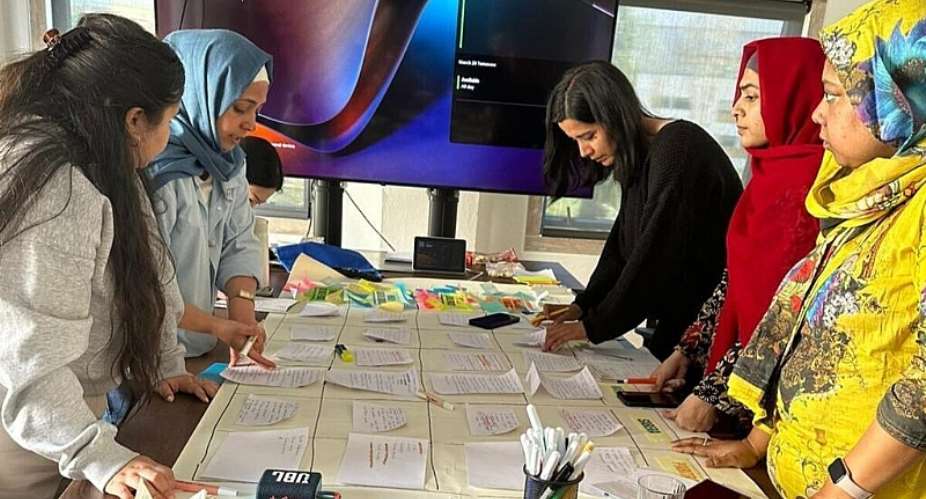
At the Ismaili Centre in Lisbon, a small team is prepping for the organisation's outreach work. Their aim is to gather information on the mental health and wellbeing of migrants, as part of a project called What Health.
Their plans include approaching migrant communities on the street, as well as making the most of diaspora festivals and events to distribute their questionnaires.
"Mental health is an extremely complex subject, and therefore a taboo for many," explains Sofia Peyssonneau, a community development officer at the Aga Khan Foundation working on the project.
"We can't just organise events labelled 'mental health'. We need to find other strategies. For example, when there's a diaspora festival, we ask to set up a stand there. We offer a health check-up with the team's doctors, and then participants fill in a questionnaire on mental health."
It is most often people from migrant backgrounds themselves who are driving outreach efforts like these – from Nepal, China, India, Bangladesh and Pakistan. Having qualified in their countries of origin, some as doctors, they aim to improve the living conditions of their peers by helping to collect data and raise awareness.
"There is a need to improve things, because migrants in Portugal face difficulties accessing healthcare services and mental health remains a major taboo," explains Pabitra Neupane, a cultural mediator for the Nialp organisation, who also works on the What Health project.
French health minister promises fast-track access to mental health for youth
Funded in part by the European Union, What Health will carry out extensive research into the mental health of migrants until 2029.
After collecting personal accounts, the team of researchers work with doctors to identify gaps in the system, before training them in an approach that takes cultural factors into account.
Practitioners will then reach out to migrant communities to raise awareness of mental health issues and explain the care pathways available.
From emigration to labour shortage
Since the late 1990s, Portugal has transformed from a country of emigrants to one of immigrants.
"Initially, the country mainly welcomed migrants from Portuguese-speaking countries, such as Brazil and Cape Verde, followed by citizens from Eastern Europe," says Mario Ribeiro, a PhD student and coordinator of the Migration Observatory, which collects data on migration to Portugal on behalf of the government's agency for receiving and integrating new arrivals.
From the mid-2010s onwards, Syrian and Afghan refugees, workers from the Indian subcontinent and European pensioners began arriving – against a backdrop of an ageing local population and a growing need for labour.
"We need migrant workers for agriculture, tourism and caring for the elderly," Ribeiro says. "If you go to the fields of the Alentejo or the Ribatejo, the majority of the harvesting is done by migrant workers."
The presence of these new groups means services need to adapt, particularly in the field of mental health.
Many people are arriving in Portugal traumatised, either by the conflicts that forced them to flee their homes or by the dehumanising and often dangerous journey to safety.
In Almeirim, a town 80km east of Lisbon, Cátia Sequeira runs a local centre for migrant support and integration called Claim. She often works with Syrian and Ukrainian refugees scarred by war.
"Some people would jump at the mere sound of a toilet flushing because it reminded them of the sound of bombing," she recalls.
The Claim centre has developed Cuidar+, a psychological and social support programme designed to help people regain a sense of direction.
"We needed to create a space where we could listen to them. There is also a great deal of domestic violence and more complex forms of violence. We have established a climate of trust and we foster a close relationship with our service users, which enables us to intervene when more sensitive situations arise," Sequeira explains.
The healthcare system has also had to adapt to the arrival of large numbers of non-Portuguese speakers, with Ribeiro noting this language barrier is the primary challenge.
Telephone interpreting services and intercultural mediators have been put in place, organised by the What Health project as well as organisations including the Portuguese Council for Refugees (CPR).
EU steps up Channel migrant crackdown with more staff and surveillance
Cultural differences
In Loures, the reception centre run by the CPR provides another gateway to healthcare, designed for people applying for refugee status.
Upon arrival, asylum seekers are provided with accommodation and support throughout the initial phase of their asylum application.
"They are always assessed within the first 48 hours, with a psycho-social assessment that takes into account their physical health, as well as an initial assessment of their mental health," explains Catarina Baptista, the centre's director and a psychologist. This initial screening enables the most urgent cases to be identified quickly.
"Our team of psychologists then carries out a more in-depth assessment, either one to one or in a group setting, depending on the individual's circumstances."
The CPR also has an arrangement with the Júlio de Matos Psychiatric Hospital in Lisbon to ensure faster access to consultations for its service users.
For Baptista, providing care in a setting that is familiar to asylum seekers and refugees is crucial.
"The support provided here is designed to be culturally sensitive. In many hospitals, there are still difficulties in accessing translation services or understanding behaviours that vary across cultures. This lack of understanding hinders diagnosis and continuity of care, even though the Asylum Act obliges the country to guarantee access to healthcare."
Political context takes its toll
Whilst those working on the ground are stepping up their efforts, the political and economic climate in Portugal is taking its toll on migrants' mental health.
Since a 2025 reform came into force, people without proper documentation have had to pay more than €100 to go to hospital – a sum beyond the means of many recent arrivals.
"The fact that these people, who are in the process of regularising their status, have to pay often leads them to give up on seeking treatment," says Sequeira.
"Many stop going to hospital because they've heard a friend say they went to A&E and were sent a bill. So they wait until they're at the end of their tether, and when they arrive here we often have to call A&E straight away."
The rise of the far-right Chega party and the normalisation of anti-immigration rhetoric in Portugal are also having an impact on mental health.
"Racism is on the rise. When I arrived in 2022, people were welcoming. Now if you wear a headscarf, you face discrimination. I've already been refused boarding on a bus," says Sabera Parvin, a doctor and field researcher for the What Health project.
"We felt that the local community had gradually come to accept these new residents. Then we had to start fighting against prejudice and misinformation all over again. The Chega party ultimately undermined the work we had already done," echoes Sequeira.
Portugal tightens immigration rules with far-right backing
Baptista from the CPR says hate speech affects refugees in particular.
"A process of re-traumatisation sets in: I leave my country because I don't feel welcome there, and I arrive in another country where I don't feel welcome either. It's a new layer of trauma added to a pre-existing one. Trust in the institutions and the people who are supposed to help is eroding, which makes people even more vulnerable."
The CPR is running a project named From Care to Self-Care, which aims to share its expertise on mental health issues with other professionals within the asylum system.
"This project has two main objectives. On the one hand, to train teams to be culturally sensitive and informed about trauma, and on the other to help them protect themselves from secondary stress linked to exposure to suffering," explains Baptista.
The organisation says caring for migrants also means taking into account those who support them, so that the entire reception system can remain humane.
This article has been adapted from the original version in French by RFI's correspondent in Portugal, Yann Le Ny.


 Mahama assures transfer of UGMC to University of Ghana
 Wontumi told me he would get 20year jail term before judgment was read – Lawyer ...
 Sarkodie Warns Gov’t: ‘Explain the 24-Hour Economy or Risk Voter Backlash’
 ‘Ofori-Atta Must Account’: COPEC Boss Warns NPP of 2028 Backlash Over Lingering ...
 Kpebu: Claims of ‘Fast-Tracked’ Political Cases Not New — “Every Gov’t Faces Sam...
 UG Economist Slams Gov’t: “24-Hour Economy Implementation Far From Reality”
 Ghana Flags 1.8m Housing Gap at UN Forum, Says Urban Pressures Demand Urgent Act...
 Ghana, India Set Bold $6bn Trade Target as Ablakwa, New Envoy Deepen Strategic T...
 NDC Draws Red Line: Gov’t Appointees Who Don’t Resign Barred from Executive Elec...
 Kpebu Warns: “Judicial Independence Won’t Come From Law Alone — It Needs Judges ...

