




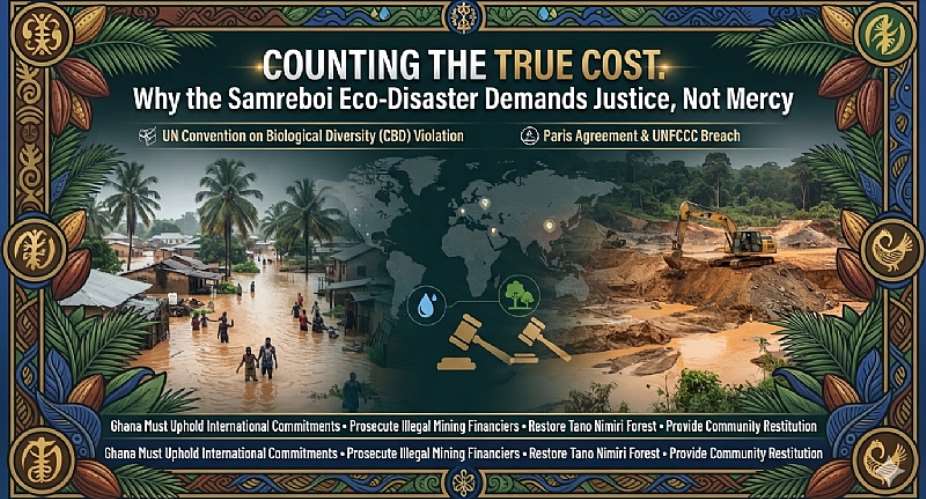
The Statutory and Moral Case for Uncompromising Justice
The catastrophic flooding of the Samreboi township and the systematic lawlessness inside the Tano Nimiri Forest Reserve are not tragic acts of nature. They are clear, documented environmental crimes resulting from deliberate, illegal mining operations (galamsey). For years, commercial actors prioritized short-term profits over public safety, stripping away natural protection systems and destabilizing entire eco-zones. As political proxies openly appeal to President Mahama for executive clemency on behalf of convicted mining financiers, the Republic of Ghana stands at a critical judicial crossroads. Granting pardons for environmental sabotage is an insult to the rule of law and a direct assault on the victims of these disasters. This publication lays bare the strict legal, human, and international costs of this crisis, establishing a non-negotiable case for total statutory enforcement and community restitution.
Rejecting the Call for Leniency – Environmental Crime is Not a Personal Political Feud
This public response is necessitated by the recent public appeal made by Dr. Palgrave Boakye-Danquah, acting as the official spokesperson for the convicted Bernard Antwi Boasiako (Chairman Wontumi). Dr. Boakye-Danquah has publicly begged President John Dramani Mahama for mercy and clemency, packaging the appeal around a personal apology for derogatory statements Wontumi made against Mahama's family during past political campaigns. We completely reject this framing. The 20-year prison sentence handed down by Justice Audrey Kocuvie-Tay was not a penalty for political insults; it was strict judicial retribution for the destruction of Ghana's ecosystem and the poisoning of our water bodies. A crime against the state and the people of Samreboi cannot be washed away by a convenient political apology. Leniency in this matter sets a dangerous precedent of impunity.
International Dimensions: Breaching Global Conventions and Sabotaging Sovereign Creditability
When corporate mining operations breach state forest reserves, the legal liability extends far beyond national boundaries. Ghana is a signatory to stringent multilateral treaties, meaning that state-sanctioned or politically shielded galamsey places Ghana in direct breach of international law, inviting severe global penalties:
- Violations of the UN Convention on Biological Diversity (CBD): By permitting Akonta Mining to clear the pristine Upper Guinean Forest Belt within the Samreboi concession, Ghana has violated its binding commitments under the UN Convention on Biological Diversity. Under the Kunming-Montreal Global Biodiversity Framework, member states are legally obligated to halt human-induced extinction of known threatened species and protect intact ecosystems. Leveling a globally recognized biodiversity hotspot directly exposes Ghana to international environmental litigation, severe funding cuts from the Global Environment Facility (GEF), and global censure.
- Breach of the UN Framework Convention on Climate Change (UNFCCC) & REDD+ Pacts: The Tano Nimiri Forest Reserve serves as a vital sovereign carbon sink under international climate frameworks. Destroying this canopy via heavy excavation represents a material breach of Ghana’s Nationally Determined Contributions (NDCs) under the Paris Agreement. This ecological vandalism directly jeopardizes millions of dollars in international carbon credit payouts and restricts Ghana's access to upcoming green bonds and global climate adaptation financing.
- EU Deforestation Regulation (EUDR) Blacklisting: The destruction of forest reserves directly triggers strict European Union bans on commodities linked to deforestation. Because premium cocoa fields surround Samreboi, tracing illegal mining directly into this agricultural belt threatens to trigger a wholesale European blacklist or heavy financial penalties against Ghana’s multi-billion dollar cocoa exports.
- The "Dirty Gold" Export Discount: Major global refineries and jewelry markets enforce strict Environmental, Social, and Governance (ESG) compliance. The high-profile exposure of a ruling-party regional chairman utilizing corporate machinery to illegally extract gold from protected reserves stains the global reputation of Ghanaian gold, driving down international investor confidence and reducing the commodity's premium value.
The Cost of Loss: Individual Deprivation vs. Collective Economic Sabotage
To fully comprehend why clemency is a betrayal of the Ghanaian people, we must examine the financial reality of this disaster. The losses must be calculated on two distinct levels: the localized financial ruin of individual households, and the macro-level economic strain imposed collectively upon state taxpayers.
1. The Individual Cost of Loss (The Burden on the Citizen)
- Wiped-Out Household Capital: With 100 buildings completely collapsed and 20 partially destroyed, individual families have lost their single largest lifetime investments. In today’s economy, replacing a basic family house costs between GH₵300,000 and GH₵800,000—a cost thrust onto innocent citizens who played no part in illegal mining.
- Destruction of Personal Micro-Livelihoods: Local petty traders, market women, and artisans have seen their entire physical stock, tools, and structures completely submerged, resulting in immediate individual losses of GH₵10,000 to GH₵50,000 per vendor. This has effectively forced independent citizens into sudden, deep poverty.
- Loss of Lifelong Agricultural Income: For the affected smallholder farmers, the submersion of hundreds of hectares of cocoa farms is a permanent financial blow. Cocoa trees take 3 to 5 years to mature; an individual farmer losing a 5-acre farm stands to lose up to GH₵40,000 annually in recurring, reliable revenue.
2. The Collective Cost of Loss (The Burden on the State)
- National Agricultural and Export Deficits: Collectively, the submersion of vast premium cocoa farmlands drains the state of essential foreign exchange reserves. When galamsey systematically degrades cocoa belts, Ghana loses millions of dollars in international trade value.
- Exorbitant Public Emergency Expenditures: On a collective municipal scale, taxpayer funds through NADMO have had to be heavily diverted to manage over 1,900 displaced victims. Supplying emergency shelter, medical teams, food aid, and essential post-flood fumigation drains funds that were originally budgeted for local schools, clinics, and roads.
- Massive Structural Reclamation Liabilities: Re-engineering, desilting, and dredging the heavily blocked Tano and Samre riverbeds—where miners deliberately altered flow paths to cross heavy excavators—will cost the state millions of Ghana Cedis in infrastructural contracts. Taxpayers are effectively paying to fix the crimes of a few wealthy individuals.
The Human and Structural Toll: Concrete Facts and Figures
The recent unprecedented rainfall totally submerged Samreboi because the heavily silted Tano and Samre riverbeds lost their capacity to channel heavy water volumes. Data verified by NADMO and municipal authorities reveals a severe human crisis:
- Loss of Precious Human Life: The flood disaster tragically claimed two young lives—a 14-month-old baby and a 17-year-old boy.
- Mass Displacement: Over 1,900 local residents were completely displaced from their homes, forced into emergency shelters in schools and church buildings.
- Structural Ruin: A total of 100 residential buildings completely collapsed under the floodwaters, while 20 additional structures suffered severe structural damage.
- Economic Paralysis: Hundreds of hectares of vital cocoa farmlands were entirely submerged, destroying seasonal livelihoods and crippling local trade infrastructure.
- Critical Siltation: Massive, unauthorized excavation stripped away natural riverbank barriers, triggering catastrophic erosion and blocking natural drainage paths.
Criminal Infractions within the Tano Nimiri Forest Reserve
The conviction and subsequent 20-year prison sentence handed to illegal mining executives are firmly grounded in clear violations of the Minerals and Mining Act and the Forest Protection Amendment Act. The environmental devastation inflicted on this protected state reserve include:
- Illegal Diversion and Destruction of Waterways: Heavy machinery systematically excavated protected riverbanks, destabilizing natural water containment.
- Severe Chemical Contamination: Toxic mercury and heavy metals were introduced into critical water tables, poisoning local aquatic life and endangering municipal water supplies.
- Unlawful Deep-Forest Clearing: Massive tracts of ancient canopy were completely leveled, permanently fracturing the biodiversity of a globally protected ecological area.
- Total Ecosystem Collapse: The structural clearing of the forest floor completely compromised its natural ability to absorb and mitigate heavy seasonal rainfall.
Mandatory Statutory Recommendations and Restitution Measures
To uphold the integrity of Ghana's judiciary and ensure the total recovery of the Wassa Amenfi West municipality, the state must aggressively implement the following actions:
- Execute Absolute Asset Seizure: Invoke the Anti-Money Laundering Act (Act 1044) to freeze, seize, and liquidate all assets of convicted mining financiers to fund victim resettlement.
- Enforce a Total Ban on Executive Clemency: The executive arm of government must completely reject all political petitions for presidential pardons to preserve the judiciary's deterrent power.
- Initiate Immediate River Redredging: Allocate emergency state capital to dredge the choked channels of the Tano and Samre rivers before the next rainy season begins.
- Deploy Permanent Armed Military Protection: Station permanent, uncorruptible detachments of the military (Operation Halt) to secure the borders of the Tano Nimiri Forest Reserve 24/7.
- Mandate Corporate Restitution: Force all linked corporate entities to legally underwrite the multi-million cedi eco-restoration and replanting exercises led by the Forestry Commission.
A Definitive Verdict for Ghana's Future
The imagery of a submerged Samreboi is a stark warning that Ghana can no longer tolerate political expedience over human lives. A 20-year prison sentence for individuals who systematically destroy a nation's water bodies and forest reserves is not excessive; it is the absolute legal baseline for accountability. If the state compromises on justice now, it signals to future international trade partners and internal syndicates that our laws are weak and our natural heritage is cheap. True mercy belongs to the displaced families, the grieving parents, and the scarred landscape of Samreboi—not to the perpetrators. Let the law take its full, uninterrupted course, and let the restoration of our sovereign environment begin immediately.
✍️ Retired Senior Citizen
For and on behalf of all Senior Citizens of the Republic of Ghana 🇬🇭
📍 Teshie-Nungua
📧 [email protected]


 Sarkodie Warns Gov’t: ‘Explain the 24-Hour Economy or Risk Voter Backlash’
 ‘Ofori-Atta Must Account’: COPEC Boss Warns NPP of 2028 Backlash Over Lingering ...
 Kpebu: Claims of ‘Fast-Tracked’ Political Cases Not New — “Every Gov’t Faces Sam...
 UG Economist Slams Gov’t: “24-Hour Economy Implementation Far From Reality”
 Ghana Flags 1.8m Housing Gap at UN Forum, Says Urban Pressures Demand Urgent Act...
 Ghana, India Set Bold $6bn Trade Target as Ablakwa, New Envoy Deepen Strategic T...
 NDC Draws Red Line: Gov’t Appointees Who Don’t Resign Barred from Executive Elec...
 Kpebu Warns: “Judicial Independence Won’t Come From Law Alone — It Needs Judges ...
 US holds fire against Iran as media reports say Washington's stockpiles are dwin...
 Ga Traditional Council calls for halt to planned Chamba Chief outdooring in Madi...

