




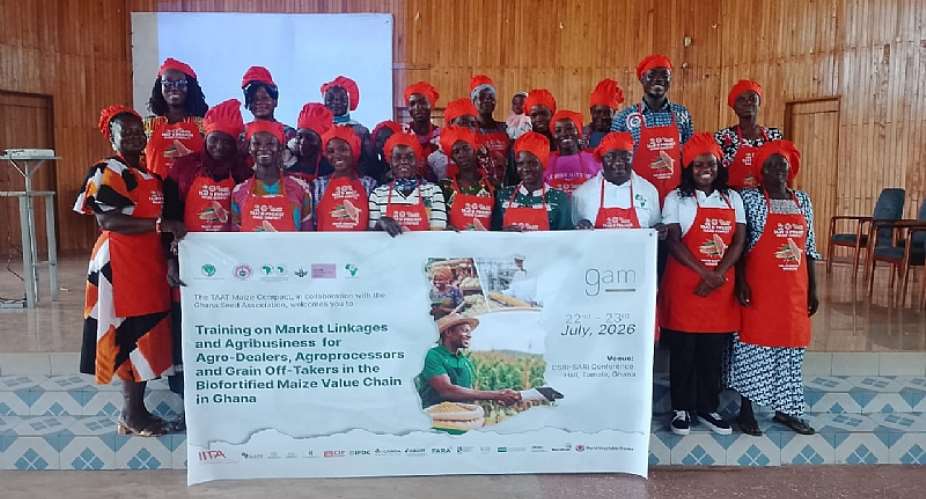
A capacity-building workshop was held to promote value addition in Biofortified maize and create sustainable livelihood and business opportunities along the maize value chain for food processors in the Tolon District.
The workshop aimed to encourage the consumption of yellow and orange maize products with enhanced nutritional value.
White maize is said to be naturally deficient in provitamin A, as such, the Biofortified ones are said to be fortified with iron, zinc and provitamin A, thereby providing the essential nutrients needed by the body for growth. The provitamin A is the form in which the vitamin A exists in the plants.
In view of that, an integrated value-chain approach to connect research institutions, extension services, seed companies, farmers, processors, entrepreneurs, food vendors, nutrition experts, consumers and policymakers needed for the promotion of Biofortified maize, a practical, sustainable and food-based approach to address nutritional deficiencies.
The approach would help to promote the production, utilization and commercialization of Biofortified maize by increasing awareness of its nutritional benefits and strengthening the capacity of value-chain actors to develop nutritious, attractive and marketable maize-based food product
The workshop organised by the Council for Scientific and Industrial Research of Savanna Agricultural Research Institute (CSIR-SARI) with support from other national and international stakeholders’ forms part of the Technologies for African Agricultural Transformation Foundation Phase II Maize Compact, (TAAT) II seeks to accelerate the dissemination, adoption and utilization of improved maize technologies across Africa.
In Ghana, the programme supports the promotion of high-yielding, climate-resilient and nutrition-enhanced maize varieties, together with appropriate production, processing and marketing technologies.
It is also to improve food and nutrition security, increase agricultural productivity, strengthen maize-based enterprises and improve the incomes and livelihoods of actors along the maize value chain.
Also, to expose participants to appropriate processing methods, product formulation, hygiene and food safety, packaging, product quality and opportunities for establishing or expanding businesses based on Biofortified maize.
Speaking at the ceremony Senior Research Food Scientist and Human Nutritionist Dr. Flora Amagloh said, the development of policy for the promotion of the yellow and orange would help to provide the needed nutrients to new born babies and adults as well.
According to her, many maize food processors and entrepreneurs lack a lot of nutritional information and education about the foods that they process and so the education would help to be circumspect on the kind of maize to use.
“There is therefore the need for agri-processors to link up with nutritionists to know the nutritional value of the foods that they are processing”, she said.
Project Coordinator of TAAT II Maize Compact at CSIR-SARI Dr Isaac Kodzo Amegbor said maize is one of the most widely cultivated and consumed crops in Ghana that contributes to food security, animal feed production, industrial processing, employment creation and income generation.
Despite its importance, many households, particularly women and children, continue to experience nutritional challenges, including deficiencies in vitamin A, iron and zinc, he said.
“Through crop improvement, maize varieties can be developed with increased levels of essential micronutrients, including provitamin A, iron and zinc. When these varieties are produced, processed and consumed regularly, they can contribute significantly to improved nutrition and better health outcomes, especially among vulnerable groups”, he said.
A beneficiary Ms. Helen Akunyagra expressed gratitude to CSIRI-SARI and partners for the opportunity saying “It would help them process nutritional food products for both domestic and commercial consumption.
An Innovation Scaling Specialist working with CSIR-SARI Dr. Desmond Sunday Adogoba said, the aim of the workshop was to help the processors to develop about three different products from the Biofortified maize, using a combination of nutrient-available products in their system.
We targeted small processors who process on small scale so that once they get back to their respective communities, they can transfer this knowledge gained back to the other women in their respective communities, he said.
He therefore called on government and others stakeholders in agricultural development. to make available funding for the women agribusiness enterprises to expand their businesses.

 Sarkodie Warns Gov’t: ‘Explain the 24-Hour Economy or Risk Voter Backlash’
 ‘Ofori-Atta Must Account’: COPEC Boss Warns NPP of 2028 Backlash Over Lingering ...
 Kpebu: Claims of ‘Fast-Tracked’ Political Cases Not New — “Every Gov’t Faces Sam...
 UG Economist Slams Gov’t: “24-Hour Economy Implementation Far From Reality”
 Ghana Flags 1.8m Housing Gap at UN Forum, Says Urban Pressures Demand Urgent Act...
 Ghana, India Set Bold $6bn Trade Target as Ablakwa, New Envoy Deepen Strategic T...
 NDC Draws Red Line: Gov’t Appointees Who Don’t Resign Barred from Executive Elec...
 Kpebu Warns: “Judicial Independence Won’t Come From Law Alone — It Needs Judges ...
 US holds fire against Iran as media reports say Washington's stockpiles are dwin...
 Ga Traditional Council calls for halt to planned Chamba Chief outdooring in Madi...

