




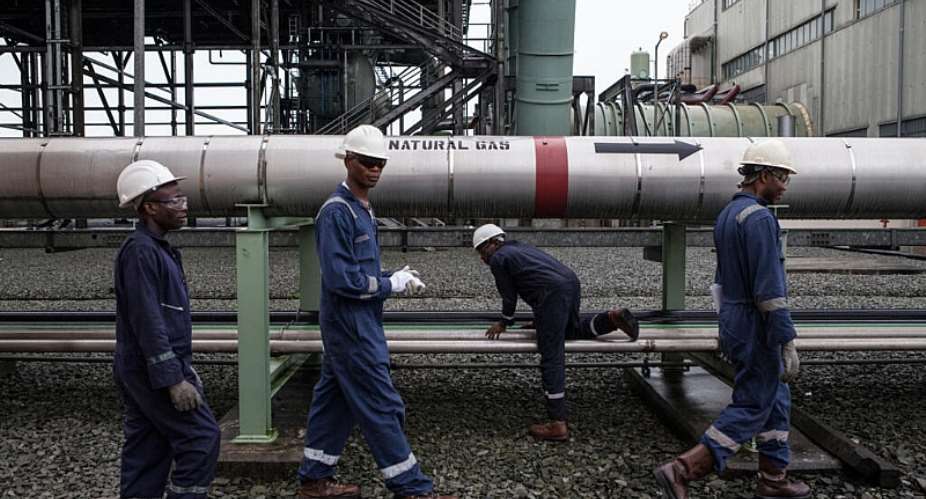
The agreement, signed by the Economic Community of West African States (Ecowas) at a summit in Sierra Leone on Monday, establishes the legal framework for the pipeline, which has been under discussion since 2016.
"Don't be surprised when the gas comes your way," quipped Julius Maada Bio, Sierra Leone's president and current head of Ecowas, following the signature.
The roughly 6,000km pipeline will run along Africa's Atlantic coast, carrying Nigerian natural gas to Morocco, before connecting with the existing Maghreb-Europe pipeline to Spain.
Construction is expected to start in 2028.
"The plan currently on the table envisages 30 billion cubic metres of gas per year, of which around 15 billion will go to Morocco and then on to Europe," says Amina Benkhadra, head of Morocco's National Office of Hydrocarbons and Mines (ONHYM), which is overseeing the project on Morocco's side.
Benkhadra said getting agreement from Ecowas was important because it transforms years of political support into a common legal framework.
"The signing of this agreement marks the culmination of a long process of consultation," she told RFI, citing the harmonisation of rules on governance, taxation, regulatory stability, investment protection and cross-border cooperation for all the countries involved.
France's TotalEnergies to invest billions in Nigeria
Africa's growing energy needs
For energy expert Charles Majomi, the pipeline marks a new and important change to current models, by which gas is extracted from African countries but refined abroad and then shipped back at a far higher cost.
That practice is a "complete devaulation of the resource that is so fortunately endowed in places like Nigeria and other countries," the former Nigerian government advisor told the BBC.
The pipeline will cross 13 countries (plus Western Sahara) before reaching Morocco, making regional cooperation essential.
Benkhadra said every transit country had been involved since the project's feasibility studies began in 2017. Cooperation agreements have already been signed with national energy companies to coordinate technical work and oversee implementation.
While transit countries will receive fees, she argues the main issue lies elsewhere – in meeting Africa's growing energy needs.
"The pipeline will provide sustainable energy to countries that need it to accelerate electrification and support their industrial development, particularly energy-intensive sectors such as mining."
Demand forecasts have been developed through to 2050, she said, to match future production with expected consumption across the region.
Africa's longest oil pipeline takes shape in Niger
Building a regional market
Nigeria's natural gas reserves, the largest on the African continent, underpin the project. But Benkhadra insists the pipeline is intended to become a regional network rather than a single-country export route.
In addition to Nigeria, she pointed to gas resources in Mauritania and Senegal. "And if, in future, Côte d'Ivoire's reserves turn out to be sufficient for export, it too will have a means of transport within reach.
"Gas needs are set to rise across every African country, so we'll connect supply and demand to help build a market in this region of our continent," she said.
The next stage will be creating a project company to oversee construction, commercial agreements and financing, together with a governing authority for the pipeline. Those bodies are expected to be established by the end of the year or early 2027, while the first gas deliveries are scheduled for 2031.
Europe turns to Algeria as war causes Middle East gas supplies to falter
Investors needed
The political agreement, however, does not mean construction will begin straight away.
The project, estimated to cost between $25bn and $27bn, still requires investors and a final investment decision before work can begin.
According to the joint statement from Morocco's ONHYM and Nigeria's state oil company, the pipeline is intended to strengthen the integration of African energy markets while creating a new development corridor linking West Africa, the Sahel, Morocco and Europe.
The route also differs from the proposed Nigeria-Algeria Trans-Saharan Gas Pipeline by following the Atlantic coast, avoiding much of the insecurity affecting the Sahel region.
Constructing offshore will, however, increase costs.
There are also questions over the future of demand for gas in Europe, as the continent speeds up its transition to renewables.


 US holds fire against Iran as media reports say Washington's stockpiles are dwin...
 Gabonese President Brice Oligui Nguema to visit Ghana
 Chaos mar NDC branch elections in Assin Central
 Court issues bench warrant for arrest of man accused of threatening EOCO staff
 Farmer arrested for shooting man dead attempting steal yam from farm at Abongo N...
 Oti High Court adjourns NPP Krachi East Organiser election dispute to October 9
 Gov't earmarks GH¢50 million for UMaT Kenyasi campus development – Education Min...
 IGP, Mahama urged to honour man who chased, captured a member of Tema robbery ga...
 Ga Traditional Council calls for halt to planned Chamba Chief outdooring in Madi...
 Several people are injured at Berlin's LGBTQ+ march after a car drives into the ...

