




A distant explosion, filmed for only a few seconds: that is what appears in a video shared on Telegram on July 16, documenting an Iranian strike on Kuwait. The footage was recorded from the Iraqi border city of Umm Qasr, a location confirmed by the FRANCE 24 Observers team.
Since the conflict began on February 28, Iran has repeatedly responded to US and Israeli attacks by targeting US military sites in allied states across the Persian Gulf region: Bahrain, Kuwait, Saudi Arabia, Qatar, the United Arab Emirates and Jordan, all of which host US bases.
But images documenting these strikes are often fleeting and filmed from a distance. Across the region, authorities have pursued repressive policies against anyone documenting the impact of Tehran's attacks. From the first days of the war, residents, journalists, tourists and expatriates have faced a severe crackdown.
According to Amnesty International, more than 1,000 people have been arrested across these US-allied states.
'Gulf countries have used the war as a pretext to expand restrictions on freedom of expression'
Mahmoud Shalaby, a regional researcher at Amnesty International, said:
"Since the beginning of the war, Arab countries across the Gulf have issued blanket warnings instructing citizens and residents not to film or share images of Iranian attacks on Gulf states. They then launched a crackdown.
Gulf countries have used the war as a pretext to expand restrictions on freedom of expression that were already in place before the conflict.
For example, between May 20 and May 26, more than 300 people were arrested in Bahrain alone. At least 34 people were sentenced to prison terms ranging from three to 10 years for sharing a photograph or video on Instagram, according to local human rights groups.
In Kuwait, more than 200 people received either suspended sentences or prison terms ranging from one to 10 years between April and May.
In the UAE, authorities announced the arrest of 375 people in March. We also documented Emirati police conducting door-to-door searches and inspecting phones in areas where drones had struck. However, we have little information about the legal status of those detained in the UAE.
Another aspect of the crackdown in Kuwait and Bahrain is the stripping of citizenship.
Bahrain recently announced that it had revoked the citizenship of 69 people for, according to the authorities, 'expressing sympathy with the Iranian attacks or engaging with external parties'.
Kuwait also announced that it had stripped more than 1,000 people of their citizenship without providing reasons.
It is important to note that, while countries may derogate from certain rights during armed conflict, such measures must comply with international human rights standards, including legality, necessity and proportionality.
The blanket bans imposed by Gulf states go far beyond these requirements and remain incompatible with international law."
Read more Videos show US missiles being launched from Kuwait into Iran
Satellite imagery and smoke detection used to verify strikes
Shalaby said the crackdown was “undermining the ability of media and researchers to document these attacks”. Since the beginning of the war, Kuwait, the UAE, Bahrain, Qatar and Jordan have also adopted a common public line, claiming to have intercepted the attacks – despite evidence to the contrary – before some of the monarchies recently began acknowledging that certain strikes did get through.
The US has also prohibited satellite-imagery companies from providing updated images of these countries. As a result, journalists and researchers have largely had to rely on rare, short videos posted online despite the risks, lower-resolution European satellite services such as Sentinel-2, Iranian satellite imagery and images supplied by some Chinese companies.
Available imagery contradicts many official claims that Iranian attacks were intercepted.
For example, after an Iranian drone attack on Bahrain on June 10, the Bahraini government said it had “intercepted several Iranian aerial attacks” and reaffirmed its defensive readiness to protect the kingdom. However, a single blurry photograph enabled the FRANCE 24 Observers team to geolocate a strike on an important US radar installation on Al-Dukhan Hill in Bahrain.
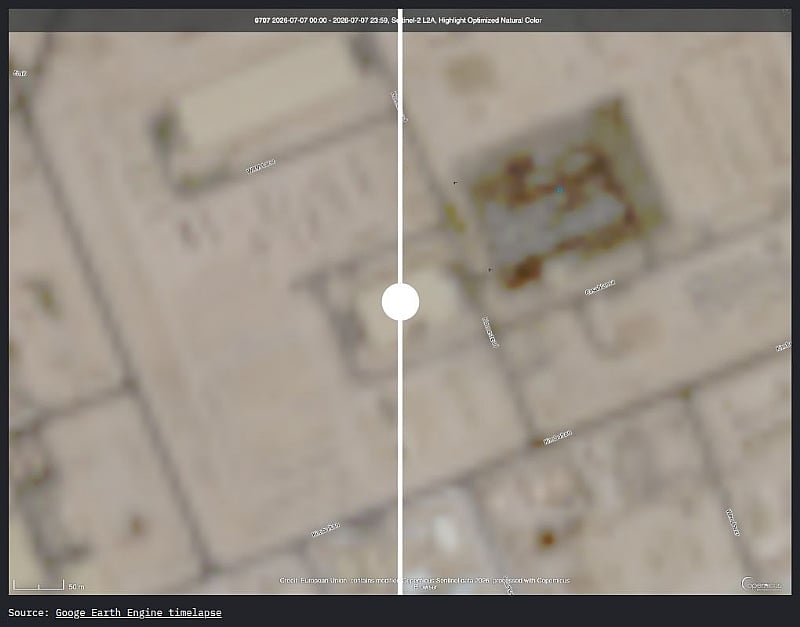
A comparison of European Sentinel-2 satellite images from July 7 and 12 shows evidence of a direct hit on Al Udeid, a US military base in Qatar. No ground-level images have emerged, and neither the Qatari government nor the Pentagon officially confirmed the strike. This is one of several similar cases.
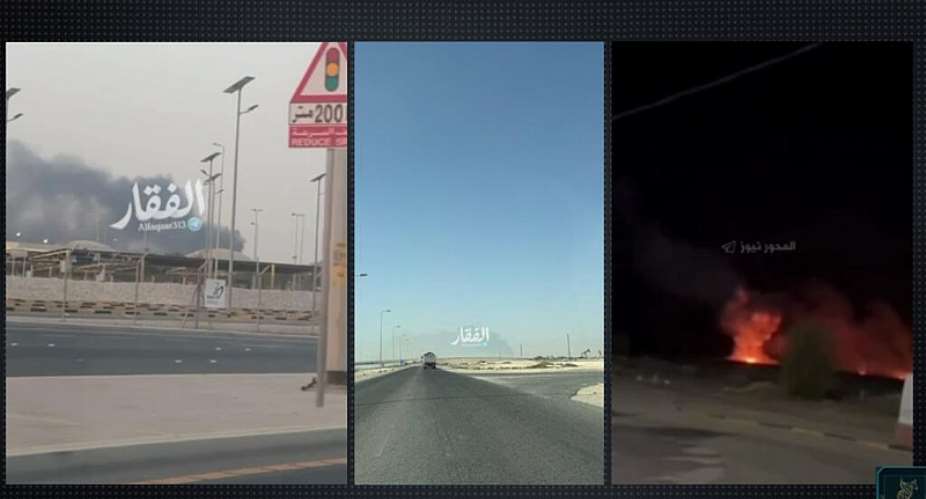
On July 11, the Bahraini government claimed to have intercepted missiles and drones. However, a photo and video shared on Telegram that same day showed a road with black smoke rising in the distance.
FRANCE 24 geolocated the footage to Al-Isa Airbase, a US military base in Bahrain. The photo shows the aftermath of an Iranian attack, despite the Bahraini government's claim.
This photo was taken from 18km away from the Isa Airbase. Near a bridge, a petrol well, one main road and a secondary road. The attack on Isa Airbase was confirmed by a fire detected by the NASA fire detection satellite and also European low-resolution satellite imagery, Sentinel-2.
A short video also documented the same incident:
'The Gulf states want to protect their image as safe havens'
Shalaby told our team:
"I think there are several reasons why these countries want to conceal the impact of the attacks.
“Since the start of the war, some people in these countries have used social media to criticise the presence of US military bases, arguing that the attacks on their countries were a consequence of hosting those bases. Concealing the impact of the attacks is one way for governments to counter that argument.
“The second reason is that it is very important for Gulf states to protect their polished image as safe havens and destinations for foreign investment and tourism. They therefore try to minimise or restrict information about the impact of these attacks."
Arab countries in the region are not alone in denying or minimising Iranian attacks on their territory. According to investigations by international media outlets, the Trump administration has also concealed the extent of missile and drone attacks on US bases in the Middle East and withheld the true number of US soldiers injured during the war.

 'I shall continue to walk in late President Atta Mills' footsteps' — Mahama mark...
 Flood Mitigation Task Force begins demolition of structures on waterways in Accr...
 Refund GH¢60 deductions in two weeks — Service personnel to NASPA
 Parliament expected to adjourn sine die on July 31
 Police bust motorbike theft cartel, seven suspects arrested in Upper West
 GoldBod suspends Dominic Bonsu Ventures' gold trading licence, secures bench war...
 Being better than the last NPP gov't should never be the standard — Sulemana Bra...
 'No room for mob justice in addressing migration challenges' — South Africa's Fo...
 Migration challenges will not strain Ghana-South Africa relations — Ronald Lamol...
 'You had your priorities wrong' – NPP's Peter Ayinbisa rejects govt's new SHS fo...

