




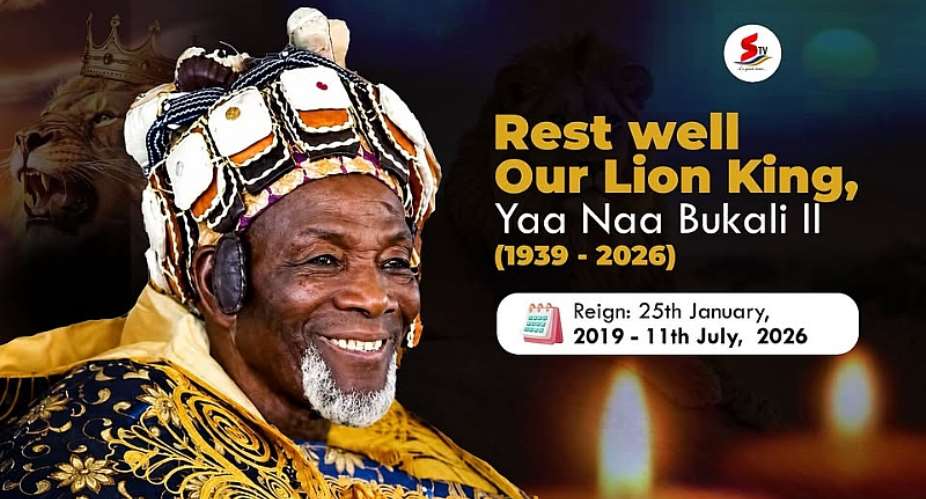
Tomorrow marks the second adua, Bogli‑lugbu, for Naa Gbewaa Bukali II, the Ya‑Na who led the Kingdom of Dagbon not with a clenched fist, but with an open palm.
The Importance of Bogli‑lugbu in Dagbon Chieftaincy
In Dagbon, the funeral rites of a Ya‑Na are not completed in a single day. They are carried out in stages, and the second adua, known as Bogli‑lugbu, holds deep cultural and spiritual significance.
Bogli‑lugbu is the formal gathering where the elders, chiefs, and people of Dagbon reconvene after the first burial rites and the third‑day adua. It is a day of remembrance, prayers, and counsel. The name itself speaks to reflection and consolidation.
Three things make Bogli‑lugbu important:
- Prayers for the departed: Imams, elders, and the people offer special prayers for the soul of the late king, asking Allah to grant him Al‑Jannah Firdaus.
- Affirmation of continuity: By sitting together again, the chiefs and people reaffirm that the skin is not empty. The institutions, traditions, and unity of Dagbon remain intact even in grief.
- Direction for the future: During Bogli‑lugbu, elders remind the kingdom of the values the late king stood for—justice, humility, and peace—so that those values guide whoever will sit on the skin and those who serve under it.
In short, Bogli‑lugbu turns mourning into memory, and memory into guidance for the next generation.
And if there was one lesson Naa Bukali II taught us, it was this: strength does not always roar.
Not every lion roars to shake the earth; Some roar through wisdom, And kingdoms sleep in peace.
Naa Gbewaa Bukali II sat upon the skin, but he never sat above his people. His palace was never closed to the humble. His ears never turned away from the cries of the farmer in the field, the trader in the market, or the chief in council.
He wore the skin not for pride, but for service. He held the skin not for power, but for unity.
Those who met him remember three things: he listened first, he spoke last, and when he spoke, elders nodded. He smiled, and children drew closer. He walked, and peace walked beside him. Even seated on the ancient skin of the kings of Dagbon, his heart remained among the people on the ground.
That is why his reign felt different.
He became a father to thousands. A counsellor to chiefs who carried heavy disputes to Yendi. A refuge to the troubled who had nowhere else to go. And a beacon to generations yet unborn, who will only know him through stories.
A king is measured not only by the years he reigns, but by the quarrels he settles, the traditions he protects, and the calm he leaves behind. By that measure, Naa Bukali II was among the strongest. He taught us that the greatest king is not the one who conquers with the sword, but the one who conquers hearts with justice.
Today, Dagbon weeps. Not because a king has fallen, But because a great tree has returned to the earth, Leaving countless branches to remember the shade it gave.
Yet in Dagbon we know: true kings never die. They live in every custom they preserved. In every dispute they settled with patience. In every prayer they offered for the land. In every life they touched without asking for anything in return.
So tomorrow, as we observe Bogli‑lugbu, the drums will be low. The silence in Yendi will be heavy, but it will not be empty. It will be filled with his name, and with the lessons we must carry forward.
The winds of Yendi will continue to whisper his wisdom. The soil of Dagbon will forever bear his footprints. And generations yet to come will speak of him with pride, saying:
Here lived a king whose greatest crown was peace, whose greatest strength was humility, and whose greatest victory was the unity of his people.
May Allah grant Naa Gbewaa Bukali II Al‑Jannah Firdaus. Your reign has ended, but your legacy shall reign forever.
Rest in peace, Lion of Dagbon. We will keep the peace you chose.


 Police arrest mother of suspected Nsawam highway robbery leader for hiding gun; ...
 How police busted armed robbery gang targeting gold dealers in Ashanti, Western ...
 Family demands answers over reported disappearance of corpse at Battor Catholic ...
 How errand boy murdered Dr Jesse Amuah and his wife and now arrested for hiding ...
 Police dismantle robbery gangs across Ghana; AK-47s and ammunition recovered
 Effiduase Asokore MP threatens to sue Reverend Owusu Bempah over defamation
 NPP Nasara wing in Ashanti condemns Reverend Owusu Bempah over divisive comments...
 Gov’t spent over GH¢49m to evacuate Ghanaians from South Africa's xenophobic ten...
 “The direction this country is going is dangerous, Ghana is sick" – Rev. Fr. Adu...
 Gov’t supports farmers for large-scale dry-season tomato cultivation to boost su...

