




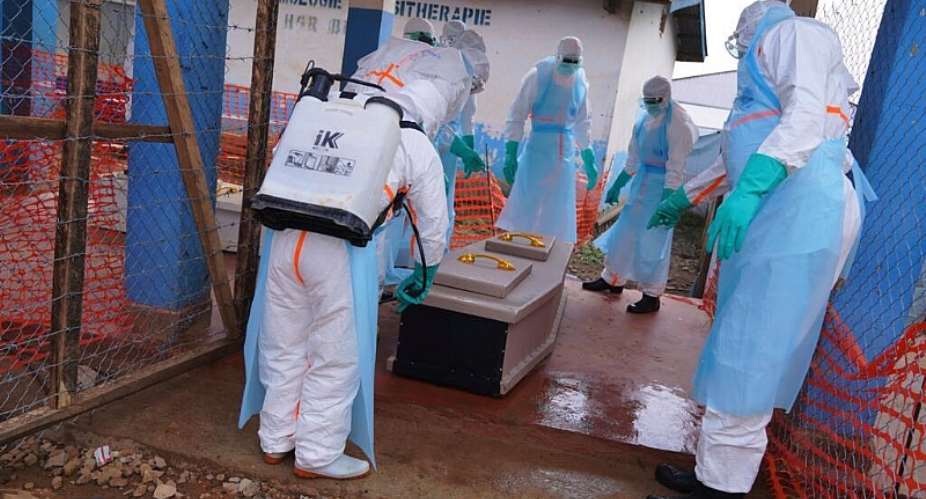
Fifty new Ebola cases were detected on Monday in the eastern DRC provinces of Ituri and North Kivu, the country's public health institute said in its latest report, as the outbreak declared in May continues to accelerate.
A total of 2,536 cases of the deadly virus have been confirmed in the DRC since May, along with 1,001 deaths, plus two deaths registered in neighbouring Uganda, according to a World Health Organization overview based on official data from the two countries.
The DRC's 17th Ebola outbreak was declared on 15 May after several deaths in Ituri, and has remained concentrated in the mineral-rich northeastern province, which is plagued by fighting between armed groups.
A toll on children
Nearly 90 percent of the cases are in Ituri province, where children are paying a heavy price. According to the NGO Save the Children, 189 children have already died and 476 have been infected, while thousands more are suffering from trauma after losing a loved one, being displaced, or living under the constant threat of the virus.
Efforts to control the outbreak through contact tracing require "enormous resources" because of Ituri's poverty and violence, said Trish Newport, director of emergency programmes for Doctors Without Borders (MSF) in Bunia, the provincial capital.
Some of the deceased are buried without protective measures by their families, accelerating the spread of infection. "A single death can lead to up to 17 cases of transmission," Newport said.
A semblance of normality still prevails on the streets of Bunia, but many of its nearly 1 million residents are anxious.
"I saw three members of the same family die in the space of a week. It scared me so much," said Heritier Bomengo, a motorbike taxi driver who, like many of his colleagues, has stocked up on hand sanitiser.
Ebola cases in DRC may be four times official tally, says WHO
'Faster than any previous outbreak'
Cases of Ebola, which spreads through close contact and infected bodily fluids, have also been found in four other DRC provinces. The cases found in Uganda were mostly Congolese citizens who crossed the border, and the country says it has gone three weeks without registering any new cases.
WHO chief Tedros Adhanom Ghebreyesus, warned last week that the outbreak had over the past month "expanded faster than any previous outbreak" of Ebola.
Despite a ramping up of the response, "the outbreak remains ahead of us and we are still in a phase of catching up," Thierno Balde, WHO's incident manager for Bundibugyo virus in DRC, told reporters on Tuesday.
There is currently no approved vaccine or treatment for the Bundibugyo strain behind this outbreak. But the WHO has reported "encouraging progress," with trials for two potential treatments, a vaccine and a post-exposure prophylaxis underway on the ground.
(with newswires)


 KMA reports Police Officer over alleged gun threat during vehicle towing dispute
 President Cyril Ramaphosa sent a delegation to me over South Africa xenophobic a...
 Sweeping South Africa xenophobia under the carpet will not resolve root causes —...
 High Court to rule on former NAFCO CEO's bid to strike out criminal charges
 Stop using entrance exams as admission preconditions — GTEC warns universities
 Finance Minister to present 2026 Mid-Year Budget Review to Parliament today
 ‘I forgive you’ - Bawumia tells police to end prosecution of NDC Agona West Orga...
 NDC suspends Awutu Senya East Constituency Chairman
 Kojo Oppong Nkrumah chases Ato Forson to explain $1.2bn international reserves d...
 FDA closes 44 food production facilities over safety and licensing breaches

