




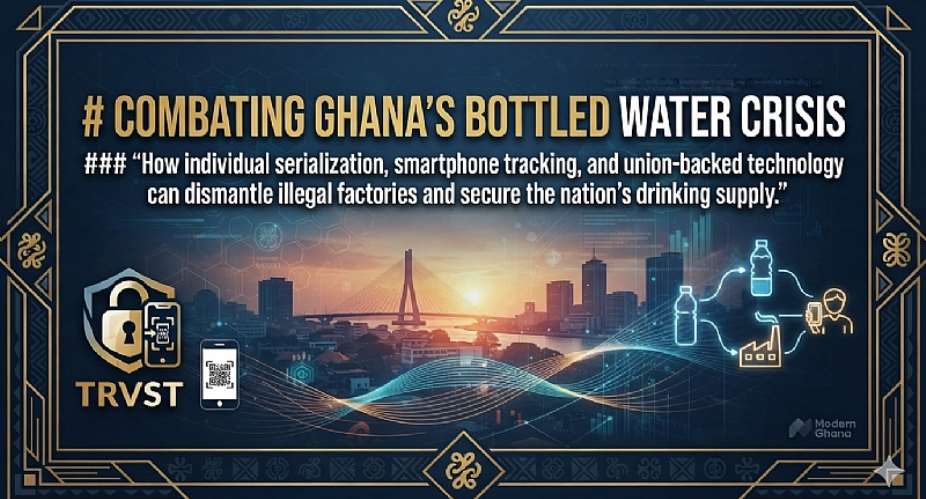
In Ghana, water is life, but unvetted packaged water is becoming a silent threat. Statistics show that a staggering percentage of households remain vulnerable to waterborne contaminants due to unsafe, informal supply chains. While millions of citizens rely daily on sachet water ("pure water") and bottled brands for quick hydration, an underground economy of unregulated, illegal producers is thriving. These rogue operators reuse brand names, replicate basic Food and Drugs Authority (FDA) registration numbers, and bypass life-saving filtration protocols. Visual inspection is no longer enough to spot the difference; a counterfeit plastic pouch looks identical to an authentic one.
To win this war on fake water, Ghana must pivot toward a digital defense. By adapting the barcode serialization architecture already used to secure the national pharmaceutical supply chain, the FDA can give every single package of water a unique digital identity. This article outlines how modern inline print technology and the FDA’s existing software blueprints can empower everyday Ghanaians to instantly identify counterfeit products using their mobile phones.
The Blueprint: How the Data Structure and Print Technology Work
Securing a low-margin commodity like sachet water requires ultra-efficient technology that adds almost zero cost to production. The transition involves a technical symbology that can be applied to packaging lines seamlessly:
- The GS1 DataMatrix Code: Unlike standard, long grocery barcodes, the GS1 DataMatrix is a compact, square two-dimensional matrix capable of holding a dense string of verification data. In a single micro-stamp, it embeds predefined Application Identifiers (AIs) including the Global Trade Item Number (GTIN), the unique serial number of that specific sachet, the batch/lot number, and the expiry date.
- High-Speed Inline Printing: Automated sachet factories use fast-moving Form-Fill-Seal (FFS) machines. The FDA can mandate the integration of inline Thermal Inkjet (TIJ) printers right onto these lines. As plastic film feeds through the machine, the inkjet head drops microscopic ink droplets to print dynamic 2D codes in milliseconds without slowing down production.
- Smudge-Proof Eco-Solvent Inks: Because water packaging lines are humid and wet, the system utilizes specialized eco-solvent or UV-curable inks. These adhere instantly to low-density polyethylene plastic film, ensuring the barcode remains smudge-proof even when crammed into distribution sacks or submerged in vendor ice coolers.
- The TRVST Pharmaceutical Blueprint: This infrastructure does not need to be built from scratch. The FDA can replicate the architecture of Ghana’s National Pharmaceutical Traceability System (TRVST), designed to secure medicines. Using the same backend database registry, water manufacturers can upload their serialized batches to the central system before distribution begins.
The Power in Your Pocket: How Consumers Scan and Detect Fakes
By deploying an intuitive mobile validation framework, the FDA transforms Ghana’s massive mobile-subscriber base into a decentralized army of public health inspectors.
- The Smartphone Scan Workflow: A consumer purchasing water from a street vendor simply opens a lightweight, data-optimized FDA consumer safety app and scans the 2D barcode using their phone's built-in camera.
- Instant Verification Output: Within seconds, the phone communicates with the FDA Product Registry data core, returning an unmistakable visual feedback loop:
- 🟢 Green Verification: Displays an authentic message (e.g., "Certified Brand X, Factory Location: Kumasi, Batch #302, Approved for Consumption").
- 🔴 Red Warning Alert: Triggers if the code is unlisted, unregistered, or associated with an entirely different manufacturer.
- Exposing the "Cloned Stamp Anomaly": Rogue operators will try to defeat the system by copying a single genuine barcode and printing it on millions of fake sachets. Digital traceability easily catches this: if the central system registers that the exact same unique serialization code is being scanned by 50 different phones across Accra and Takoradi within the same hour, it flags a clone anomaly. The app instantly alerts users that the product is a counterfeit.
- The Offline USSD Alternative: Recognizing that internet connectivity can fluctuate outside major municipal areas, the system should feature an offline fallback. Consumers with basic feature phones can type a human-readable numeric code printed beneath the barcode into a free shortcode format (e.g., *443*CODE#) to get an instant verification SMS.
- Crowdsourced Enforcement Hotspots: When a consumer scans a fake water package, the app can automatically drop a secure, anonymized GPS pin to the FDA’s enforcement desk. This gives regulators real-time location mapping of exactly where illegal batches are entering the market, allowing for swift containment and product seizures.
Economic Realities: Real-World Printing Equipment Estimates
One of the main anxieties among local producers is the cost of compliance. However, modern coding hardware is highly accessible and will not force an inflation of sachet water retail prices if planned correctly:
- Entry-Level Inline TIJ Systems: Industrial, automated Thermal Inkjet (TIJ) printers that mount directly onto standard Form-Fill-Seal sachet machines range between $300 to $800 USD (approx. GH¢ 4,500 to GH¢ 12,000) per production line.
- High-Speed Continuous Inkjet (CIJ): For premium bottled water plants running complex, curved-surface conveyor lines, heavy-duty continuous inkjet systems range from $2,500 to $5,000 USD (approx. GH¢ 37,500 to GH¢ 75,000).
- Per-Unit Consumable Costs: A standard 42ml fast-drying eco-solvent ink cartridge costs roughly $40 to $70 USD (GH¢ 600 to GH¢ 1,050) and can print up to 300,000 to 500,000 miniature 2D matrix codes. This brings the tracking cost to less than 0.002 Pesewas per sachet, meaning compliance will not alter the consumer price index of affordable drinking water.
Funding Compliance: CSR Funds and Environmental Levies
To prevent small-scale, authentic local producers from feeling squeezed by the initial hardware costs, innovative financing mechanisms must be tapped:
- Redirecting the Environmental Sanitation Levy: Ghana collects an Environmental Excise and Sanitation Levy on plastics. A percentage of these collected funds should be repurposed into a revolving technology fund. This fund can provide direct grants or interest-free equipment loans to registered cottage-industry sachet producers to purchase compliance printers.
- Corporate Social Responsibility (CSR) Synergies: Major multinational beverage, plastic production, and petrochemical companies operating in Ghana can direct their CSR budgets toward community water safety. By subsidizing coding hardware for smaller, local water plants within their operational districts, these corporations can actively protect public health while building sustainable local supply chains.
- Bulk-Purchase Discounts: The FDA, in collaboration with industry unions, can negotiate directly with printer manufacturers for bulk procurement. Using redirected levy funds to buy hardware at scale will drive down the per-unit cost of inline TIJ printers significantly for small businesses.
Technical Access: App Stores and Telecom Hosting Partnerships
For this system to scale nationwide, the verification tools must be universally accessible, data-free, and securely distributed across Ghana's digital ecosystem:
- App Store Architecture: The official smartphone validation app must be published on the Google Play Store (for Android users, who make up the majority of the market) and the Apple App Store. The application must be lightweight, heavily compressed, and optimized to run on older smartphone processors without draining battery or processing memory.
- Zero-Rated Telecom Alliances: The FDA must partner directly with Ghana’s telecommunication giants, MTN Ghana and Telecel Ghana. Through these partnerships, mobile data used while interacting with the verification app will be entirely zero-rated. Consumers will not need active data bundles to scan and verify their water.
- USSD Infrastructure Hosting: For the millions of citizens utilizing basic feature phones, MTN and Telecel will co-host a unified, cross-network USSD shortcode system. The telecom operators will white-list the shortcode to ensure that text-based inquiries are completely free of charge to the consumer, removing all economic barriers to public safety.
Shared Governance: Co-Managing the Database with Local Unions
A top-down enforcement mechanism will struggle without grassroots support. The FDA can foster compliance by sharing management of the verification infrastructure with local unions, such as the National Association of Sachet and Bottled Water Producers (NASAWAP).
- Federated Registry Access: While the FDA maintains ultimate regulatory oversight and security of the master servers, NASAWAP and regional water unions can be given sub-administrator dashboards. Legitimate local unions can directly manage and update the list of active, paid-up, and licensed factories in their districts.
- Self-Policing & Peer Onboarding: By giving unions a direct hand in database management, the association can self-police. When a new producer joins a local chapter, the union can expedite their digital onboarding into the system. Conversely, if a factory violates basic safety standards, the union can freeze their token allocation, preventing them from generating new scannable barcodes.
- Mitigating Red Tape: Allowing local unions to co-manage data uploads shifts the administrative burden away from a centralized FDA office in Accra. It empowers regional executives to handle localized data issues, making the system run faster, smoother, and with less regulatory friction.
Policy Recommendations and Suggestions for the FDA
- Mandate a Phased Rollout Strategy: The FDA should execute this policy in structured phases, mandating it first for high-volume bottled water brands, followed by a grace period for medium-to-small sachet water producers to upgrade their assembly printheads.
- Establish Print Technology Subsidies: To preserve the affordable pricing of sachet water for lower-income citizens, the government should provide tax rebates or duty-free waivers on the importation of compatible inline TIJ/CIJ coding hardware.
- Create an Inter-Agency Taskforce: Form a dedicated enforcement coalition combining the FDA, the Ghana Standards Authority (GSA), and NASAWAP to monitor compliant factories and penalize those operating off-grid.
- Launch Nationwide Public Sensitization Campaigns: Deploy aggressive public education across radio, television, and local markets to teach consumers to look for, scan, and report products missing the protective 2D serial identifier.
The era of relying purely on visual trust to buy packaged water must come to an end. Fake sachet and bottled water operations are a direct threat to public health and undermine legitimate Ghanaian businesses that invest heavily in safe filtration standards. By combining GS1 serialization technology with the widespread accessibility of mobile phones, the FDA can build a secure, transparent ecosystem where bad actors have nowhere to hide. Implementing this framework protects our communities, secures our national health metrics, and places Ghana at the forefront of digital consumer safety across the continent.
It is time to make our water auditable, verifiable, and safe—one scan at a time.
✍️ Retired Senior Citizen
For and on behalf of all Senior Citizens of the Republic of Ghana 🇬🇭
Teshie-Nungua
[email protected]


 KMA reports Police Officer over alleged gun threat during vehicle towing dispute
 President Cyril Ramaphosa sent a delegation to me over South Africa xenophobic a...
 Sweeping South Africa xenophobia under the carpet will not resolve root causes —...
 High Court to rule on former NAFCO CEO's bid to strike out criminal charges
 Stop using entrance exams as admission preconditions — GTEC warns universities
 Finance Minister to present 2026 Mid-Year Budget Review to Parliament today
 ‘I forgive you’ - Bawumia tells police to end prosecution of NDC Agona West Orga...
 NDC suspends Awutu Senya East Constituency Chairman
 Kojo Oppong Nkrumah chases Ato Forson to explain $1.2bn international reserves d...
 FDA closes 44 food production facilities over safety and licensing breaches

