




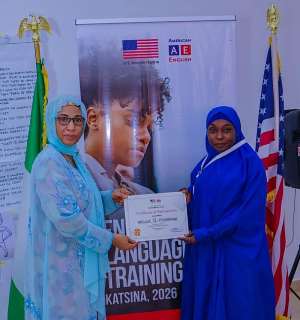
The U.S. Embassy in Abuja, through its Window on America centre in Katsina, hosted a two-day English Language Teacher Training Programme last week, equipping 30 educators drawn from across Katsina State with American teaching tools and methodologies. The participants, whose first languages are Hausa and other regional tongues rather than English, were trained to strengthen classroom instruction in a state where English remains a second language for the vast majority of pupils.
A public diplomacy tool with local reach
Window on America centers form part of the network of American Spaces that the U.S. Mission in Nigeria maintains across the country, offering libraries, digital resources and programming aimed at education, exchange and cultural engagement. The Katsina training falls under the Embassy's Public Diplomacy Section, which regularly partners with Regional English Language Officers to deliver methodology workshops for Nigerian teachers, part of a wider State Department effort that has run similar programmes for public school teachers elsewhere on the continent and beyond.
For Katsina, a state at the heart of Hausa-speaking northern Nigeria and my own home state, the programme lands in classrooms where teachers often work with limited resources and pupils for whom English is encountered mainly as a subject rather than a spoken language. Equipping local educators directly, rather than routing training through Abuja or Lagos, extends the reach of embassy-run programming into a part of the country that does not always feature prominently on the public diplomacy calendar.
Branding tied to America's 250th
The Embassy tied the Katsina training to two campaign banners it has been running through 2026: #AmericanExcellence and #Freedom250, the latter linked to the semiquincentennial marking 250 years since the U.S. Declaration of Independence. Freedom250 programming has featured across U.S. missions in Africa this year, from sporting events in Abuja to cultural programming elsewhere on the continent, and the Katsina teacher training appears to be one of the initiative's education-focused entries in northern Nigeria.
Why it matters
English-language capacity remains a persistent constraint in northern Nigerian schools, feeding into broader learning outcomes and, eventually, into the pool of candidates able to access higher education and formal-sector employment. Small, targeted interventions of this kind, thirty teachers trained over two days, will not by themselves close that gap, but they add to a layer of American soft power investment in northern Nigeria that has tended to be less visible than the security and counter-terrorism cooperation the U.S. maintains with Abuja in the same region.
Mustapha Bature Sallama.
Medical/ Science Communicator,
Private Investigator, Criminal investigation and Intelligence Analysis.
International Conflict Management and Peace Building.USIP
[email protected]
+233-555-275-880
Reference
U.S. Embassy Abuja, Window on America Katsina, English Language Teacher Training Programme announcement, July 2026


 CAF chief Motsepe backs Infantino despite criticism
 Afia Schwarzenegger Fires Shots: Wontumi’s 20‑Year Sentence Is a Warning to All ...
 6,000 Africans in diaspora traces their root back to Paga – DNA study reveals
 Africa has reduced HIV infections by 40%, but health systems remain fragile — WH...
 Terrorism in Sahel demands coordinated response — African Union
 GMET forecasts thunderstorms in Northern Ghana as Southern areas expect cloudy w...
 NDC Branch Organiser granted GH¢200,000 bail over alleged false claims against B...
 Wontumi 20-year sentence is like freeing an armed robber and jailing the victim ...
 Mahama, former Presidents, dignitaries to attend Apostle Kwadwo Safo's funeral
 'We are not satisfied with Wontumi's plea bargain proposal in EXIM Bank case; so...

