




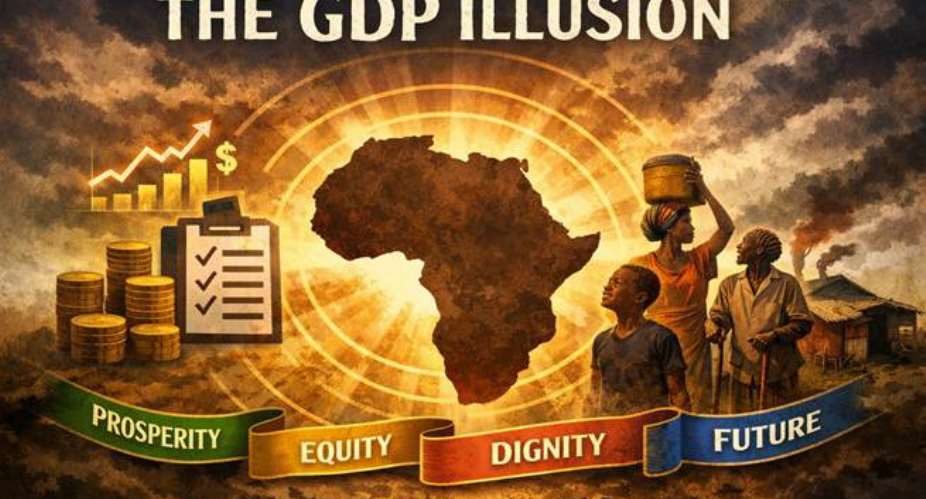
Epigraph
“In Africa, our forefathers’ fight was for the Liberation of our Lands and self‑rule. Today, our fight is for the Liberation of our minds.” — Albert K. Owusu, CMS I
GDP: Why Africa Must Think Anew
This week, Ghana’s finance minister will present the national budget to Parliament. Headline figures will highlight low inflation, declining interest rates, and a stable cedi. Yet the National Development Planning Commission (NDPC) has already characterized Ghana’s recent trajectory as jobless growth — confirming what citizens know: these numbers do not translate into prosperity in their pockets. Transport fares remain high, rents are unaffordable, and millions live in makeshift housing without sanitation facilities. Gross Domestic Product (GDP) was institutionalized by Bretton Woods institutions after the Second World War to measure production capacity, not well‑being. It remains useful for tracking output, but it does not inform us whether the value is retained locally, whether citizens benefit, or whether leadership decisions anticipate long‑term consequences.
Similarly, ESG frameworks have advanced compliance checklists but leave citizens invisible. Recent critiques highlight this disconnect. Trade Finance Global (2025) argues that Western ESG standards are “ill‑suited to African trade finance” and amount to ESG colonialism, excluding SMEs and widening the continent’s trade finance gap. The International Journal of Business Ecosystem & Strategy (2025) finds ESG reporting in Sub‑Saharan Africa often amounts to symbolic disclosure with limited evidence of meaningful implementation. The Kenya Sustainability Forum (2026) notes that ESG discourse remains top‑down and poorly understood outside corporate circles, excluding local communities and youth. Together, these critiques confirm that while ESG advances compliance, it fails to measure consequence or lived reality.
Africa cannot afford another 69 years of recycling imported frameworks and their behavioural impact — cycles that are net negative on the collective self, intergenerational in damage, and short‑termist in their illusory fixes. What is needed is a corrective lens authored from Africa’s epistemic foundations.
CMS proposes Consequence Metrics (CCM) as that lens. These indicators are not yet established global measures; they are introduced here as a framework for debate and adoption. They include:
- Value Retention Index (VRI): assessing how much national production remains after external leakages.
- Knowledge Transfer Score (KTS): measuring whether foreign firms build local skills and capacity.
- Custodianship Quotient (CQ): evaluating whether leaders act for collective benefit rather than personal gain.
- Consequence Literacy Index (CLI): gauging whether policies anticipate ripple effects across generations and the diaspora.
Together, these metrics complement GDP and ESG by embedding consequence into measurement. They do not discard existing frameworks but complete them, ensuring that Africa’s progress is judged not only by production or compliance but by retention, reciprocity, custodianship, and foresight. The NDPC’s warning of jobless growth should be a wake‑up call. Africa must think anew — shifting from imported measures of output to authored measures of consequence. Only then can governance be held accountable not to numbers on paper, but to the lived dignity of citizens.
Proposed CMS Consequence Metrics (CCM): A New Grammar of Accountability
CMS calls for a shift from GDP and FDI as the dominant measures of progress to Consequence Metrics (CCM) — a framework that embeds retention, custodianship, and consequence into measurement. The CCM grid captures what it measures, making visible dimensions of governance and citizen welfare that GDP and FDI overlook.
| Existing Metric | CMS Consequence Metric | What It Captures |
| GDP (Gross Domestic Product) | Value Retention Index (VRI) | How much of GDP remains after profit repatriation |
| FDI Inflows | Knowledge Transfer Score (KTS) | Whether foreign firms build local capacity and whether it benefits the nation |
| Leadership Optics | Custodianship Quotient (CQ) | Decisions judged by collective benefit, not personal gain |
| Policy Announcements | Consequence Literacy Index (CLI) | Anticipation of ripple effects on citizens and ecosystems |
| Elections | Civic Agency Metric (CAM) | Citizen participation beyond voting — audits, accountability, transparency |
CMS Mindset Awareness & Impact Implementation
Mindset Awareness
- Recognizes that recycling Africa’s frameworks has produced today’s dependency and marginalization.
- Calls citizens and leaders to confront uncomfortable truths about governance, custodianship, and consequence.
- Anchors sovereignty in epistemic clarity: Africa must think anew.
Impact Implementation
- Moves beyond rhetoric into measurable consequence.
- Embeds retention, transfer, and custodianship into execution.
- Demands accountability from leaders and citizens — shifting civic culture from silence to active engagement.
- Ensures that policies anticipate ripple effects, preventing cycles of poverty, migration, and ecological devastation.
Together: These two perspectives form the foundation of CMS Consequence Metrics (CCM). They insist that Africa’s progress cannot be measured by inflows or slogans but by what is retained, shared, and transformed into collective dignity.
Comparative Case Study: GDP vs CMS Consequence Metrics (CCM)
| Country | GDP (2026) | FDI Inflows (2025) | Reality Check | CCM Lens – Key Metrics |
| Ghana | $118.3B | $2.61B (China, Cayman Islands, India, Nigeria) | $1.83B reinvested earnings. Citizens see hospitals without equipment, schools underfunded, and mining communities poisoned by galamsey with no infrastructure. | VRI: Less than half retained. KTS: Minimal transfer; foreign firms dominate. CQ: Patronage & citizen silence drive youth to risk Sahara/Mediterranean migration. |
| Nigeria | ~$500B | ~$5B (oil, gas, fintech) | Oil revenues repatriated. Villages near oil fields face pollution, poverty, and violence while billions flow abroad. | VRI: Oil wealth exported. KTS: Energy tech locked abroad. CQ: Kleptocracy reinforced by disengaged citizens; youth disillusioned, desperate to migrate. |
| Kenya | ~$120B | ~$2B (ICT, services, infrastructure) | The tech sector is vibrant, but foreign venture capital dominates. Profits exit offshore; local innovators are underfunded. | VRI: ICT value leaks offshore. KTS: Some fintech transfer, weak in manufacturing. CQ: Imported hierarchies & weak civic accountability allow elites to capture the narrative. |
Closing Invocation
GDP growth without jobs is precisely what the NDPC calls jobless growth. CMS Consequence Metrics (CCM) go further — they measure whether value is retained, whether knowledge is transferred, and whether leadership decisions anticipate consequence
Africa does not lack value creation. It lacks value retention, mindset awareness, and consequence‑driven implementation. CMS Consequence Metrics (CCM) is the proposed corrective — a new grammar of accountability that ensures Africa’s progress is measured not by inflows, but by what remains, what is transferred, and what is transformed.
“Own the mindset, own the present — Africa’s progress is in your hands.” — Albert K. Owusu, CMS I
“The time for knowing is over. The time for doing is now.” — Albert K. Owusu, CMS I
Author’s Note
Citizens are invisible in ESG, yet they embody the true measure of governance failure. Imported frameworks count compliance checklists, but they do not count consequences. This is why CMS insists on a new paradigm shift — not the usual rhetoric, plagiarism, and patronage, but a new way of being. CCM complements GDP and ESG by embedding consequence into measurement. Authored from Africa’s epistemic foundations, it assesses not just whether firms tick boxes, but whether nations retain value, whether citizens benefit, and whether leadership decisions anticipate consequences.
Africa must think anew.
About CMS
The Consequential Management System (CMS) is an African epistemic governance framework authored and codified across three volumes (CMS I–III). It introduces Consequence Literacy as a framework for institutions, enterprises, and communities, embedding African metaphysical governance and worldview. CMS dramatizes the #ConsequenceGeneration movement — positioning Africa to reclaim agency, strengthen institutions, and steward civilizational outcomes.
Author Bio
Albert K. Owusu is the founder and architect of the Consequential Management System (CMS), an African epistemic governance framework authored and codified across three volumes. A global strategist, financier, and policy architect, he draws on lived experience of governance implementation at senior levels in corporations and institutions across Europe and Africa. Unlike purely academic models, his work integrates consequence‑based measurement with practical realities of institutional reform, positioning CMS as a framework for accountability, retention, and custodianship in a multipolar world.


 Highly influential people sponsoring Ghana Jollof TikTok activities – CID
 'Ghana Jollof' case: Bawumia's condemnation of nurse's arrest is hypocritical – ...
 Ahafo Ano South West MP involved in road accident
 Constitutional Review alone will not solve Ghana’s problems – Kwesi Pratt Jnr.
 East Legon Football Academy applauds NPA Boss for supporting youth football
 Gov't didn't show NPP enough respect in constitutional review process – Martin K...
 September 18: Cedi sells at GHS12.15 on forex market, GHS11.53 on BoG interbank
 Lawyer challenges two-week remand of Salomey over connection to wanted 'Ghana Jo...
 Minority calls for NSA boss Ampofo Ankrah, others to be dismissed over alleged 2...
 ‘You gave us GH¢60,000 to run 66 offices nationwide and expect us to function?’ ...


