




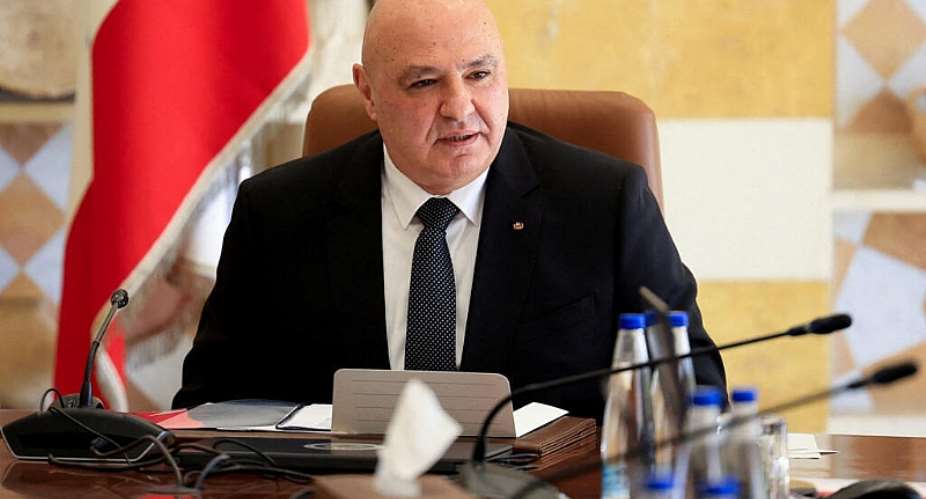
Lebanese President Joseph Aoun will meet with his US counterpart Donald Trump in Washington on Tuesday, as pressure builds for Beirut to disarm Shiite militant group Hezbollah, Israel's key condition before withdrawing its troops from south Lebanon.
It comes a day after the United States, which has sponsored negotiations between Lebanon and Israel, announced the start of the implementation of an agreement granting the Lebanese army control over "pilot zones" in southern Lebanon.
These zones are primarily located just outside lands Israel occupied after Hezbollah drew Lebanon into the Middle East war in March following the US-Israeli killing of Iran's supreme leader Ayatollah Ali Khamenei.
Aoun, who has staunchly criticised Hezbollah's decision to pull Lebanon into the war, is now hoping Trump will further pressure Israel to withdraw from occupied Lebanese lands.
Read more Middle East war: Lebanon, Israel and US sign framework agreement in Washington
Israel has nonetheless consistently refused to pull out as long as Hezbollah remains armed – a demand echoed by Washington.
"As long as that problem exists, Lebanon will never truly get peace," US State Secretary Marco Rubio said after meeting Aoun on Sunday.
In an earlier statement, Rubio "commended the courage of the Government of Lebanon ... for their determined effort to reclaim Lebanon's sovereignty, disarm Hezbollah and dismantle its terrorist infrastructure".
Aoun is the first Lebanese president to be invited to Washington since 2009.
Maha Yahya, director of the Carnegie Middle East Center, said that while the meeting "demonstrates a continued US interest in Lebanon", it "raises a lot of concern around what more Lebanon may be asked to do".
A Lebanese official said Aoun believes only Trump possesses the leverage needed to pressure Israel to withdraw its troops and help Lebanon restore its sovereignty.
The official said that Aoun, in addition to asking the US president to press Israel to withdraw, would also present Trump with a written proposal on how to decommission Hezbollah's massive arsenal.
'A dangerous idea'
Aoun, who previously served as the commander of Lebanon's US-backed army, has vowed to disarm Hezbollah since being elected as president in early 2025 with Western support, marking a major political shift in Lebanon.
However, Hezbollah has repeatedly rejected disarmament.
Israeli strikes have killed more than 4,300 people in Lebanon since fighting began in March, according to authorities. Hundreds of thousands of people remain displaced following Israel's invasion of the country's south.
Violence has significantly decreased after the signing of a framework agreement between the US and Iran last month, along with Lebanon's continued negotiations with Israel.
Under the agreement, the Israeli military is to withdraw from southern Lebanon and the Lebanese army is to deploy, starting with two "pilot zones".
But the deal is contingent on the disarmament of Hezbollah, which has flatly rejected both the deal and the Israel-Lebanon negotiations that underpin it.
Yahya believes the agreement is "deeply disadvantageous" to Lebanon.
Iran, which insisted on including Lebanon in its April ceasefire with Washington, has been trading renewed strikes with the US since July 7.
Aoun is also expected to ask for more aid to the Lebanese army, given the difficult task of disarming Hezbollah.
In exchange, Trump would "no doubt want to hear additional evidence of Aoun's seriousness" in disarming the group, wrote Robert Satloff, executive director at the Washington Institute.
Satloff said Trump would also want guarantees that Aoun would root out army officers believed to be complicit with Hezbollah, and eventually reach peace with Israel.
He added that Aoun's visit would also allow him to "put a stake through the heart of a dangerous idea that seems to have grabbed Trump's imagination: empowering Syria to dispatch troops into Lebanon to supposedly quash Hezbollah".
Syrian President Ahmed al-Sharaa had previously said that his country had no intention to intervene in Lebanon, despite Trump's repeated calls for him to do so.
Aoun is a Maronite Christian, as required by Lebanon's sectarian power-sharing system that stipulates the prime minister must be Sunni Muslim and the speaker of parliament must be Shiite Muslim. A career soldier, Aoun was wounded twice and still carries a shrapnel wound.
His rise reflected a major shift in the power balance in Lebanon, following a devastating Israeli offensive against Hezbollah in 2024 and the ousting of Hezbollah's Syrian ally president Bashar al-Assad – seismic events that weakened the group and its influence over the divided state.
At his swearing-in ceremony, Aoun vowed to affirm "the state's right to a monopoly on arms".
(FRANCE 24 with AFP and Reuters)


 South Africa evacuation expenditure: Ablakwa harassing Foreign Ministry staff ov...
 Bawumia engages health professionals on sector challenges
 'Backbone of the web': What is PHP and how has it raised AI hacking fears?
 Russian missiles hit Kyiv as Moscow signals readiness for peace talks
 Meta fined $25 billion in New Mexico over Cambridge Analytica scandal
 Health Ministry assures Ghanaians of readiness to manage Ebola cases
 FDA shuts down Arcan Bitters factory again over illegal production in Ashanti Re...
 PAC chair praises NPA CEO Edudzi Tameklo’s performance at committee hearing
 Ghanaian jailed nine months in US for using relative’s social security number to...
 Ukraine war: I'm going to Russia to convince President Putin to ceasefire — Maha...


