




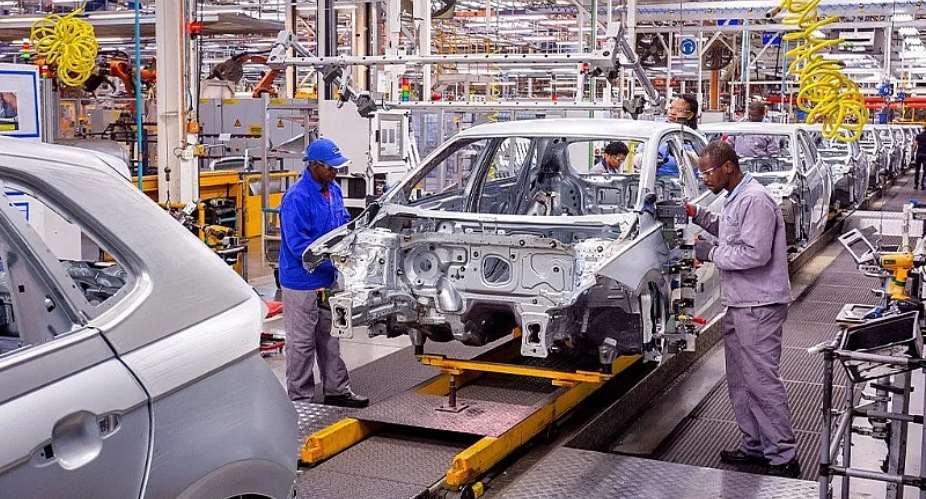
Ghana’s roads carry thousands of vehicles every day — workers heading to their jobs, traders moving goods, students commuting to school, and families travelling across the country. For many, buying a vehicle is simply a personal choice based on cost, reliability and convenience. But today, that choice carries national significance.
Opting for a locally assembled vehicle is no longer just about transportation. It is a direct investment in Ghanaian jobs, local industry, and long‑term economic transformation.
A Heavy Reliance on Imports — and Its Cost
For decades, Ghana has depended almost entirely on imported vehicles. The country brings in about 100,000 vehicles every year, nearly 90% of them used. While these imports meet transport needs, they drain the economy.
Ghana spends an estimated $1.5 billion annually on vehicle imports — money that puts pressure on foreign exchange reserves and flows out of the economy instead of supporting local production, skilled jobs and industrial growth.
As Ghana pushes to strengthen domestic industries, reduce imports and retain more value locally, supporting locally assembled vehicles has become both strategic and necessary.
Building a Local Automotive Ecosystem
Momentum grew in 2019 with the launch of the Ghana Automotive Development Policy, part of the government’s broader Ten‑Point Industrial Transformation Agenda and aligned with initiatives like One District One Factory (1D1F).
Today, Ghana’s automotive landscape includes:
- 10 licensed assemblers
- 7 active assembly plants
- Global brands: Volkswagen, Toyota, Nissan
- Local players: Kantanka
- Heavy‑duty manufacturers: Zonda Tec Ghana Limited
Zonda Tec, supported by 1D1F, recently completed a $30 million expansion in Kpone‑Katamanso, boosting capacity to assemble over 3,000 trucks annually — a major step toward reducing reliance on imported commercial vehicles.
Jobs, Skills and Industrial Growth
Behind every locally assembled vehicle is a growing network of Ghanaian workers. The industry has already created:
- 700+ direct factory jobs
- 1,000+ indirect jobs in transport, spare parts, sales and retail
Companies are also investing in technical training schools to equip artisans and engineers with skills in assembly, repairs and maintenance — ensuring Ghana builds not just factories, but a skilled workforce.
A strong automotive sector also stimulates related industries: metals, glass, rubber, plastics, electronics, machinery. This ripple effect is how many countries industrialised — and Ghana is positioning itself to follow that path.
Supporting National Priorities
Locally assembled trucks, excavators and concrete mixers are essential for construction, mining and road development. Through partnerships with Sinotruk and Shantui, Zonda Tec is assembling equipment used for major infrastructure projects.
Assemblers are also helping curb illegal mining by verifying buyers’ environmental and mining licences before selling heavy machinery — preventing equipment from ending up in the hands of galamsey operators.
Driving Value from Ghana’s Natural Resources
Vehicle assembly offers Ghana a chance to move beyond exporting raw materials. By linking assembly to local processing of metals and components, the country can retain more value from its resources.
Government is establishing an Automotive Development Support Centre to regulate standards and help SMEs produce components. An advanced automotive lab at Suame Magazine will support metal analysis and component production. Ghana is also preparing to manufacture industrial fasteners — bolts, nuts, springs — for automotive and mining use.
AfCFTA: A Gateway to Continental Markets
With the AfCFTA Secretariat in Accra, Ghana is well positioned to become a regional production and distribution hub. Ghana was the first country to complete AfCFTA Rules of Origin certification, signalling readiness for duty‑free continental trade.
Assemblers are increasing the share of locally produced components to meet export requirements. But before Ghana can dominate African markets, it must first build a strong domestic automotive base — and that depends on Ghanaians choosing locally assembled vehicles.
A Choice That Builds a Nation
The growing number of assemblers means healthy competition, better quality, more innovation and gradually more affordable vehicles.
Buying a Made‑in‑Ghana vehicle is not just patriotic — it is practical economic action.
It:
- Supports Ghanaian jobs
- Attracts investment
- Promotes skills and technology transfer
- Reduces dependence on imports
- Strengthens local industries
- Builds a foundation for exports under AfCFTA
When Ghanaians choose locally assembled vehicles, they are doing far more than buying a means of transport. They are helping build a stronger, more productive and more prosperous Ghana.

 'The standard which cleared Tsatsu Tsikata in 2016 be applied in Wontumi’s convi...
 Presidential pardon for Wontumi a good call but he should serve for five to seve...
 'You've failed Ghanaians; resign' - Independent presidential candidate slams Mah...
 Mahama hosts African leaders for AU Summit on Universal Health Coverage and Dise...
 The justice system has been turned upside down — Oppong Nkrumah on Wontumi's 20-...
 'High Court judgment flawed; Wontumi was convicted on assumptions and inferences...
 Environmentalists hail Wontumi's 20-year sentence as major breakthrough in anti-...
 Imprisoned TikToker Camilla Alhassan is NPP member in Awutu Senya West — Nana B ...
 Wontumi's 20year jail term a victory for anti-galamsey fight – Solomon Owusu
 OSP refutes claims US Immigration Court dismissed its charges against Ofori-Atta

