




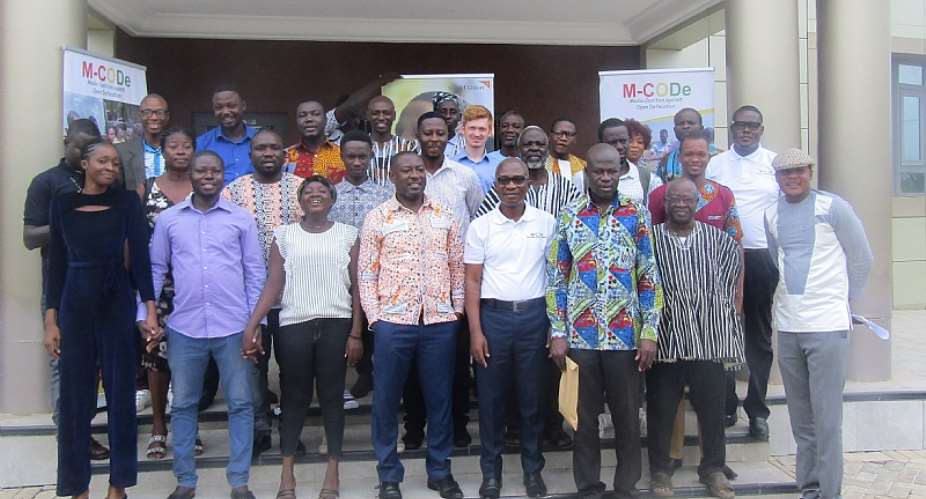
The Upper East Regional branch of the Media Coalition Against Open Defecation, M-CODE, is set to begin a one-week regional accountability activation from July 20th to 25th to independently track how Metropolitan, Municipal, and District Chief Executives are delivering on the government's new directive to make sanitation a Key Performance Indicator.
Under the theme “Institutionalizing Sanitation Performance,” the exercise marks the first phase of M-CODE’s revitalization agenda and positions the media as the accountability bridge between government, traditional authorities, local assemblies, and citizens in the push to achieve a clean environment and end open defecation.
The Upper East Regional branch of M-CODE, in a statement issued in Bolgatanga at the weekend, said it will deploy journalists across the region to engage local governance stakeholders and conduct direct interviews with Assembly Members on district-level efforts, challenges, and progress toward OD-free communities.
President John Dramani Mahama's official announcement that sanitation is now a key performance indicator for MMDCEs changes the focus from just talking about it to making it a specific requirement that is directly linked to how well they perform and deliver results.
M-CODE, with support from World Vision Ghana, will provide independent, public, and evidence-based monitoring of that performance.
“The era where sanitation remained in policy documents and campaign speeches is over. This activation is about evidence. The Coalition stated, "We are assessing what is working on the ground, what is stalling, and where citizens are still being left behind." The Coalition stated, "We are assessing what is working on the ground, what is stalling, and where citizens are still being left behind."
The One-Week Regional Accountability Framework has been tailored to regional governance structures to maximize impact.
Teams will assess budget allocation, infrastructure delivery, enforcement of by-laws, community sensitization, and coordination between assemblies and traditional authorities.
The Upper East activation is part of a broader national intervention. In partnership with World Vision Ghana, M-CODE is undertaking similar accountability projects in six other regions during this initial rollout: Northern, Western, Greater Accra, Upper West, and Ashanti.
Officials say the multi-region approach will allow for comparative learning and pressure for uniform standards across assemblies.
“By tracking all seven regions at the same time, we can identify best practices that can be scaled, and also name districts where progress is slow so that citizens and duty bearers can act,” the statement noted.
Open defecation remains a public health and dignity challenge, particularly in rural and peri-urban communities. With sanitation now embedded as a KPI, MMDCEs will be assessed not only on roads and infrastructure but also on measurable progress toward OD-free status.
The Coalition said the media’s role in this phase is not to antagonize but to document, verify, and amplify. Findings from the week-long exercise will be published through various media platforms and shared publicly to inform citizens, traditional leaders, and policymakers.
M-CODE added that subsequent phases of the revitalization agenda will deepen community monitoring, amplify citizen voices, and track budget execution on sanitation projects at the district level.
 FDA disposes of alcohol mixed drinks, unwholesome products
 Mahama concludes two-day Volta Regional tour
 Mahama optimistic completed sections of Ho-Aflao Highway will be opened within s...
 Accra-Kumasi highway traffic diverted after articulated truck blocks road at Bir...
 MPs demand tougher action against container trucks carrying unsecured loads
 Police impound 700 vehicles in Western Region over illegal sirens and emergency ...
 Let’s liberate African politics from tyranny of money – Dr Ibn Chambas
 Supreme Court nominations meant to replace retiring judges, not attempt to pack ...
 Supreme Court, Chieftaincy exist for same enduring purpose - Chief Justice Baffo...
 Withdraw TikToker Camilla Alhassan’s second prosecution, other pending cases - M...

