




Opening Hook
The government can distribute birds. It cannot automatically distribute customers.
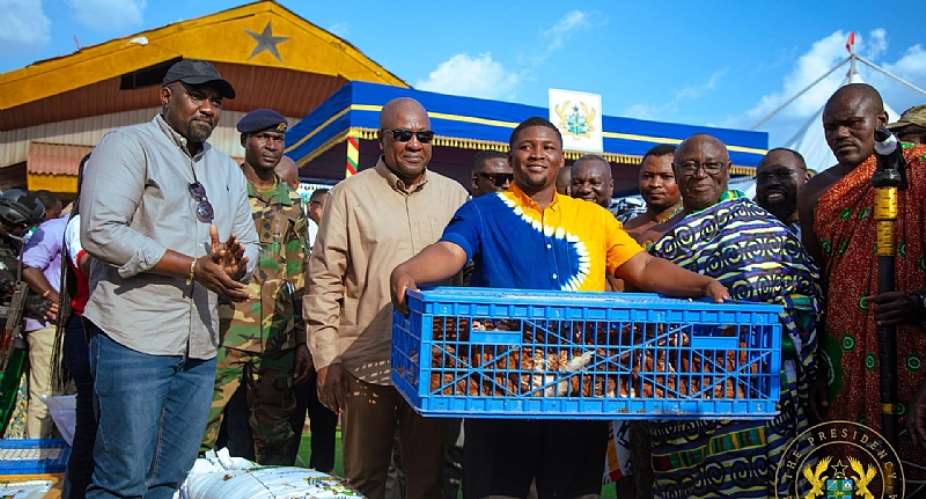
That gap, between what a policy can hand over and what a household actually needs to earn a living, sits at the heart of Nkoko Nkitinkiti's second act. The first act is already written. Three million birds were procured. Close to 80,000 households were reached across all sixteen regions. A commercialisation phase is now underway, with anchor farmers lined up for 80,000 chicks apiece and a national processing drive targeting 18 million birds this year. It is, by any measure, an impressive logistical achievement. But raising a healthy chick to a laying hen or a market-ready broiler is only the first half of the story. The second half begins the moment that bird is ready to be sold, and it is a much harder story to tell, because it depends on something the government cannot simply announce into existence: somebody willing to buy at a price that makes the whole exercise worthwhile.
The Birds Have Arrived. What Happens Next?
Ask a beneficiary what they plan to do with a healthy flock, and the honest answer is often less certain than the launch-day speeches suggested.
The government has been candid, in its own way, about how unpredictable that next step already looks. The Minister for Food and Agriculture told Parliament's Assurance Committee that some beneficiaries had simply killed and eaten the birds they received, rather than raising them as the small enterprise the programme intended, going as far as sending him videos of themselves doing it. That is not, by itself, evidence of a failing programme. Eating a chicken you were given to eat is a perfectly reasonable choice for a household that needed the food. But it is also a clear signal that the path from "here are your birds" to "here is your income" is not one that beneficiaries are being walked down with much support, and that the programme's economic ambitions and its beneficiaries' immediate needs are not always pointing in the same direction.
Ghana's Poultry Ambition
To understand why this matters so much, it helps to see the size of the gap Nkoko Nkitinkiti is being asked to close.
Ghana currently produces only a fraction of the chicken it eats. Figures cited in the government's own 2026 poultry sector planning work put domestic production at around 60,000 tons of chicken meat against national consumption of roughly 330,000 tons, an 18 percent self-sufficiency rate, down from a period in the 1980s and 1990s when local farms supplied as much as 80 percent of demand. That decline is exactly why the Ministry of Food and Agriculture, working with Agri-Impact Limited and the Mastercard Foundation, is finalising a national poultry sector master plan in 2026, aimed squarely at the parts of the value chain that production alone cannot fix: breeding stock, hatcheries, cold storage, and getting young people and women into the industry in ways that last. Nkoko Nkitinkiti was launched into exactly this context, as the household-facing piece of a much larger ambition. The question this article asks is whether the household piece has been built to connect to that larger ambition, or whether it is quietly operating on its own.
From Household Project to Household Business
Fifty chicks sound like a lot until you ask what a household is actually meant to do with them.
The scale of what beneficiaries have received varies. The programme's November 2025 launch described 50 chicks per household. By the time the initiative reached the Volta Region, officials were describing roughly 15 birds per beneficiary household. Either number is a modest flock by commercial standards, and neither comes with a clearly stated answer to the obvious next question: at what point does a household stop being a poultry hobbyist and start being a poultry entrepreneur? The commercial side of the programme has a much clearer answer. Fifty selected anchor farmers are being equipped with 80,000 chicks each, a categorically different scale aimed at producing four million birds for the commercial market. That is a sensible way to build a serious poultry industry quickly. But it also means there are, in effect, two different Nkoko Nkitinkitis: a household-scale version handing out a few dozen birds, and a commercial-scale version handing out tens of thousands, with no stated bridge connecting a successful household producer to the commercial tier. Nobody has said how, or whether, a beneficiary is expected to grow from one into the other.
Who Will Buy the Birds and Eggs?
This is the single biggest gap in the whole picture, and it deserves to be asked plainly. Who is actually going to buy what these households produce?
Nothing in the public record shows that Nkoko Nkitinkiti beneficiaries have been connected to specific buyers, whether traders, hotels, institutions, or processors, as part of the programme itself, beyond general encouragement to treat the birds as a business. That silence matters because of simple arithmetic. If tens of thousands of households across a region all start selling surplus eggs or mature birds around roughly the same time, because they all received their chicks around the same time and birds grow on roughly similar timelines, local demand can be overwhelmed quickly, and prices can fall exactly when households need them to hold. A programme that creates thousands of small producers without first mapping out who will buy from them is solving half a problem and calling it done.
The Aggregation Gap
A single household with a modest flock cannot supply a supermarket, a hotel chain, or a processor on its own. Hundreds of households, organised properly, could.
Ghana's poultry market already works, informally, through a chain of intermediaries: farmers sell eggs at the farm gate, traders buy and resell to market women, market women sell to the final customer, and each step along the way adds its own margin. That kind of informal aggregation happens whether or not the government does anything about it. What does not appear to exist, at least not yet, is anything more deliberate: a producer cooperative, a scheduled collection point, a district aggregation centre built specifically around Nkoko Nkitinkiti's new wave of household producers. Rwanda offers a useful contrast here. Its poultry sector has built agrovet-style outlets that let farmers buy and sell in quantities matched to their own flock size, a small piece of infrastructure that meaningfully reduces the risk each individual smallholder carries. Ghana has not yet built anything like it specifically for this programme.
The Feed Price Trap
Even a household that finds a buyer still has to answer a harder question first: Did raising the bird cost more than the bird is worth?
Feed remains the dominant cost in Ghanaian poultry production, and Ghana's feed mills are reportedly running at only 40 to 50 percent of their installed capacity, with maize, the backbone of most feed formulations, subject to the same price swings that have already squeezed the country's established commercial farmers. A household that received its chicks for free or at a subsidised cost can still lose money on the deal if feed prices rise faster than egg or bird prices do. Coordinated, group-based feed buying, the kind that lets producers negotiate as a block rather than as isolated individual customers, would blunt a good deal of this risk. Nothing in the public record suggests Nkoko Nkitinkiti beneficiaries have been organised into anything of the sort.
Women, Poultry, and Household Income
The government said, from the very first announcement, that this programme was meant to reach women in particular. That is the right instinct. Whether it has been built to actually deliver on it is a separate question.
There is a good reason to take this seriously. International research has shown, again and again, that when women get real access to agricultural inputs, finance, and market information, not just birds, but the whole supporting system around them, household welfare improves in ways that go well beyond the immediate transaction. Ghana already has a parallel initiative moving in this direction. The Ghana Women and Youth Employment and Social Cohesion Programme, backed by a 71 million dollar African Development Bank grant and launched in June 2026, specifically targets poultry, alongside fisheries, livestock, and beekeeping, and pairs that support with skills training and financing, not just an asset handout. That is an encouraging sign for Ghana's poultry sector broadly. What is less clear is whether Nkoko Nkitinkiti itself has built comparable support into its own design, addressing the things that often hold women back specifically, access to credit, mobility, unpaid care work at home, and whether the money from selling eggs or birds ends up in her hands or gets folded quietly into general household spending, or whether the programme is simply counting on a separate initiative to handle all of that on its behalf.
Can This Really Create Youth Jobs?
Not every young person who receives a bird has been given a job. It is worth being honest about that distinction before the claims get ahead of the evidence.
Ghana's youth unemployment rate stands at 32.8 percent, according to the government's own figures, which is exactly why any credible youth jobs claim matters, and why an inflated one is particularly costly. A comparable Ghanaian poultry initiative, the Mastercard Foundation-backed Harnessing Agricultural Productivity and Prosperity for Youth programme, reports 8,000 youth jobs created over roughly two years, alongside 4.6 million birds produced and 25.2 million dollars in revenue, a real result, even if modest against the scale of the country's unemployment challenge. No comparable jobs figure has been published for Nkoko Nkitinkiti specifically. Ghana has been here before. An earlier national Youth in Agriculture Programme fell well short of its own targets, hampered by delayed payments, land access problems, and political interference in how coordinators were appointed. None of that means Nkoko Nkitinkiti will repeat those mistakes. It does mean the programme owes the public a clear, honest definition of what counts as a job created, rather than simply counting every beneficiary as one.
The Processing Problem
A live bird and a chilled, packaged one are two very different products, and only one of them can really compete with what sits in a supermarket freezer next to it.
There is genuine progress to report here. Ghana's National Broiler Project, an offshoot of Nkoko Nkitinkiti, has already processed more than 100,000 birds since December 2025 across three companies and is targeting 18 million birds this year, with plans to scale a single Central Region facility from 100,000 to 300,000 birds a week. That is one of the stronger parts of the whole picture. What remains uncertain is whether ordinary household beneficiaries, as opposed to the large anchor farms feeding that processing pipeline directly, have any realistic access to it. If most household producers are still selling live birds into the same informal market that existed before the programme began, while the processing investment concentrates around the commercial tier, Ghana's poultry sector will end up with two separate value chains rather than one connected one, and household producers on the wrong side of it.
Will Ghanaians Actually Pay Less?
It would be easy and tempting to promise that more local chickens mean cheaper chicken at the market. The evidence does not yet support that promise, and it is worth saying so plainly rather than letting hope stand in for proof.
Ghana still imports the large majority of the poultry it consumes, and multiple layers of traders and middlemen already sit between any farm and any dinner table. Adding household-level production, without also fixing aggregation, processing, and logistics, is far more likely to shift local, seasonal micro-markets than to move national prices in any way consumers would actually notice. The honest case for Nkoko Nkitinkiti right now is about household nutrition and food security, which matter in their own right, not about handing every Ghanaian household a cheaper egg by Christmas.
The Data and Market Visibility Gap
Ask how many Nkoko Nkitinkiti beneficiaries have actually sold anything, and at what price, and there is currently no public answer.
No dashboard, no beneficiary sales survey, no district-level tracking of how much of this new production is reaching any market at all has been published. That silence is not a small technical gap. Every serious decision about where to put an aggregation point, which buyers to approach first, and how much production to expect in a given season depends on exactly this kind of information. Without it, any market strategy the Ministry designs would be built on guesswork rather than evidence, in a sector where guesswork is an expensive habit.
The Subsistence Trap
There is nothing wrong with a family eating the eggs their own hens lay. The trouble starts only when a programme with much bigger economic ambitions quietly settles for that outcome by default, simply because nothing was built to take it further.
Ghana's own minister has acknowledged, candidly, that some beneficiaries are consuming their birds rather than building a business around them. Read one way, that is a food security success story. Read another way, it is the visible symptom of a programme that has not yet defined what comes after "eat well," for the households it clearly hopes will do more than that. Moving a household from consumption to occasional surplus sales, then to regular market participation, then to something resembling a real small business, does not happen automatically. It requires a deliberate sequence of support, and nothing in Nkoko Nkitinkiti's public record currently describes one.
Lessons from Africa and the World
Ghana is not the first country to try to turn smallholder poultry into a serious industry, and it does not need to learn every lesson the hard way.
Rwanda built formal, agrovet-style points where farmers buy and sell in quantities that match their own flock size, cutting the risk each smallholder carries on their own. Kenya's poultry researchers found that informal, trust-based relationships between farmers and buyers often worked better than rigid formal contracts, a useful reminder that Ghana's own market-building effort does not need to start with paperwork-heavy agreements to succeed. And closer to home, Ghana's own USDA-supported Ghana Poultry Project ran a youth mentorship scheme that produced 57 start-up poultry businesses and 18 outgrower schemes, arrangements that gave young farmers training, inputs, and, crucially, a guaranteed buyer, all built in from the start. That last example may be the most useful of all, because it shows, inside Ghana's own recent experience, exactly the kind of built-in market linkage that Nkoko Nkitinkiti currently lacks.
What Ghana Must Build Now
None of what follows requires starting over. It requires finishing what has already been started.
Map, district by district, who produces poultry under this programme, how much, and who the realistic buyers actually are, before production expands any further. Organise interested beneficiaries into producer groups that can aggregate output to volumes worth a buyer's attention and use those same groups to negotiate feed prices collectively rather than leaving every household to buy alone at retail. Share basic, credible price information so producers know roughly what a fair price looks like before they sell. Explore, carefully and lawfully, whether schools, hospitals, and other public institutions could become structured buyers for organised, quality-assured producer groups. And publish, plainly, a graduation pathway, however simple, that tells a household what comes after "you have a healthy flock," with specific attention to what women and young beneficiaries need at each step to actually keep the income they generate.
From Backyard to a National Poultry Economy
None of this is one ministry's job alone, and treating it that way would be a mistake.
The Ministry of Food and Agriculture can set the strategy, but district assemblies have to do the local market mapping, private hatcheries and feed millers have to invest in the capacity the programme is asking them to supply, banks and microfinance institutions have to build working-capital products that fit a poultry production cycle, and producer groups themselves have to own the aggregation and bargaining that no government office can do on their behalf. Get this coordination right, and Nkoko Nkitinkiti becomes the household-level foundation of a genuinely competitive domestic poultry economy. Get it wrong, and Ghana will have proven, at real public expense, that it can hand out birds, without ever proving it can build the market that turns those birds into a living.
Conclusion
The government has shown, convincingly, that it can distribute three million birds. It has not yet shown that it can distribute the one thing that actually pays a household's bills: a buyer.
That is the test Nkoko Nkitinkiti now faces, and it will not be settled by another announcement or another launch event. It will be settled quietly, over the coming year, whether a woman in the Upper West Region or a young man in the Volta Region can sell what he raised for a fair price, reinvest what he earns, and do it again next season. The government has built the front half of a poultry economy. The households it set out to serve are waiting to see if it finishes the back half.
About the Authors
Dr. Emmanuel Norgah Bukari is a procurement and supply chain management professional, researcher, author, and lecturer, with professional experience spanning Ghana's public sector and higher education. He serves as Chief Quantity Surveyor at the Ministry of Roads and Highways' Procurement Directorate and as a Lecturer in Procurement and Supply Chain Management at KAAF University. His research and professional interests include public procurement, infrastructure and agricultural supply chains, digital transformation, governance, and value for money.
Dr. Nancy Maame Akua Erskine-Sackey is a researcher and academic with the Center for Graduate Studies and Research at KAAF University, with professional interests spanning supply chain systems and public sector development in Ghana.

 How IGP Yohuno led Police team to rescue victim, arrest four kidnappers in Assin...
 Akufo-Addo would have used Accra-Kumasi expressway for galamsey – Mahdi Gibrill
 Nigeria's Dangote refinery launches continent's biggest IPO
 Accra-Kumasi Expressway to cut travel time to 2hours, drive 120km per hour — Mah...
 'Our own money $2billion ready, we have not gone to borrow money from anywhere' ...
 Founder’s Day September 21 declared public holiday
 Council of State was not qualified to determine prima facie case against Torkorn...
 'Grounds for removal of Chief Justice and justice of superior court shallow, eph...
 Don't be a Bar that flips on principles but a Bar that is consistent — AG tells ...
 Prostate cancer may show no symptoms until advanced stage – Urologist warns


