




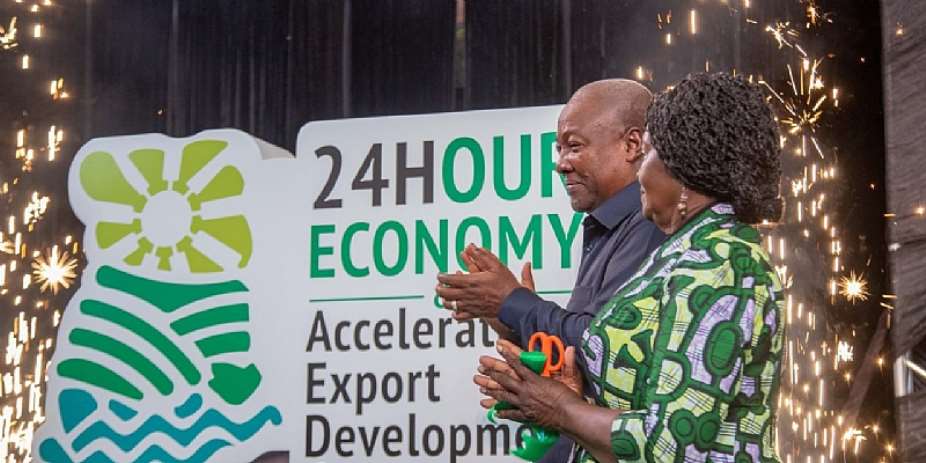
The Secretariat of the 24‑Hour Economy programme has dismissed claims that the policy has failed to produce results, insisting it has moved beyond planning and is already attracting major investments, expanding round‑the‑clock services and boosting industrial activity.
According to the Secretariat, the programme has secured $5.5 billion in Joint Development Agreements with co‑development partners as of May 2026, while 268 filling stations and 33 manufacturing companies have begun operating under its multi‑shift model.
The response follows comments by the Ranking Member of Parliament’s Economy and Development Committee, Kojo Oppong Nkrumah, who questioned what the initiative had achieved and suggested that significant public resources had been committed without clear outcomes.
‘Measure Us by Investments and Jobs, Not Government Spending’
The Secretariat argued that the programme’s progress should be assessed by the investments mobilised, production capacity created, exports generated and jobs expected — not by direct government expenditure.
“The right measure is the investment the Programme mobilises and the production, exports and jobs it generates,” the Secretariat said.
It reiterated that the programme is targeting 1.7 million decent jobs by 2028, with four agreements signed in the past 90 days alone projected to create over 160,000 direct jobs.
GH¢650bn Claim ‘Misleading’
The Secretariat rejected suggestions that the programme had consumed part of the GH¢650 billion approved by Parliament over the past two years.
“The GH¢650 billion cited by Hon. Oppong Nkrumah is the total that Parliament has appropriated for all government programmes over the past two years. It is by no means the expenditure made by or on the 24‑Hour Economy.”
It emphasised that the initiative is built on private‑sector financing, with Ghanaian and foreign companies funding most projects. Government support is limited to project preparation, viability gap financing and coordination.
Major Projects Underway
The Secretariat highlighted several flagship projects, including:
$1.45 billion Buipe solar and battery project Expected to generate 1,500MW of electricity and create 13,000 jobs.
$250 million Kambonwule oil palm complex Projected to create 120,000 jobs at maturity.
It added that public institutions such as the DVLA, Ghana Publishing Company, and Ghana Ports and Harbours Authority have already rolled out 24‑hour services.
Deliberate Rollout, Visible Impact Coming
The Secretariat said the gradual rollout was intentional, allowing government to secure investment partners, prepare bankable projects and resolve issues related to land, infrastructure and reliable power.
It maintained that the impact of the policy will become increasingly visible through expanded factory operations, new investments, job creation and higher production for domestic consumption and export.
— CitiNewsRoom
 NACOC intercepts GH¢100m tramadol shipment at Accra International Airport, arres...
 TikToker jailed over false claims about Mahama to face fresh High Court charge —...
 Ghana must never go back to an era of fear and silence — NPP condemns jailing of...
 'Release the woman' — Kofi Asare condemns jail term on TikToker over false claim...
 Weija Children's Hospital to open soon after EOCO brokers handover agreement
 Grief and Grandeur in Yendi: Thousands Gather for Ya‑Na Abukari II’s Third‑Day A...
 Atuguba Sounds the Alarm: ‘Party Loyalty Is Sinking the Ship of State’
 24‑Hour Economy Secretariat Fires Back: ‘The Programme Is Delivering, Not Draini...
 BoG Pushes Bold Community Banking Reform to Break Ghana’s Credit Barrier
 Supreme Court Exposes ‘Kululu’ in $270k Gold Case, Affirms Acquittal of Two Men

