




When the dust settles on the 2026 FIFA World Cup semifinals, historians may remember more than scores, goals, and championship aspirations. They may remember what the rosters themselves revealed about the changing world. France, Spain, England, and Argentina emerged as the tournament's final four nations, but a closer look at the players representing those countries tells a deeper story about migration, identity, colonial history, and the globalization of talent.
The title of this article is intentionally provocative: And the World Cup Winner Is Melanin. It is not a biological argument. It is a cultural and historical observation about the growing influence of people of African, Afro-Caribbean, and Global South ancestry on the world's most popular sport.
Football, known as soccer in the United States, is often called the global game. Yet what many fans fail to recognize is that the sport's biggest stages increasingly feature athletes whose family histories extend far beyond the borders of the nations they represent. Publicly available player biographies show that France possesses the highest percentage of players with African ancestry among the semifinalists. England follows with a substantial number of players of African and Caribbean descent. Spain has become increasingly multicultural in recent years, while Argentina remains the least diverse of the four semifinal nations.
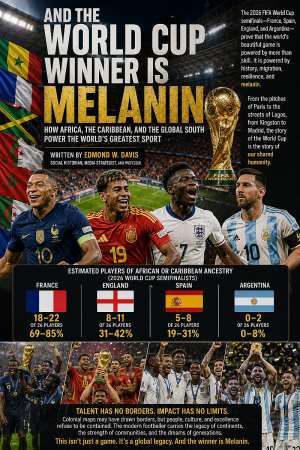
According to Okay Africa, the estimated breakdown of players with African ancestry among the semifinalists is striking:
- France: Approximately 69–85% England: Approximately 31–42% Spain: Approximately 19–31% Argentina: Approximately 0–8%
While FIFA does not classify players by race or ethnicity, these estimates reflect publicly known family backgrounds and national origins.
These numbers tell a story that extends far beyond sports.
EBSCO data explains that for centuries, France, Britain, and Spain built colonial empires that stretched across Africa, the Caribbean, Asia, and Latin America. Millions of people were moved, exploited, educated, governed, and connected through those imperial systems. The descendants of those populations now appear on football fields wearing the jerseys of former colonial powers.
What was once empire has become migration. What was once colonization has become citizenship. What was once exclusion has become representation.
In many respects, modern football reflects a twenty-first-century geopolitical chessboard.
France's national team offers perhaps the most visible example. Many of its stars trace family roots to nations such as Cameroon, Mali, Senegal, Algeria, Morocco, Guinea, and the Democratic Republic of Congo. England's roster similarly reflects generations of migration from Jamaica, Nigeria, Ghana, and other parts of the African diaspora. Spain's rise has included contributions from players whose ancestry extends into Equatorial Guinea, Morocco, and other regions linked to Spanish history.
The irony is impossible to ignore.
Many of the same societies that once viewed African and Caribbean populations as colonial subjects now celebrate them as national heroes when championships are at stake. When goals are scored and trophies are lifted, diversity becomes a strength. Yet debates about immigration, identity, and belonging continue throughout Europe and other parts of the world.
This contradiction reveals something important.
Talent does not recognize borders.
Excellence is not confined to a single race, ethnicity, language, or nationality. Great athletes emerge from neighborhoods in Lagos, Kingston, Dakar, London, Paris, Madrid, and countless other cities. What matters most is access to opportunity, development systems, coaching, support, and belief.
Argentina presents a different but equally fascinating case. Historically, Argentina promoted a national identity closely associated with Europe. Massive waves of immigration from Italy and Spain transformed the country's demographics during the late nineteenth and early twentieth centuries. Travel Noire stated that historians have documented how Afro-Argentine populations became increasingly marginalized and statistically invisible despite their historical presence. Today, Argentina's football team largely reflects the nation's modern demographic profile.
Still, Argentina's participation in the semifinals reinforces another lesson: football success is influenced by culture, investment, infrastructure, and national commitment to player development. No single factor explains excellence.
What the World Cup demonstrates, however, is that multiculturalism has become one of football's greatest strengths. The game increasingly serves as a mirror reflecting the realities of globalization itself. Teams are no longer simply collections of athletes from one background. They are often living examples of how societies evolve through migration, diversity, and cultural exchange.
The 2026 World Cup semifinals therefore represent more than a competition among four nations. They symbolize the interconnectedness of our modern world. The athletes competing for football's highest honor carry the stories of multiple continents, cultures, and generations. Their success reflects not only individual talent but also the contributions of communities that span oceans and histories.
So who wins when the World Cup reaches its final whistle?
The obvious answer is the nation that lifts the trophy.
But the broader answer may be something else entirely.
The winners are the countless families, communities, and cultures whose contributions have helped shape the modern game. The winners are the young boys and girls who see themselves represented on the world's biggest sporting stage. The winners are the societies that understand diversity is not a weakness but a competitive advantage.
The World Cup remains the world's game because it belongs to the world.
And if the semifinal rosters teach us anything, it is that the future of football will continue to be written by people whose stories cross borders, challenge assumptions, and remind us that greatness can emerge from every corner of the globe.
In that sense, the winner is not merely a nation. The winner is the global human story itself.
ABOUT THE AUTHOR
Edmond W. Davis is a social historian, journalist, professor, and documentary host. Davis is the founder of the National HBCU Black Wall Street Career Fest. This native of Philadelphia, PA, his wife, and his son currently live in the Little Rock, Arkansas, area. Davis is committed to cultural empowerment and educational equity through storytelling and civic engagement. In 2026, Davis was a grand marshal at the 38th Annual African American History Month Celebration Parade, the largest in the U.S. during Black History Month.


 'If we were wrong, we must first apologise to NPP' – Mustapha Gbande on National...
 Han SHS to get boarding status as Mahama inspects GETFund projects in Upper West
 Late herbal doctor’s wife granted GH¢100,000 bail amid poisoning, arson claims
 NDC has failed to deliver on Agenda 1-3-3 for 24-hour economy – Sam Pyne
 Wa-Bolgatanga trunk road to be asphalted – Mahama
 Gbewaa College of Education lecturer dies after alleged military assault in Pusi...
 Ghana won’t back down on mining value addition – Ambassador Kojo Bonsu
 How Dr Jesse Amuah, wife was murdered over GH¢1,500 payment dispute
 Mahama announces 20% salary incentive for health workers in deprived areas
 Ghana must move from plastic policies to implementation – EPA CEO


