




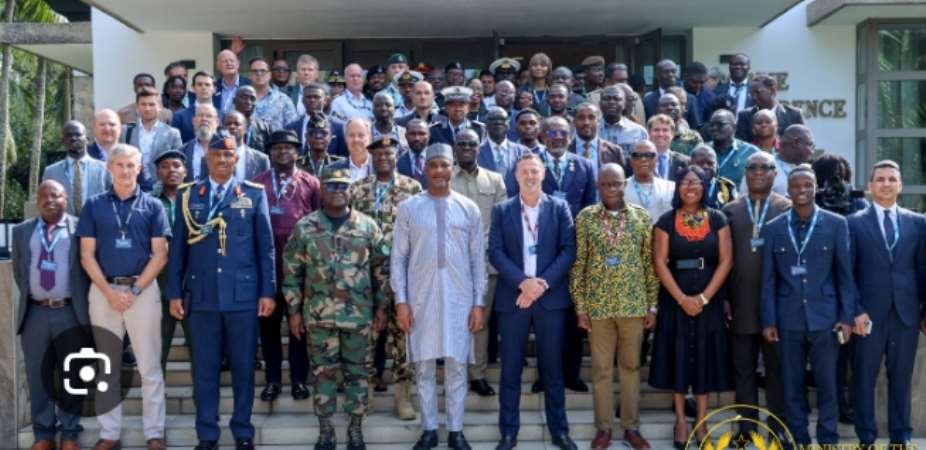
The 13th Africa Security Symposium, ASEC 2026, wrapped up in Accra last week after three days of deliberations that brought together 415 delegates from 29 African countries, alongside technology providers and partners from Europe, Asia and the Americas.
Held at the Labadi Beach Hotel under the theme "Strengthening African Security Through Innovation and Inclusion," the symposium once again positioned Accra as a continental convening point for governments, industry and multilateral partners working on Africa's evolving security architecture.
Closing the event, Ghana's Minister for the Interior, Mohammed Mubarak Muntaka, set a demanding standard for what would count as success. He told delegates the real measure of the gathering would not be the quality of discussions, but the actions that follow.
It was a pointed reminder that Accra has hosted this conversation twelve times before, and that African publics are increasingly asking what changes on the ground as a result.
Themes on the table
According to Ghana's Interior Ministry, delegates spent the three days working through counterterrorism and violent extremism, border security and transnational crime, cyber resilience, climate-driven insecurity, health security, peace operations, and aviation security.
That spread reflects how far the definition of "security" has stretched on the continent, from armed groups in the Sahel and Lake Chad Basin to the slower-moving pressures of climate shocks and public health emergencies.
The minister urged participants to leave Accra with renewed resolve, framing innovation as a tool that must ultimately serve people rather than institutions for their own sake, and calling for cooperation that produces measurable gains in peace and stability. The symposium ran under Chatham House rules, which allowed frank exchanges among ministers, military chiefs, police and intelligence officials, and private technology vendors, even as the headline messaging stayed carefully diplomatic.
The insurgency and kidnapping challenge on the doorstep
The urgency behind ASEC's agenda is not abstract. Ghana itself has avoided the large-scale insurgent violence tearing through Mali, Burkina Faso and parts of northern Nigeria, but analysts who track organised crime note that its proximity to countries affected by violent extremism raises the risk profile along the northern border, particularly around Bawku and the Cinkassé corridor near Togo. Those same border zones have become hubs where arms, drugs and people move together, often under the control of organised networks rather than any single insurgent group.
The concern security planners raise most often is spillover from the Sahel, where JNIM and allied jihadist formations have expanded their footprint deep into Burkina Faso and towards the coastal states. Analysts warn that armed groups linked to the Sahel exploit weak border enforcement and marginalised, fractured communities to run kidnapping operations that in turn feed trafficking networks, using ransom and coerced labour as parallel revenue streams. Land disputes between pastoralist and farming communities in northern Ghana compound the risk, since they weaken local trust in security institutions at precisely the points where early warning matters most.
Human trafficking remains a persistent front
Trafficking figures reinforced why the symposium's border security and transnational crime sessions carried weight. Ghana's Anti-Human Trafficking Unit, together with EOCO and the Immigration Service, opened 273 investigations in 2024 and secured 25 convictions, operating under a National Action Plan that runs through 2026.
Enforcement capacity has grown, but the gap between the legislative framework and what happens on the ground in fishing communities on Lake Volta, at Kotoka Airport, and in recruitment corridors across the north remains significant.
That gap was visible in April, when the Ghana Immigration Service rescued 305 West African nationals, including 113 children, from an organised street-begging network in Accra, an operation authorities described as part of a second phase of coordinated interventions against trafficking rings.
Recruiters have also moved online: in January, police rescued more than 100 young people lured from the Volta Region through fake job and scholarship offers advertised on social media, many of whom had paid substantial sums before family members even learned they had left home. The U.S. State Department's most recent trafficking assessment keeps Ghana on Tier 2, crediting increased prosecutions and victim-service funding while flagging continued gaps in victim identification, particularly among workers on Chinese-owned fishing vessels operating in Ghanaian waters.
Why it matters for the region
Accra's hosting of ASEC for a 13th consecutive year underscores Ghana's positioning as a stable convening hub even as neighbouring states in the Sahel contend with jihadist insurgencies, military transitions and shrinking civic space. Hosting continental security dialogues is both a diplomatic asset and a signal of the kind of stability Accra wants to project to investors and partners, but the trafficking and border-security data presented alongside the symposium's panels are a reminder that the threats under discussion are not confined to neighbouring capitals.
The test now, as Muntaka himself framed it, is whether the partnerships forged in conference rooms translate into faster information-sharing, better-resourced border agencies, and coordinated responses the next time insurgent violence, kidnapping, or a trafficking network crosses African borders, as so many now do.
Mustapha Bature Sallama.Medical/ Science Communicator, Private Investigator, Criminal investigation and Intelligence Analysis.International Conflict Management and Peace [email protected]+233-555-275-880
References
- Citi Newsroom. "ASEC 2026: Africa urged to unite against growing security threats." https://www.citinewsroom.com/2026/07/asec-2026-africa-urged-to-unite-against-growing-security-threats/
- Citi Newsroom. "Africa must strengthen security through innovation and cooperation – Muntaka." https://www.citinewsroom.com/2026/07/africa-must-strengthen-security-through-innovation-and-cooperation-muntaka/
- Ministry of the Interior, Republic of Ghana. "Africa Security Symposium ends in Accra with call for African-Led Innovative Security Solutions." https://www.mint.gov.gh/africa-security-symposium-ends-in-accra-with-call-for-african-led-innovative-security-solutions/
- ENACT Organized Crime Index. "Criminality in Ghana." https://africa.ocindex.net/country/ghana
- Hope Education Project. "Human Trafficking in Ghana: Causes, Routes and Reality." https://hopeeducationproject.org/human-trafficking-in-ghana/
- Hope Education Project. "Drivers of human trafficking in the north of Ghana." https://hopeeducationproject.org/why-northern-ghana/
- Ghana Broadcasting Corporation. "Ghana rescues 305 West African nationals, including 113 children, in anti-trafficking crackdown." https://www.gbcghanaonline.com/general/ghana-children-trafficking/2026/
- U.S. Department of State. "2025 Trafficking in Persons Report, Ghana." https://www.state.gov/reports/2025-trafficking-in-persons-report/ghana/

 Sophia Akuffo calls for limits on Supreme Court interlocutory appeals to avoid u...
 Online fraud accounts for 47% of cybersecurity incidents in Ghana — CSA
 ‘Resign and join NDC’ — NPP tells Chief Justice over alleged political commentar...
 Gomoa Central MP A-Plus accuses Police of killing two, injuring 19 in New Winneb...
 Norway seizes Russian ship to enforce $4.22 billion Ukrainian compensation claim
 Okuapeman-Mount Sinai SHSs violence clash barbaric, perpetrators must face justi...
 Foreign Affairs Ministry reaffirms zero-tolerance on middlemen in attestation se...
 Bawumia engages nurses and midwives on healthcare policy and welfare
 September 3: Cedi sells at GHS12.15 on forex market, GHS11.33 on BoG interbank
 FDA orders recall of Arcan Bitters within 14 days over undeclared sildenafil

