




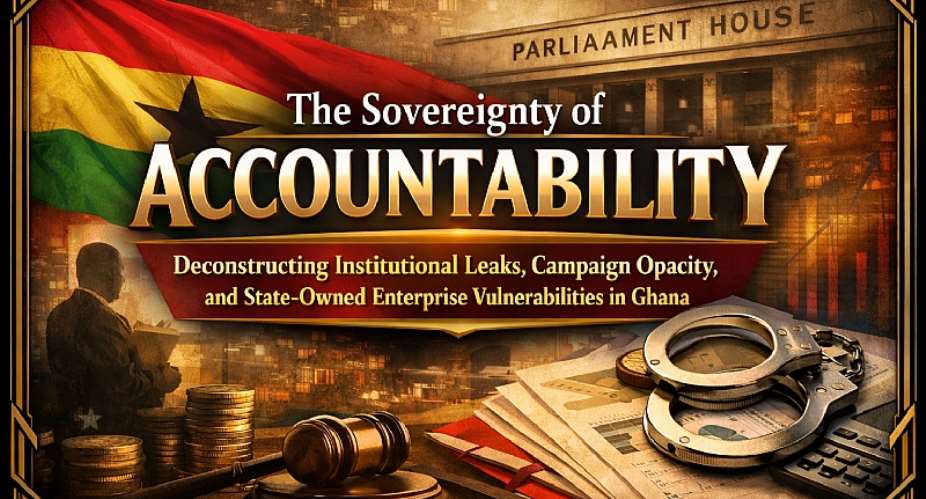
The durability of Ghana’s constitutional democracy depends entirely on an unyielding, unbroken relationship between public trust and fiscal integrity. When that bond fractures under the compounding weight of systemic administrative and procurement misconduct, the electorate faces an existential mandate to re-evaluate the ultimate fitness of its political leadership class.
In contemporary Ghana, as political actors aggressively position themselves for high executive offices, parliamentary seats, and the ultimate oversight of key State-Owned Enterprises (SOEs), recurring patterns of unchecked financial malfeasance threaten to fundamentally degrade our constitutional and institutional frameworks. To honor the legacy of Dr. Kwame Nkrumah—who envisioned a sovereign nation built on selflessness, structural merit, and rigorous industrial discipline—Ghanaians must intentionally look past the immediate charisma of public political communication and enforce uncompromised accountability.
A democratic state cannot survive if public coffers are treated as a revolving personal benefit pool, or if campaign managers, communications directors, and national operational strategists operate in institutional vacuums devoid of independent forensic auditing. The recent high-profile investigative interventions taken by state anti-graft bodies underscore an urgent, undeniable truth: the standard of baseline vetting for national leadership must be radically elevated, and institutional leaks must be plugged systematically rather than treated as isolated political theater.
The Legal Scope of EOCO: Statutory Powers and the Limits of Enforcement
The Economic and Organised Crime Office (EOCO) operates as a specialized financial intelligence and law enforcement agency established under the Economic and Organised Crime Office Act, 2010 (Act 804). It possesses a distinct, powerful mandate to monitor, investigate, prevent, and prosecute transnational organized crime, economic offenses, and institutional corruption. Under Sections 33 and 34 of Act 804, EOCO holds unique, sweeping statutory powers to trace, freeze, and seize assets suspected to be proceeds of crime well before a formal judicial conviction is achieved.
The agency’s legal mandate directly empowers it to step cleanly into public institutions—such as the Inter-Ministerial Coordinating Committee on Decentralisation (IMCCoD)—to audit, detain, and process state officials linked to severe procurement breaches. This was vividly demonstrated following a recent forensic audit spanning August 2022 to February 2025, which led to the high-profile interception and detention of former Executive Secretary Dennis Miracles Aboagye at Kotoka International Airport over an alleged GH¢55 million public funds scandal.
When state investigators impose massive, prohibitive judicial thresholds—such as setting a staggering GH¢50 million bail condition requiring three distinct sureties—it signals the immense scale of the financial dissipation being processed. Legal analysts explicitly note that such heavy bail terms reflect the extreme gravity of charges like conspiracy to steal, money laundering, and causing financial loss to the state. However, the structural limits of EOCO often become apparent during these crises. Because its core leadership relies completely on executive appointments, the agency frequently faces intense political pushback, partisan demonstrations, and systemic operational bottlenecks when its investigations directly target high-ranking party insiders or key campaign operatives.
The Vacuum of Campaign Finance: A Sandbox for Unvetted Capital
Ghana's current legal framework creates a highly dangerous, unregulated blind spot regarding the massive volumes of capital that power national political campaigns. While the Political Parties Act, 2000 (Act 574) provides fundamental ground rules, it contains profound systemic weaknesses regarding real-time transparency. Act 574 explicitly restricts political contributions strictly to Ghanaian citizens, yet in operational reality, foreign corporate entities and local proxies routinely route unvetted capital through highly complex internal networks.
Furthermore, while the law demands that political parties submit audited financial statements to the Electoral Commission (EC) following a national election cycle, these submissions are almost always highly generalized summaries. They completely lack itemized operational balance sheets, leaving the massive budgets of national communication directorates, media handlers, and campaign operatives entirely unaudited.
This deep institutional opacity routinely triggers fierce internal party friction, with national treasury officers publicly stating that significant operational allocations lack any transparent balancing or accounting records. When campaign actors intentionally avoid rendering financial accounts to party treasurers, it exposes a broader culture of financial evasion. This completely unregulated campaign finance ecosystem effectively transforms public democratic elections into high-stakes corporate investments. Financiers and campaign directors expect a direct, lucrative return on their invested capital, creating a vicious cycle where state appointments are used to reward operatives. When a presidential flagbearer—such as Dr. Mahamudu Bawumia—fails to aggressively vet, discipline, or structurally distance his executive office from closest aides caught in multi-million cedi fraud probes, it signals a profound breakdown of executive oversight.
State-Owned Enterprises: From Public Wealth to Political Benefit Pools
State-Owned Enterprises (SOEs) and statutory authorities are legally mandated to serve as engines for economic development and national wealth generation. Instead, deep-seated institutional weaknesses have converted many of them into strategic hubs for political patronage, elite lobbying, and massive financial leakage. Highly lucrative state entities—including Goldbod, COCOBOD, and the Ghana National Petroleum Corporation (GNPC)—constantly become the targets of intense boardroom lobbying by powerful campaign operatives seeking executive control or chief executive roles.
Once political actors successfully secure these executive appointments, the statutory provisions of the Public Procurement Act, 2003 (Act 663) are frequently bypassed or completely evaded. Boards of directors and executive secretaries regularly utilize single-source procurement methods or restrictive tendering to deliberately award massive state contracts to political allies, shell companies, and campaign financiers.
To maintain this grip on institutional resources, incoming executives frequently execute aggressive administrative purges, summarily dismissing long-serving technocrats, coordinators, and internal auditors. These purges are specifically designed to strip away institutional gatekeepers, bypassing civil service protections solely to create extra financial margins for personal benefit and illicit enrichment. According to successive State Ownership Reports published by the Ministry of Finance, these systemic procurement irregularities, unvetted expenditures, and abysmal governance frameworks within SOEs continuously drain billions of cedis from the national treasury, directly hampering macroeconomic stability.
Strategic Recommendations for the Ghanaian Electorate
To permanently halt this cycle of public exploitation, Ghanaian citizens, civil society organizations, and independent media must move beyond passive complaints and aggressively enforce structural, legislative reforms:
- Enforce Judicial Pre-Conditions for State Appointments: Ghana must establish an unbreakable legal precedent ensuring that any individual under active investigation, state detention, or restrictive bail conditions by EOCO is permanently disqualified from lobbying for or assuming executive control of any State-Owned Enterprise.
- Legislate Real-Time Campaign Finance Auditing: Parliament must urgently amend Act 574 to introduce comprehensive campaign finance laws that mandate real-time, publicly accessible digital tracking of all political donations, corporate sponsorships, and media expenditures during election cycles.
- Insulate Anti-Graft Leadership from Executive Control: To eliminate partisan interference, the appointment and removal powers for the leadership of EOCO, the Auditor-General, and the Office of the Special Prosecutor must be completely shifted away from the Executive President to an independent judicial council.
- Transition from Oratory to Performance Metrics: The electorate must completely reject the dangerous, long-standing habit of equating eloquent media communication or political public relations with ethical administrative competence. Voters must treat elections as rigorous corporate interviews, filtering candidates strictly by their documented fiscal discipline and clean public records.
A Critical Call to National Vigilance
Ghana stands at a precarious historical crossroads. The nation cannot genuinely champion the progressive, self-reliant ideals of Dr. Kwame Nkrumah while simultaneously allowing its core financial structures, statutory committees, and state enterprises to be hollowed out by calculated elite misconduct. When high-ranking political figures, campaign directors, and state directors repeatedly find themselves at the center of multi-million cedi procurement scandals, internal funding disputes, and state-level fraud probes, the warning signs are absolute. To deliberately overlook these flashing red flags out of blind partisan loyalty or temporary financial incentives is an act of collective national self-sabotage.
Ghanaians must wake up and scrutinize every individual seeking to steer the affairs of the republic. If the citizenry does not demand complete transparency from campaign handlers, institutional directors, and presidential candidates alike, the state will inevitably inherit a bankrupt governance system. The ultimate preservation of Ghana’s sovereignty depends entirely on our collective willingness to replace blind political worship with uncompromised, institutional accountability.
✍️ Retired Senior Citizen
For and on behalf of all Senior Citizens of the Republic of Ghana 🇬🇭
Teshie-Nungua
[email protected]


 Chief Justice Baffoe-Bonnie is Mahama's surrogate to control the judiciary — Mar...
 Court gives OSP four more weeks to serve Ofori-Atta, Akore in US
 Dangote's $16bn Kenya refinery 'new chapter' for Africa
 Mahama to open national conference on housing finance
 NPP announces voter ID requirements for October 3 national conference
 Ghana rejects calls to abolish International Criminal Court , urges stronger act...
 September 30: Cedi sells at GHS12.20 on forex market, GHS11.70 on BoG interbank
 'Ghana is now training lawyers illegally' — Former Bar president
 Akyem Hemang residents demand justice for alleged military shooting of 29-year-o...
 Adenta-Accra morning travel time improves significantly in just 23 minutes under...


