




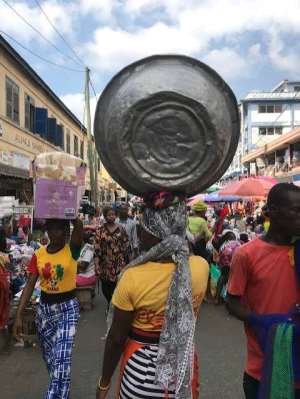
Every day, long before most shops open and long after many have closed, thousands of Ghanaians are already at work carrying the nation's economy on their heads, backs and shoulders.
From the bustling lanes of Makola Market in Accra to Kejetia in Kumasi, from Takoradi's commercial centres to Tamale's busy trading hubs, women balance heavy loads on their heads while young men push trolleys stacked with cement, beverages, furniture, foodstuffs and other goods. Known as kayayei, porters, trolley pushers and load carriers, they perform one of the most physically demanding yet least appreciated jobs in Ghana.
Though they rarely feature in economic reports or policy discussions, their labour keeps markets functioning, businesses supplied and goods moving efficiently across the country.
Most load carriers are internal migrants from the Northern, North East, Savannah and Upper East Regions who travel to major cities in search of employment and better opportunities. For many, head portering or trolley pushing is the first available source of income because it requires neither formal education nor start-up capital—only physical strength, determination and endurance.
Women, popularly known as kayayei, transport food items, clothing, household goods and market purchases for traders and customers. Their male counterparts typically handle heavier cargo, including construction materials, electronics, beverages and bulk produce, often using hand-pushed trolleys to navigate crowded streets where vehicles cannot reach.
Their contribution extends far beyond the markets. They serve as the final link in Ghana's supply chain, moving goods from wholesalers to retailers, assisting passengers at bus terminals, transporting building materials to construction sites, and helping households relocate. Without their services, the movement of goods within many urban centres would become slower, more expensive and less efficient.
Despite their vital economic role, the work comes with significant hardship. Long hours of carrying heavy loads expose many to chronic back and neck pain, joint injuries, headaches and other health complications. Pregnant women who engage in head portering face additional health risks, while access to healthcare remains limited for many workers.
Accommodation is another challenge. Many live in overcrowded structures, temporary shelters or market areas with inadequate sanitation, clean water and security. Their earnings are often modest and unpredictable, with some making only GH¢20 to GH¢50 a day depending on demand. Cases of harassment, underpayment and outright refusal by customers to pay agreed fees are frequently reported.
The sector also has wider social implications. Economic hardship continues to push some young girls out of school and into head portering, limiting their educational opportunities and perpetuating cycles of poverty. Road accidents, theft and gender-based violence further expose these workers to daily risks.
Recognising these challenges, government agencies and civil society organisations have introduced interventions aimed at improving the welfare of load carriers. Skills training programmes have been established to help some kayayei transition into trades such as tailoring, catering, hairdressing and soap production. Selected beneficiaries have also been enrolled onto the National Health Insurance Scheme, while organisations including SEND Ghana, the International Labour Organization (ILO) and women's advocacy groups continue to provide literacy programmes, financial education and support for improved working conditions.
However, much more remains to be done. Labour advocates are calling for greater recognition of load carriers within national employment statistics and social protection programmes. Improved market infrastructure, including designated resting areas, water facilities, safe walkways and storage spaces, would significantly improve their working environment. Expanding access to affordable credit and vocational training could also enable many to establish small businesses and reduce long-term dependence on physically demanding work.
There are also growing calls for clearer regulations to protect workers from exploitation, establish fair pricing guidelines and improve safety standards within markets and transport terminals.
As Ghana pursues industrialisation and economic transformation, it is important not to overlook the thousands of people whose daily labour supports commerce at the grassroots level. Load carriers may operate within the informal economy, but their contribution is indispensable to national productivity.
They carry the goods that fill our shops, transport the materials that build our homes and businesses, and provide an essential service that keeps commerce moving every day.
The question for policymakers is not whether load carriers matter—they clearly do. The challenge is whether Ghana can create an economy where hard work is matched by dignity, safety and opportunity, and where no child is forced to abandon education simply to survive.
A nation that depends so heavily on the strength of its load carriers owes them not only recognition, but also protection, respect and a genuine pathway to a better future.


 NPP holds constituency elections in 245 constituencies as 31 locked-up in disput...
 Two run to Supreme Court to clarify presidential two-term limit
 Togolese national convicted for stealing four-year-old boy from Kpedze to Accra
 Dennis Miracles Aboagye granted GH¢50 million bail over GH¢55 million EOCO probe
 GMET forecasts morning mist, coastal showers and evening thunderstorms today
 'EOCO is intimidating political opponents' — Kwesi Botchwey Jr. on Miracles Aboa...
 We have turned democracy upside down in Ghana — Elvis Darko
 'NDC plan is to keep Miracles Aboagye in detention for days' — Oppong Nkrumah al...
 'If you have evidence, take Dennis Miracles Aboagye to court' – Russian NPP Chai...
 Viral sewage contamination claims against Ghana Water false — GWL

