




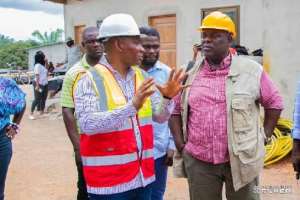
This past Friday and Saturday, something moving happened across seven regions of Ghana.
Ministers put down their briefcases and picked up shovels. Members of Parliament swept gutters alongside market women. Police officers traded handcuffs for wheelbarrows.
The President and Vice President themselves stepped into communities to desilt drains and clear refuse.
It was a rare, genuinely hopeful sight — public officials and ordinary citizens shoulder to shoulder, sleeves rolled up, doing the unglamorous work of saving our own country.
The occasion was sobering. The floods of June 29 killed more than 30 people, displaced thousands, destroyed homes and livelihoods, and once again exposed how choked drains and mountains of plastic waste turn heavy rain into disaster.
The two-day National General Cleaning exercise, organised under the Post-Flood Mitigation Committee, was Ghana's answer: an emergency, all-hands mobilisation to clear the mess before the next downpour.
It should be applauded but it should also worry us that we can conspire to consciously allow the floods to drown us because of our extremely negative behavioral pattens.
Applause Is Deserved.
There is real value in what happened this weekend. Drains that had not seen a shovel in years were opened. Markets and lorry parks that had become informal dumping grounds were cleared.
Communities saw their own leaders working in the sun, not issuing directives from air-conditioned offices.
For two days, "the Ghanaian spirit of community, discipline, and unity" — the language used to launch the exercise — was not just a phrase, it was visible in the streets.
We have heard all the commitments not to allow things to get worse.
Indeed, I have seen video clips of citizens beginning to hold fellow citizens accountable and making irresponsible citizens do the right things.
Let's Be Honest About What a Two-Day Exercise Cannot Do
Ghana has been here before. We have had national clean-up days, "Keep Ghana Clean" campaigns, and monthly sanitation exercises launched with fanfare and left to quietly fade.
The pattern is familiar: a disaster strikes, officials mobilize, the nation cleans for a day or two, cameras capture the goodwill, and within weeks the same drains are choked again, the same plastic waste piles up at the same street corners, and the same excuses return.
Indeed, I participated in the cleanup exercise at the headquarters of the Christian Council of Ghana (CCG), Osu, and the debris/garbage put out for collection since Friday/Saturday, still sits at the frontage of the CCG as at the time I am putting this article together on, Monday, July 13, 2026.
The CCG case is only a microcosm of the general inability to collect the rubbish/debris gathered in many areas and so in no time, we shall see all the gathered stuff filter back to where it came from – “cos 90”.
This is not a criticism of the people who came out this weekend. It is a criticism of a national habit: we treat sanitation, and civic responsibility more broadly, as an event rather than a way of life.
We schedule cleanliness the way we schedule a funeral — as something you show up for dressed appropriately, and then return to normal life.
The uncomfortable truth is that floods are not caused by government's failure to organise clean-up days. They are caused by what citizens do on the 363 days when no clean-up day has been declared: the sachet water bag tossed out of a moving trotro window, the gutter used as a bin because there is no better option nearby, the market trader who sweeps her stall's rubbish into the open drain rather than into a bin, the estate developer who builds over a waterway because no one enforces the permit, and the Ghanaian who sh*ts in a plastic bag and drops it anywhere when no one is looking.
No two-day directive from Jubilee House can undo a habit that is repeated, unthinkingly, a thousand times a day, all year round.
The Real Diagnosis: A Mindset Problem, Not Only a Logistics Problem
We keep responding to the symptom — blocked drains — with limited logistics: trucks, shovels, gloves, deployed personnel. These are necessary but logistics alone cannot fix a mindset that does not yet see littering as theft from the community, or indiscipline as a betrayal of the very freedom our forebears fought for.
Ghana's National Anthem asks us to be "bold to defend forever the cause of Freedom and of Right," to be filled with "true humility," to "cherish fearless honesty," and to build the nation "together."
The National Pledge asks every citizen to hold "in high esteem our heritage, won for us through the blood and toil of our fathers" and to "uphold and defend the good name of Ghana."
These are not just words for assembly mornings. They describe exactly the mindset a clean, disciplined, self-respecting nation requires — a citizen who does not throw rubbish in a gutter because doing so is a small act of disrespect to a heritage paid for in blood and toil.
We do not have a shortage of fine words. We have a shortage of the daily practice of those words.
What Total Mindset Transformation Would Actually Look Like
Comprehensive mindset transformation is slower, less photogenic, and far more demanding than a two-day exercise — but it is the only thing that produces lasting change.
It would mean:
1. Sanitation and civic values taught from kindergarten, not just legislated for adults. Children who grow up understanding that littering is a breach of a value they can name, not merely a rule they can break when no one is watching, become adults who do not need a presidential directive to keep their community clean.
2. Consistent enforcement, not seasonal enforcement. By-laws against littering, illegal dumping, and building on waterways exist already. They are enforced in bursts, around disasters, and forgotten the rest of the year. Consistency, not intensity, changes behaviour.
3. Local ownership, not central mobilisation. Communities that see their environment as genuinely theirs to protect — through active assemblies, community sanitation committees, and visible local accountability — do not wait for a national directive to keep their own gutters clear.
4. Leadership that models the values daily, not only in a crisis. It was powerful to see the President, Vice President, Ministers and MPs sweeping streets this weekend. It would be transformative if the same officials were seen, without cameras, insisting on basic discipline and cleanliness in their own work environments/constituencies at every point in time.
5. A change in what we celebrate. A nation that celebrates the citizen who quietly keeps their gutter clear all year, as much as it celebrates the minister photographed with a shovel, is a nation building the right instincts.
The Choice Ahead
The two-day exercise was a good response to an emergency. It should not be mistaken for a solution to the underlying problem.
If the drains cleared this weekend are choked again by December, we will have proven, once more, that Ghana is very good at responding to floods and not yet good enough at preventing them.
The next flood, the next emergency clean-up, the next round of applause for officials with shovels — all of it can be avoided, but only if we stop treating national discipline as an event we schedule and start treating it as a character we build.
Deliberately and consciously building a transformed mindset is a harder, longer, less dramatic project than a two-day clean-up but it is also the only one that will actually save Ghana.
Samuel Koku Anyidoho
Founder & CEO, MILLS Institute for Public Policy Advocacy & Transformational Leadership Development.
Email: [email protected]
Monday, July 13, 2026.

 Ghana, Panama sign MoU to deepen bilateral political consultations
 Founder’s Day: NAPO urges Ghanaians to uphold Kwame Nkrumah’s legacy
 Founder’s Day: Mahama urges Ghanaians to draw inspiration from Nkrumah’s vision
 Mahama to build 400-bed Mother and Child Block at Korle Bu – Kwakye Ofosu
 GES threatens sanctions against SHS heads imposing unauthorised charges
 Betting could destroy future of Ghana’s youth in 3–5 years – Akim Swedru MP
 Zimbabwe Suspends Journalist for One Year Over ‘Unethical’ Reporting on Chinese ...
 Third Drug Mule in 3 Weeks: R2m Heroin Found in SA Man’s Luggage at OR Tambo
 NACOC Debunks MP’s Claim as France’s €225m Cocaine Case Deepens
 Putin party retains majority in first vote since 2022 invasion of Ukraine


