




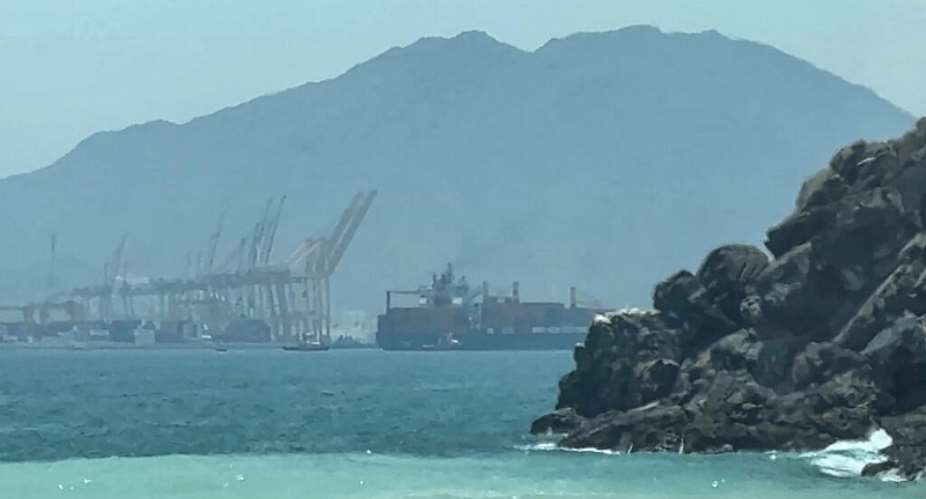
President Donald Trump reimposed a US naval blockade on Iranian ports on Monday and vowed hefty fees for ships transiting the Strait of Hormuz, as Tehran mockingly pledged to charge a lower rate for passage through the strategic waterway.
The maritime blockade was due to begin at 2000 GMT on Tuesday, the US military said, as oil prices shot up around nine percent after both sides traded attacks, raising fears of renewed conflict.
Iran's top diplomat insisted Tehran would be a fair guardian in charging tolls on the waterway vital for oil and gas trade, while the Iranian military command insisted it would not allow the US to interfere in the management of the strait.
In a post on his Truth Social site, Trump declared that the US would be "known as 'THE GUARDIAN OF THE HORMUZ STRAIT'," and "be reimbursed, at the rate of 20% on all cargo shipped, for any and all costs necessary to do the job of providing safety and security to this very volatile section of the World". President Donald Trump on July 13, 2026 announced the reimposition of a US naval blockade in the Strait of Hormuz.
While Iran's ports would again be blockaded, he said, "all other countries will have fair and open use of the strait".
Iranian Foreign Minister Abbas Araghchi immediately mocked Trump's threat to impose swingeing fees, saying Tehran would charge a lower rate.
"POTUS is absolutely right. Whoever provides secure and safe passage of commercial vessels through the Strait of Hormuz should be compensated for this service," he wrote on X.
Tehran's top diplomat said Iran had "always been the GUARDIAN" of the strait and would "remain so FOREVER", claiming it would charge fair tolls for safe passage. "20% is of course too much," he said. "We will be fair". Iranian Foreign Minister Abbas Araghchi mocked President Donald Trump's threat to re-impose a blockade in the Strait of Hormuz.
The competing claims over the strait came as the two sides traded attacks of a scale unseen since an April ceasefire came into effect.
The US military said it hit dozens of targets on Monday, while Iran's Revolutionary Guards announced new strikes in response on Bahrain, Jordan, Kuwait and Oman.
The US has vehemently opposed Tehran's desire to charge tolls in the strait, which international law generally forbids.
After Trump flipped the script on Monday, the spokesman for Iran's Khatam Al-Anbiya military command insisted that Tehran "under no circumstances will allow... the United States to interfere in the management" of the strategic waterway.
'In crisis'
Despite last week declaring the ceasefire with Iran over, Trump has said negotiations aimed at finding a permanent settlement would continue.
He told Fox News that there were hours of talks on Sunday.
Iran's foreign ministry spokesman Esmaeil Baqaei said earlier on Monday that the June memorandum of understanding that formed the basis for the negotiations and lifted the US blockade was "in crisis".
The previous blockade, in place from April to June, cut off Iranian oil exports and threatened a damaging shutdown of the industry.
Baqaei said Iran would ignore its obligations under the deal if the US did the same, but nonetheless added that Tehran was continuing talks with mediators from Qatar, Pakistan and Oman in a bid to prevent further escalation.
Pakistan, a key intermediary in negotiations, expressed "deep concern at escalation in regional tensions", according to its foreign office.
But analyst Bader Al-Saif said the escalating attacks would merely delay a permanent agreement.
"Both sides want to end the impasse on their own terms, and they are increasingly finding it difficult to do so. Hence the return to and increase in the scale of attacks," said Al-Saif, an associate fellow at Chatham House.
Yemen's Houthis target Saudi Arabia
Yemen's Iran-backed Houthis targeted Saudi Arabia on Monday, hours after the rebels accused the kingdom of attacking Sanaa airport – the biggest flare-up in years between the two sides that threatens to upend a frozen conflict.
The Saudi-backed Yemeni government claimed responsibility for the attack on the Houthi-held airport, saying it wanted to prevent an Iranian plane from landing.
It came after they failed to convince a Houthi delegation that went to Tehran for the late Iranian supreme leader Ali Khamenei's funeral to board a flight on domestic carrier Yemenia instead.
"Air defences dealt with a ballistic missile threat launched by the terrorist Houthi militia towards the southern region," coalition spokesman Turki al-Maliki said in a social media post.
Earlier, Houthi military spokesman Yahya Saree accused Saudi Arabia of "ending the de-escalation phase" and warned that "this aggression will not go unanswered or unpunished".
The latest escalation threatens to unravel a truce that has been holding since 2022 despite expiring, and comes at a time of heightened tensions as the United States and Iran trade attacks impacting the Gulf and traffic in the Strait of Hormuz.
Yemen's defence ministry accused the Houthis of "allowing an Iranian plane to violate Yemeni territory; consequently, the airport runway was targeted" in Sanaa.
Following the strikes, the head of Yemen's Presidential Leadership Council, Rashad al-Alimi, said he had "ordered that the scope of the confrontation not be expanded".
(FRANCE 24 with AFP)


 Miracles Aboagye arrest: 'You looted and your reaction is that the tables will t...
 Police arrest two with 73 parcels of suspected cannabis, reject GH¢300,000 bribe
 NACOC traces 73 assets linked to suspected drug traffickers
 Government seeks financial clearance to recruit 400 scientists – Armah Kofi-Buah
 Ya‑Naa Abubakari II laid to rest at Gbewaa Palace
 NPP will reinstate workers unlawfully sacked by NDC government - Chairman COKA
 'Neglecting grassroots dangerous' – GFL warns NDC, NPP
 'No money, no vote' — Bongo NPP delegates tell contestants in constituency execu...
 NAM1 files witness statements in Menzgold trial, seeks to rely on seven defence ...
 Miracles Aboagye’s wife raises health concerns over husband's detention by EOCO

