




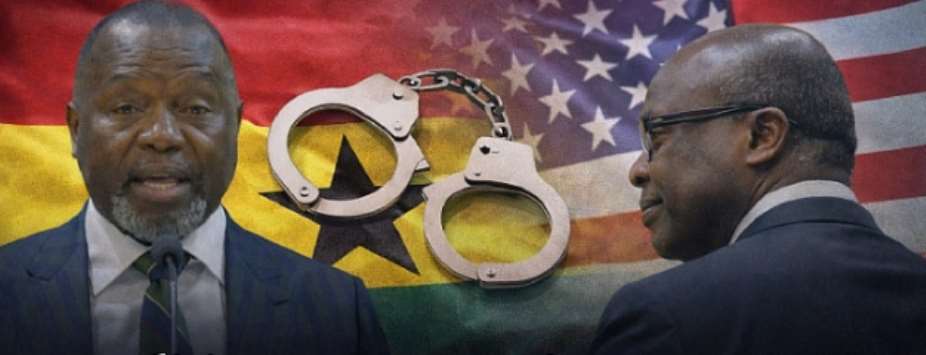
Ghana's extradition relationship with the United States has revealed an uncomfortable asymmetry in 2026. When Washington asks Accra to hand over ordinary Ghanaian citizens accused of defrauding Americans, the machinery of Ghanaian justice moves with striking efficiency, court hearings scheduled, bail conditions set, flights booked within months of arrest. But when Ghana asks Washington to return one of its own, a former government minister facing 78 counts of corruption, the same machinery grinds to a halt in an American immigration court, outmaneuvered by lawyers, procedure and, ultimately, a green card. The contrast raises an uncomfortable question about where real bargaining power sits in this bilateral relationship, and whose citizens it actually protects.
The cases that move quickly
Three recent cases illustrate how smoothly Ghana surrenders its own people when the United States comes asking. Isaac Oduro Boateng, Inusah Ahmed and Derrick van Yeboah, Ghanaian nationals accused of running a criminal organization that stole more than one hundred million United States dollars through romance scams and business email compromises, were extradited to New York in August 2025 with the close cooperation of Ghana's Economic and Organized Crime Office, its Cyber Security Authority, its National Intelligence Bureau and INTERPOL's Ghana bureau. In July 2026, Frederick "Abu Trica" Kumi, accused of running an eight million dollar romance fraud operation, was flown out of Accra on a Delta flight within days of the High Court dismissing his final challenge, even though his lawyers argued the ninety-five-year-old 1931 extradition treaty governing the two countries never explicitly listed wire fraud as an extraditable offence. The court found dual criminality sufficient anyway. In neither case did diplomatic friction, treaty ambiguity or procedural delay meaningfully slow the outcome.
The case that has not
Compare that to the case of Kenneth Ofori-Atta, Ghana's former Finance Minister, who left the country in early 2025 for what his lawyers described as medical treatment and has remained in the United States since. Ghana's Office of the Special Prosecutor charged him with 78 counts of corruption and corruption-related offences under its Operation Recover All Loots initiative, and Accra filed a formal extradition request in December 2025.
Instead of a swift surrender, Ofori-Atta was briefly detained by immigration authorities in January 2026 before a US immigration court approved his application for permanent residency in June 2026, a ruling that found Ghana had acted with prejudice in labeling him a fugitive, notwithstanding his continued presence on American soil for well over a year. That immigration ruling does not formally block a future criminal extradition, since immigration status and extradition proceedings run on separate legal tracks, but it substantially raises the practical threshold Ghana must now clear, elevating Ofori-Atta's protections closer to those of a US citizen.
The double standard laid bare
What sharpens the sting of this outcome is a case that ran the opposite direction the same year. Sedina Christine Tamakloe-Attinou, former chief executive of Ghana's Microfinance and Small Loans Centre, was convicted in Ghana on more than seventy counts including theft, money laundering and causing financial loss to the state. When she failed to return from a court-approved US medical trip during her trial, American authorities located, detained and extradited her back to Ghana in June 2026 to serve her sentence, with the US Marshals Service, the FBI's Accra legal attaché and Ghanaian INTERPOL all cooperating smoothly. Legal analysts examining both cases side by side have noted the discrepancy directly: a mid-level former state official was returned to face justice within months, while a far more senior official facing a larger and arguably more serious set of allegations has spent well over a year building legal protections against the very same outcome. The difference appears to lie less in the treaty framework, which applied to both, than in the resources, legal counsel and procedural sophistication available to a former Finance Minister that were simply unavailable to a MASLOC administrator.
The political fallout
This asymmetry has not gone unnoticed inside Ghana. Former Member of Parliament Ras Mubarak has publicly urged President John Mahama's administration to adopt a harder line, calling for Ghana to suspend all pending and future US extradition requests, and even to reconsider bilateral defence cooperation, until Washington formally returns Ofori-Atta to face Ghanaian courts. The Office of the Special Prosecutor, for its part, has maintained that the credibility of the criminal charges is a matter for Ghanaian courts alone to determine, insisting that an American immigration officer's procedural finding cannot substitute for a Ghanaian judicial verdict. Whether that position holds any real leverage over Washington, absent a matching willingness to slow down Ghana's own extradition cooperation, remains genuinely untested.
The deeper structural problem
Beneath the individual cases lies a structural imbalance that Ghana, like many African states negotiating with the United States, has yet to fully reckon with. Extradition treaties read as reciprocal on paper, but reciprocity in practice depends on which side has the deeper legal resources, the more sophisticated immigration strategy, and the greater diplomatic weight to slow-walk a request it finds inconvenient. Ghana's Economic and Organized Crime Office, Cyber Security Authority and National Intelligence Bureau have shown they can move quickly and cooperatively when Washington's requests concern low-profile citizens accused of preying on American victims. The same swiftness has not been matched when Accra is the party seeking the return of a well-connected former official, exposing a gap between formal treaty symmetry and the actual balance of bargaining power.
Conclusion
Ghana's extradition record in 2026 tells two very different stories depending on which direction the request travels. Handing over its citizens to face American courts has proven straightforward, even against a treaty written in 1931 that never anticipated wire fraud or business email compromise. Bringing a fugitive of its own home from American soil has proven anything but. Until Ghana can close that gap, either through stronger diplomatic leverage, better resourced legal teams, or a genuine willingness to condition future cooperation on reciprocity, the country risks a justice system that looks robust when giving its citizens away and considerably weaker when trying to bring them back.
Mustapha Bature Sallama.
Medical/ Science Communicator,
Private Investigator, Criminal investigation and Intelligence Analysis.
International Conflict Management and Peace Building.USIP
[email protected]
+233-555-275-880
References
Nuamah, John Kyeremanteng. "Ghana dispatch: former finance minister granted permanent residence in the US, thwarting extradition efforts." JURIST, June 2026. https://www.jurist.org/news/2026/06/ghana-dispatch-former-finance-minister-granted-permanent-residence-in-the-us-thwarting-extradition-efforts/
"Ghana dispatch: Former Finance Minister detained by US immigration authorities pending extradition review." JURIST, January 2026. https://www.jurist.org/news/2026/01/ghana-dispatch-former-finance-minister-detained-by-us-immigration-authorities-pending-extradition-review/
"Ken Ofori-Atta's US residency approval complicates Ghana extradition efforts." GBC Ghana Online, June 2026. https://www.gbcghanaonline.com/features/ken-ofori-attas-us-residency-approval-complicates-ghana-extradition-efforts/2026/
"Ghanaian official who stole $6M surrendered to authorities after Nevada arrest." The Washington Times, June 2026. https://www.washingtontimes.com/news/2026/jun/9/ghanaian-official-who-stole-6m-surrendered-authorities-nevada-arrest/
"Ghanaian Nationals Extradited For Roles In Criminal Organization That Stole More Than $100 Million Through Romance Scams And Other Fraud." US Department of Justice, Southern District of New York, August 2025. https://www.justice.gov/usao-sdny/pr/ghanaian-nationals-extradited-roles-criminal-organization-stole-more-100-million
"Ghanaian celebrity fraudster Abu Trica extradited to U.S. over $8 million fraud." Gazette NGR, July 2026. https://gazettengr.com/ghanaian-celebrity-fraudster-abu-trica-extradited-to-u-s-over-8-million-fraud/
"Abu Trica extradited to US to face fraud charges." Ghana Broadcasting Corporation, July 2026. https://www.gbcghanaonline.com/general/abu-trica-extradited-to-us-to-face-fraud-charges/2026/

 'The height of absurdity' — Ayew Afriye slams BNI over invitation of Efya Royal ...
 US envoys arrive in Moscow to thrash out plan to end war in Ukraine
 'Chief Justice was talking as a citizen; you have to look at the context in whic...
 Mandatory towing to remove broken-down, stationary vehicles from roads to begin ...
 Domelevo backs OSP probe into alleged GH¢70,000 payment to Appiagyei despite den...
 WAEC releases 2026 WASSCE results, cancels entire results of 861 candidates for ...
 Baffour Agyeman-Duah explains why profitability may not be only reason behind SO...
 Kofi Bentil defends Mahama’s dissolution of nine State Boards
 5-year-old girl dies after falling into water-filled manhole at Winneba
 Sierra Leone ex-president to return after treason case dropped

