




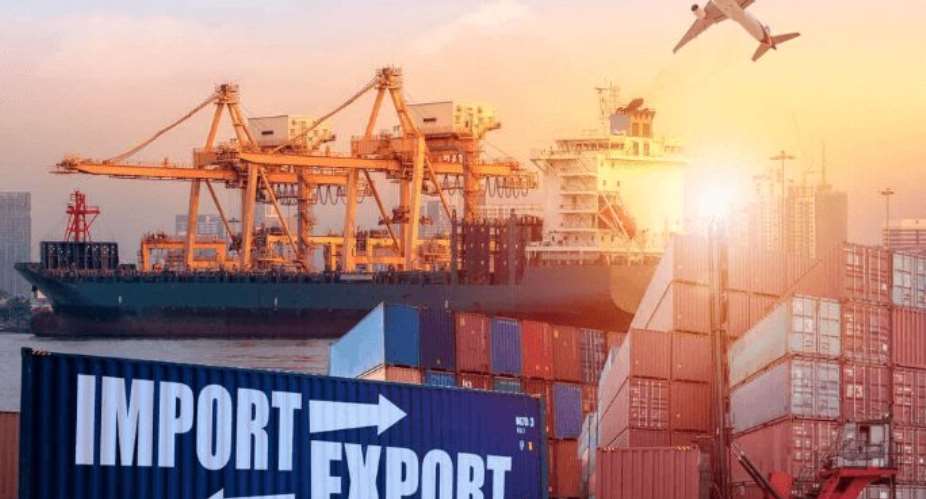
Let me start with The High Street Business' number that tells you everything about Ghana's place in the global economy. $16 billion**. That is how much Ghana exported in 2024. **$20.4 billion. That is how much we imported . The gap between those numbers, the trade deficit of over $4 billion, is not just a statistic. It is a story. A story of a nation that digs gold, grows cocoa, and pumps oil, but still cannot produce enough of what it consumes. A story of opportunity, vulnerability, and the choices that will determine whether Ghana's economy finally breaks free from the cycle of raw material dependence.
Ghana's Import and Export Market Explained
In 2024, Ghana exported $16 billion worth of goods and imported $20.4 billion . The country's exports are heavily concentrated in primary commodities: gold bullion alone accounted for 62.9 percent of total exports in 2025 . Gold is followed by cocoa beans, crude petroleum, cocoa paste, and shea nuts. The top five products accounted for 86 percent of all export earnings .
The export destination picture is shifting. The United Arab Emirates has emerged as Ghana's top export market, accounting for 25.9 percent of exports in 2025, followed by India (16 percent), Switzerland (14.2 percent), South Africa (10.3 percent), and China (4.9 percent) . Asia now absorbs over half (53.4 percent) of Ghana's exports, more than double Europe's share of 24.9 percent .
On the import side, China dominates completely. In 2024, Ghana imported $9.84 billion worth of goods from China, far ahead of India ($1.29 billion), the Netherlands ($1.25 billion), the United States ($876 million), and Belgium ($607 million) . The top imports include refined petroleum ($1.52 billion), large construction vehicles ($612 million), poultry meat ($373 million), cars ($348 million), and telephones ($338 million) .
The concentration of exports in a few primary commodities is a structural vulnerability. When gold prices are high, as they have been in 2025 and 2026, the economy booms. When gold prices fall, the economy suffers. This is the resource curse in action: dependence on a single commodity makes a country vulnerable to global price swings.
What Market Volatility Means for Ghanaian Businesses
Market volatility in Ghana takes two forms: external shocks (commodity price swings, global conflicts) and domestic pressures (currency movements, inflation, utility costs).
The cedi's historic 40 percent appreciation against the dollar in 2025 was driven by a gold boom, with prices breaching $4,000 per ounce . But the recovery is fragile. The cedi has already lost between 8 and 10 percent of those gains, according to analysts at the Citi Business Festival .
The Middle East conflict, involving Iran, Israel, and the United States, is a significant threat to businesses due to its potential impact on global oil prices and shipping costs . Electricity tariffs for industrial users have increased by about 23 percent since 2024, while water tariffs have risen by approximately 19 percent over the same period .
For businesses, volatility means uncertainty. When the cedi fluctuates, importers cannot predict their costs. When oil prices spike, transport and production costs rise. When utility tariffs increase, margins shrink. The businesses that survive are those that hedge their currency exposure, diversify their supply chains, and maintain strong cash reserves.
Ghana's Retail and Wholesale Markets: A Deep Dive
Ghana's retail and wholesale market is a rapidly growing sector driven by urbanization, a rising middle class, and increasing consumer spending . Traditional markets, small independent shops, supermarkets, and malls are popular retail formats. Wholesale trade is also a significant part of the market, with wholesale businesses catering to retailers and other businesses.
The sector is diverse, with a wide range of products including food and beverages, clothing, electronics, and household goods. Key players include local retailers, international chains, and informal traders . E-commerce is also gaining traction, providing consumers with more options for shopping .
The Kumasi Central Market, the largest market in Ghana, is undergoing a modernization phase funded by £70.3 million from UK Export Finance . The project aims to create an ultra-modern state-of-the-art structure, but has come with challenges for traders, with some losing capital and shop owners turning into hawkers .
The retail and wholesale market is experiencing a shift towards e-commerce and digital platforms, driven by increasing internet penetration and smartphone usage. Consumers are increasingly looking for convenience and a wider range of products . There is also a trend towards sustainable and eco-friendly products, with consumers showing a preference for ethically sourced and environmentally conscious brands .
Challenges in the sector include:
- Unreliable infrastructure, including inconsistent power supply and inadequate transportation systems, which can hinder operations and increase costs
- High import duties and taxes make it difficult for retailers and wholesalers to offer competitive pricing
- The presence of a large informal sector leads to unfair competition and tax evasion
- Access to financing and credit can be limited for small businesses
How Currency Movements Affect Ghana's Markets
The relationship between the cedi and the markets is a two-way street. Currency strength reduces the cost of imports, easing inflation and lowering business costs. But a strong cedi can also hurt exporters, making their products more expensive in foreign markets and squeezing margins .
A 2026 study of 589 SMEs in Accra and Tema found that exchange-rate fluctuations exert a negative and statistically significant drag on SMEs' import-export performance . However, hedging instruments, including forwards, options, swaps, and netting, were found to enhance trade performance directly while also moderating the exchange-rate effect .
The Bank of Ghana's "Gold for Oil" and "Gold for Reserves" programs have been key to currency stability . By purchasing gold locally and using those assets to pay for imports, the government has reduced demand for dollars and supported the cedi .
However, a two-tier FX system has emerged: an official price that looks good on paper and a real price that importers and traders actually pay, often GH¢11.50 or higher . Importers are increasingly forced to turn to the black market for dollars, where rates are far higher than the Bank of Ghana's quoted interbank rate.
Market Risks and Opportunities in Ghana's Economy
Risks:
- Commodity Dependence: Gold accounts for over 60 percent of exports. A drop in gold prices would devastate export earnings, pressure the cedi, and slow growth .
- Security Threats: Growing Islamist insurgency across the Sahel could spill over into Ghana, deterring investment and disrupting trade .
- Currency Volatility: The cedi's gains could be reversed by global shocks or domestic policy missteps. A weakening cedi would increase inflation and import costs .
- Debt Vulnerabilities: While progress has been made, Ghana remains at risk of debt distress if reform momentum stalls .
- Energy and Power Sector: Legacy arrears and contingent liabilities continue to weigh on public finances
. Opportunities:
- Gold Boom: Ghana can capitalize on high gold prices to build reserves, invest in infrastructure, and diversify the economy .
- Upstream Oil and Gas: Ghana has secured over $3.5 billion in upstream oil and gas investment commitments, with crude oil production expected to increase for the first time in almost six years.
- Digital Transformation: The rise of e-commerce and digital platforms offers opportunities for businesses to reach new customers and improve efficiency .
- AfCFTA: The African Continental Free Trade Area provides access to a market of 1.3 billion people. Ghana can position itself as a regional hub .
- Local Processing: Ghana is taking steps to process minerals locally. The commissioning of a new national refinery is expected in mid-2026.
The High Street Business' Bottom Line
Ghana's economy is at a crossroads. The gold boom has provided breathing room, but structural vulnerabilities remain. The country must move beyond raw material dependence and build a diversified, competitive economy. This means investing in infrastructure, education, and technology; improving the business environment; and maintaining fiscal discipline.
The markets are sending a signal. Businesses that hedge their currency risk, diversify their supply chains, and invest in digital transformation will thrive. Those that ignore the risks will struggle. And Ghana's policymakers must continue the reforms that have restored macroeconomic stability, while addressing the underlying structural issues that have held the country back.
The numbers tell the story. The choices we make will determine the ending.


 Baffour Awuah may spend night in EOCO custody — Lawyer
 Suspend Ghana-Colombia port and visa deals over cocaine seizures — Minority
 Ghana Law Society proposes National Service for fresh lawyers
 'We cannot continue to be a Bar of Accra, by Accra, for Accra' — Ghana Law Socie...
 Stop speculation, premature conclusions; allow investigation to determine Baffou...
 Judge halts Ex-NAFCO CEO's trial until ruling on seized phones
 Manhyia South MP who resisted arrest reports to EOCO a day after arrest warrant ...
 "Show us evidence" —Upper West teacher unions demand proof of payment before end...
 Adenta: Bolt driver jailed 25 years for cutlass attack and robbery of beautician...
 EOCO drags Manhyia South MP to former law firm, residence for search


