




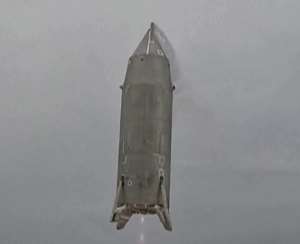
Japan's space agency announced Saturday, July 11, 2026, that its experimental reusable rocket completed its first successful lift-off and landing test, a modest but symbolically important step as the country works to master technology SpaceX has dominated for years.
The Test Flight
The prototype, known as the Reusable Vehicle eXperiment (RV-X), lifted off from the Japan Aerospace Exploration Agency's (JAXA) Noshiro Testing Center in Akita, northeastern Japan. According to JAXA's reusable rocket project manager, Takashi Ito, the rocket rose 11 meters (36 feet), moved horizontally 16 meters (52 feet) while maintaining an upright position, and then landed safely all within a flight lasting under one minute. The test was live streamed by NVS, a group of space enthusiasts, ahead of JAXA's official online briefing later that day.
The Technology Behind It
RV-X is being co-developed by JAXA and Mitsubishi Heavy Industries. The vehicle measures 1.8 meters (5.9 feet) in diameter and 7.3 meters (23.9 feet) in length, and is fitted with an engine built for enhanced durability alongside four shock-absorbing landing legs. Ito described the engine as "hardworking," noting it has already withstood 165 combustion tests during ground trials ahead of Saturday's flight.
What Comes Next
JAXA, which is also developing reusable rocket technology jointly with France and Germany, plans to push the RV-X to a significantly higher altitude of around 100 metres (218 feet) in future test flights, building incrementally toward the kind of vertical landing capability SpaceX has used commercially since 2015 to slash launch costs.
Why It Matters
Reusable rocket technology has become a defining competitive edge in the global space industry, allowing companies to relaunch boosters rather than discard them after a single flight dramatically reducing the cost per launch. Japan's success with this initial low-altitude test, while far more limited in scale than SpaceX's operational Falcon 9 boosters, represents a foundational proof-of-concept step as Tokyo seeks to keep its domestic space industry competitive in an increasingly crowded and cost-sensitive global launch market.
Mustapha Bature Sallama.
Medical/ Science Communicator,
Private Investigator, Criminal investigation and Intelligence Analysis.
International Conflict Management and Peace Building.USIP
[email protected]
+233-555-275-880
References
Associated Press (via ABC News), "Japan's space agency conducts first test flight for experimental reusable rocket," July 11, 2026. https://abcnews.com/International/wireStory/japans-space-agency-conducts-test-flight-experimental-reusable-134669204
Associated Press (via InformNNY.com), "Japan's space agency conducts first test flight for experimental reusable rocket." https://www.informnny.com/news/tech-news/ap-japans-space-agency-conducts-first-test-flight-for-experimental-reusable-rocket/


 DVLA to introduce smart number plates to boost security, improve vehicle traceab...
 Maame Grace petitions Mahama to investigate Mosquito Lab Ghana at University of ...
 Passage of Community Service Bill not enough, Ghana must modernise prisons — Mar...
 June 29 floods a clear case of Mahama's incompetence — Egyapa Mercer
 Nkoko Nkitinkiti policy will fail, can't solve Ghana's poultry problem — Kofi Be...
 Ghana's tallest man spared leg amputation after Ibrahim Mahama's intervention
 Iran strikes Gulf neighbours after new US attacks
 US senator and Trump ally Lindsey Graham dies after 'brief and sudden illness'
 Trump and Iran's supreme leader trade threats as mediators try to save deal
 More than 1 million evacuated as Typhoon Bavi makes landfall in China

