




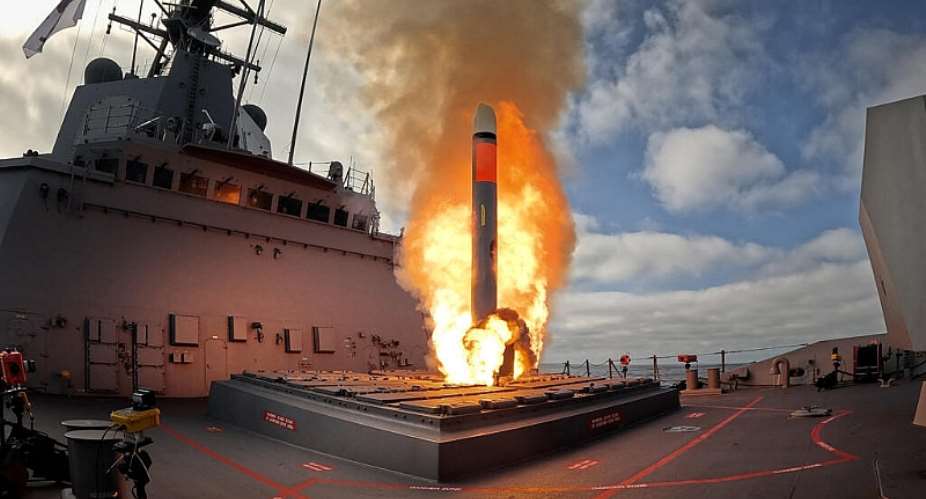
Hours after this week's NATO summit came to a close in Ankara, Chancellor Friedrich Merz told the Bundestag, Germany's parliament, that the country has agreed a deal with Washington to buy American-made Tomahawk cruise missiles and station them on German soil.
The letter of intent, signed by the two countries' defence ministries earlier this week, commits Washington to formal approval by August. It covers an undisclosed number of Tomahawks and ground-based Typhon launchers – made by arms manufacturer Lockheed Martin – without US personnel deployed to operate them.
The Tomahawk's range of around 1,600 kilometres is enough to reach deep into Russian territory from Germany. Donald Trump and Friedrich Merz meet at the White House, 3 March.
'You cannot buy gurantees'
Merz stressed that the purchase was a stopgap, saying: "We will work to develop our own European systems and station them in Europe."
But the deal illustrates a dependence that goes well beyond one missile system.
Guntram Wolff, author of "Europe's dependence on US foreign military sales and what to do about it" – a report by Brussels-based think tank Bruegel – says the danger is political as much as industrial.
"You cannot buy the security guarantee of Trump by buying fighter jets," he told RFI.
He added that Washington "can at any time decide to change the order of who gets what" under its foreign military sales programme – to which Switzerland, whose Patriot system deliveries were pushed back so Germany's order could move up the queue, can attest.
Within NATO, Europe's missile shield remains divided between the US-led Integrated Air and Missile Defence system and the German-led European Sky Shield Initiative, which saw some 20 states pool together for procurement of the Swedish-made IRIS-T missile, as well as the US-made Patriot and Arrow 3 missiles.
Meanwhile, Russia's arsenal is mature and combat-tested in its war against Ukraine – with Iskander, Kalibr and Kh-101 missiles and the massive deployment of drones, some of which have crossed into Polish, Romanian and Baltic – and therefore NATO – airspace.
As Europe pours money into defence, reliance on US remains a sticking point
'Germany exposed'
Alexandr Burilkov, a defence researcher at the GLOBSEC GeoTech Center, points to a further gap: the "strategic enablers" – satellite networks, strategic airlift, aerial refuelling – which the US has traditionally supplied within NATO.
"This is the place where Europe really is the weakest," he told RFI, noting that Germany is "most acutely" exposed, as it lacks the industrial diversity France retains.
Europe's drive to close these gaps without permanent reliance on Washington has had mixed results.
KNDS, the Franco-German manufacturer of the Leopard 2 tank and Caesar howitzer, postponed a planned Paris-Frankfurt stock market listing on 1 July after investors declined to back a valuation above €12 billion.
Burilkov called the listing "a milestone in a way", but added that whether it would produce real industrial integration was "to a certain extent an open question". France's Caesar mounted gun at the 2026 Eurosatory arms show, 16 June.
Prior to the delay of the KNDS IPO, the collapse of the Future Combat Air System (FCAS,) the Franco-German-Spanish sixth-generation fighter jet project, marked another failing in inter-European defence cooperation.
Paris and Berlin scrapped the deal in June, after Dassault and Airbus failed to resolve a dispute over industrial leadership.
According to Burilkov: "What eventually sank the FCAS project [was] France's insistence on a carrier-capable jet, [versus] Germany's reliance on American aircraft for NATO's nuclear-sharing mission."
UK to lead European initiative to fund next generation of long-range missiles
However, these setbacks have not entirely deterred Europe from its path to defence sovereignty.
Also at this week's NATO summit, the United Kingdom unveiled a coalition of around a dozen European countries pledging more than $50 billion over the next decade to develop long-range "deep precision strike" weapons, some capable of hitting targets beyond 2,000 kilometres.
The project builds on the UK's Trinity House defence cooperation agreement with Germany and the trilateral Stratus missile developed with France and Italy.
But given the setbacks around the FCAS jet deal and the KNDS listing, the question remains as to whether this plan will translate into hardware on a timeline that meets Europe's needs.


 US senator and Trump ally Lindsey Graham dies after 'brief and sudden illness'
 Trump and Iran's supreme leader trade threats as mediators try to save deal
 More than 1 million evacuated as Typhoon Bavi makes landfall in China
 'They took the mud from the gutters and put them on the streets' – Kofi Bentil f...
 Susu Collector arraigned for allegedly defrauding 35 traders of GH¢156,455
 Migration dream turns sour as Ghanaian teacher battles debt and visa crisis in T...
 South Africa World Cup midfielder Jayden Adams dies aged 25
 Former Akan NPP PC pays GHS105,000 as T&T for 1,012 delegates ahead of constitue...
 One injured, three arrested as violence mars NPP Bantama Constituency elections
 GAC raises alarm over rising HIV infections among homosexuals in Bono Region

