




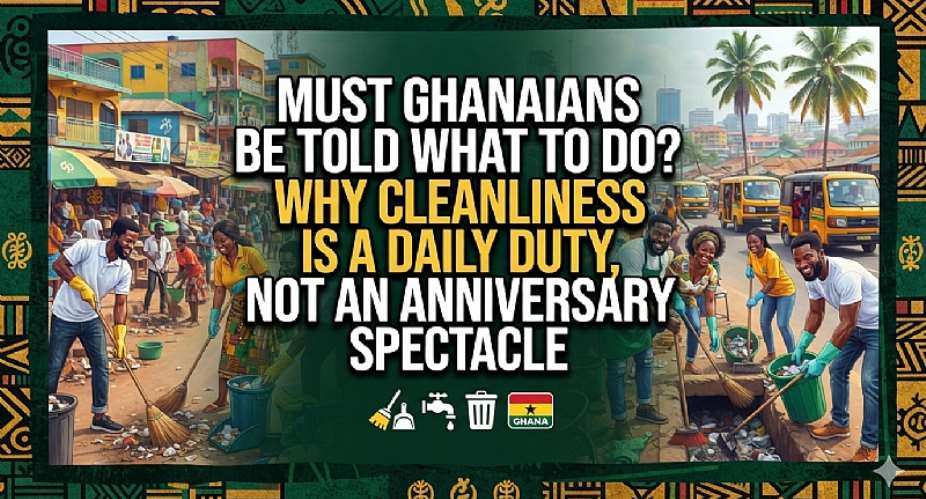
The Crisis of the Ghanaian Conscience and the Failure of Leadership
No sane adult needs a national radio broadcast to remind them to brush their teeth, take a bath, or flush a toilet. These are instinctive, routine habits of civilized human beings. Yet, the moment Ghanaians step out of their front doors, our collective sense of decency and civic pride utterly vanishes. Let us stop sugarcoating the truth: Ghana does not have a sanitation problem; it has a citizenship problem compounded by a catastrophic collapse of local governance.
We have reduced basic hygiene to a ceremonial event—a cheap public relations stunt reserved for ministerial declarations, national sanitation days, and television cameras. True civilization is what citizens do when nobody is watching. The day we stop treating cleanliness like an annual anniversary and start treating it as a non-negotiable daily obligation is the day our nation will truly transform. We do not need a single new law. Our local assembly bylaws are already gathering dust in lavish municipal offices. What we need is an end to the laziness, the filth, and the toxic mentality that someone else—whether the government or Zoomlion—must clean up after us at every step, while overpaid local authorities look on with absolute apathy.
The Hotspots of Ignominy: Choking Under the Watch of Failing Assemblies
Look across our major urban centers, and the story is the same: absolute environmental lawlessness met with total indifference from the political elites running our local assemblies.
- Accra’s Circle and Agbogbloshie Nightmare: In our capital city, the Accra Metropolitan Assembly (AMA) and surrounding municipalities have turned a blind eye to the literal mountains of filth clogging the Odaw river and the Kwame Nkrumah Interchange. Traders and residents dump refuse with impunity, waiting for the next flash flood to drown the city before anyone pretends to care.
- Kumasi’s Bantama and Central Market Chaos: The Garden City has been systematically stripped of its glory. The Kumasi Metropolitan Assembly (KMA) watches idly as plastic waste takes over Bantama, and parts of the Central Market turn into open-air dumpsites, prioritizing political correctness over strict law enforcement.
- Tamale’s Aboabo Drain Crisis: In the Northern Region, despite Tamale's reputation for wide streets, vital infrastructure like the Aboabo drain has become a hazardous choke point for filth. The Tamale Metropolitan Assembly seems content to wait for non-governmental organizations to intervene rather than using its legal powers to penalize offenders.
The Core Realities of Our Sanitation Decay
To understand why our cities are suffocating in garbage, we must confront the uncomfortable truths about our current societal attitudes and political cowardice:
- The Zoomlion Dependency Syndrome: Citizens now litter with absolute impunity under the absurd assumption that private waste management contractors are paid to follow them around like personal maids to pick up their trash.
- The Political Cowardice of MMDAs: Chief Executives of Metropolitan, Municipal, and District Assemblies (MMDAs) refuse to enforce the law because they are terrified of losing votes. They tolerate filth to protect their political survival, turning a blind eye to traders blocking drains with kiosks.
- The Death of Civic Pride: We have become a hypocritical people who keep our individual rooms immaculate while treating our immediate neighborhoods, gutters, and public spaces as open-world dumping grounds.
- Total Enforcement Paralysis: MMDAs possess all the legal powers required to arrest, fine, and jail environmental offenders today, yet they choose administrative inertia and bureaucratic laziness.
Strategic Recommendations and Suggestions
We cannot beg, plead, or pray our way into a clean country. Change will only happen when bad behavior meets immediate, painful consequences, and when local assemblies are forced to do the jobs they are paid for:
- Enforce Existing Assembly Bylaws Without Political Fear: MMDAs must stop looking the other way. The laws are already in the books. Arrest and prosecute landlords without household toilets and those who dump refuse in drains during rainstorms.
- Deploy Aggressive, On-the-Spot Sanitation Fines: Introduce a strict, swift ticketing system for littering. If someone drops a plastic wrapper or water sachet on the streets of Accra, Kumasi, or Tamale, they must face an immediate, heavy financial penalty on the spot.
- Enforce the "Clean Your Frontage" Mandate with Zero Tolerance: Every landlord, homeowner, and shop operator must be held legally and financially responsible for the cleanliness of the gutters and pavements directly in front of their property. If the gutter in front of your shop is choked, your business should be shut down immediately.
- Bring Back and Weaponize the "Saman Saman" Inspectors: Re-resource and deploy a modernized version of the traditional sanitary inspectors. Empower them with the authority to conduct unannounced house-to-house and shop-to-shop hygiene audits, free from political interference.
- Dismantle Performative Sanitation Campaigns: Shift state funding away from heavily publicized, one-off cleanup exercises that only serve as photo opportunities for politicians. Redirect those resources into sustainable, daily municipal waste collection infrastructure and enforcement.
A Call to Mature Citizenship and Accountable Leadership
A nation that requires occasional announcements to remind grown adults to clean their surroundings is a nation in a state of moral and civic regression. Keeping Ghana clean is not a task we can outsource to a contractor, nor is it a favor we do for the government. It is the basic price of admission for living in a civilized society.
We must shatter the illusion that filth is someone else’s problem to solve. Our local assemblies must wake up from their slumber, stop coddling lawbreakers for votes, and ruthlessly enforce the bylaws. Until we accept that cleanliness is a personal, daily, and quiet obligation, Ghana will remain trapped in dirt, regardless of how many new laws we pass. True patriotism starts with the trash you refuse to drop on the ground, and true governance starts when assemblies punish those who do.
✍️ Retired Senior Citizen
For and on behalf of all Senior Citizens of the Republic of Ghana 🇬🇭
Teshie-Nungua
[email protected]


 US senator and Trump ally Lindsey Graham dies after 'brief and sudden illness'
 Trump and Iran's supreme leader trade threats as mediators try to save deal
 More than 1 million evacuated as Typhoon Bavi makes landfall in China
 'They took the mud from the gutters and put them on the streets' – Kofi Bentil f...
 Susu Collector arraigned for allegedly defrauding 35 traders of GH¢156,455
 Migration dream turns sour as Ghanaian teacher battles debt and visa crisis in T...
 South Africa World Cup midfielder Jayden Adams dies aged 25
 Former Akan NPP PC pays GHS105,000 as T&T for 1,012 delegates ahead of constitue...
 One injured, three arrested as violence mars NPP Bantama Constituency elections
 GAC raises alarm over rising HIV infections among homosexuals in Bono Region

