




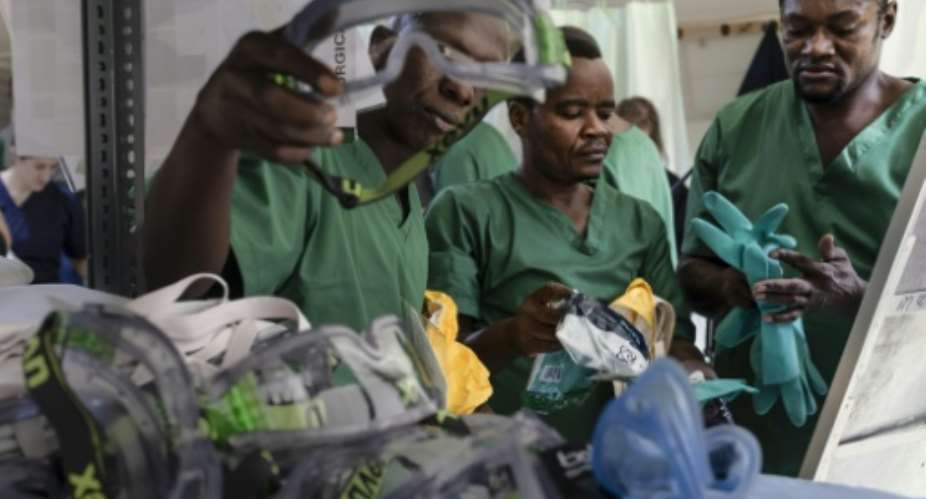
An Ebola training facility set up by Doctors Without Borders in Kenya is a chance for health workers to prepare for one of the most complex emergencies they are ever likely to face.
The outbreak in Democratic Republic of Congo (DRC) is the fastest growing ever, according to African health officials, and has claimed at least 600 lives since it was declared in mid-May.
It is happening in a region plagued by extreme poverty and multiple armed groups, while misinformation about the disease has led some locals to avoid treatment, ignore safeguards, and even attack health workers.
Health workers make up 112 of the 1,759 confirmed cases in DRC, and 35 have died.
To help prepare for this extremely challenging environment, global charity Doctors Without Borders (known by its French acronym MSF) has set up a training centre in Kenya.
Equipped with beds, mannequins, a mock laboratory, and protective gear, the simulation centre prepares doctors, nurses, and clinicians for deployments in DRC, or from regional countries at risk from the spreading disease.
"Often, you come from a hospital and a university, you have knowledge and you think you can handle it," said one of the trainees, Cisse Papa Ndiaga, 43, an MSF doctor from Senegal, soon to be deployed in DRC.
"But once you're in PPE (personal protective equipment), it's a different story," he said.
Community engagement
Trainees learn how to deal with the community, conduct safe funerals, and prevent the stigmatisation of those who have recovered.
"One of the key things is to be able to get the communities to engage, to understand. But also to make sure that we have empathy and we... take the time to sensitise them," said Diana Corben, 37, a doctor with MSF's mission in Central African Republic.
It's also about knowing your own limits, she said.
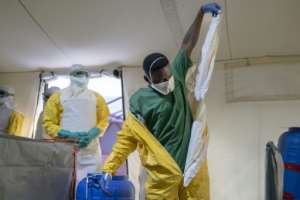 Health workers make up 112 of the 1,759 confirmed cases in DRC, and 35 have died. By Tony KARUMBA (AFP)
"We need to be very much aware of how much we can tolerate... what we're going to be put through," she said.
"This is a simulation... the reality is going to be that much more intense."
The centre began training in mid-June, and is running through to August and perhaps beyond, training around 100 people per month.
Most have been MSF staff so far, but the centre will also train Kenyan Ministry of Health officials and staff from other NGOs.
Ndiaga said he was somewhat more confident about his imminent deployment after the training.
"I'm not sure I'm ready... but I'm less scared," he said.

 Mahama Donates Medical Supplies, Flood Relief to 37 Military Hospital and Mamobi...
 Death toll in Venezuela quakes surpasses 4,000
 Typhoon Bavi forces Taiwan evacuations, batters Japan islands
 Nearly 50 abducted pupils, teachers rescued in Nigeria
 Those pushing third-term suit are plotting your downfall — Sammi Awuku to Mahama
 GES closes Yendi school temporarily after armed men attack over commercial shed ...
 Ashanti Region: Police investigate Chief Inspector over alleged rental of wooden...
 Recycling is the solution to Ghana’s sanitation crisis — Local Government Minist...
 Biggest typhoon in decades nears Taiwan after landslides kill 15 in Philippines
 Man nearly sucked out of 'detached' window on Ryanair flight

