




2014, Kantamanto Market, Accra: “Germans made this road in front of the hotel under Dr Kwame Nkrumah. It still looks like new. Never a problem with it. Rock solid.
Public transportation in Ghana is more expensive than in Germany. For workers to commute from home to their workplaces consumes more income than for a German. Public schools are poorly managed, having a reputation for failure. Parents pay for private schools a vast percentage of their income, knowing that only when their children pass these schools´ curricula, their chances later in life are far better to get employment or make it abroad, able to support them at old age and in times of financial troubles.
Good roads and infrastructure help farmers to see that their crops are not getting wasted. Manufacturing and industrial companies depend on cheap prices for power supply, well trained and motivated staff hard working, a mimimum of govermental intervention, fast tracking of needed paperwork in digital form, healthy workforce that can rely on good public health systems, access to affordable funding, free flow of goods and services locally, nationally and cross border, government promotion and lobbying as a framework around their core business, providing systems to trigger innovations, and a justice system as a professional referee of society.
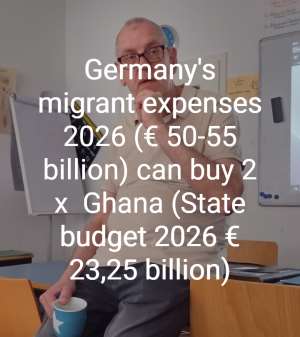
TAGG General Secretary Emmanuel Nana Opoku Acheampong has complained to the media outlet BulletTv Ghana (08.07.2026) that only 2 million Ghanaians pay tax. Like most African countries, Ghana has an informal economy with legal structures, rules and regulations in place. Poor Ghanaians argue that the little money they earn, if any, barely covers their monthly expenses. Annually, $ 3 billion is sent to Ghana from abroad by family members in the diaspora to support their loved ones back home. The state budget of Ghana for 2026 is € 23,21 Billion (Ghc 302,1 Billion) according to official figures available online. The high level of corruption and inefficiency of political, administrative and economic processes does not trickle down the money mentioned to benefit Ghanaians. Transparency and accountability with enforced consequences are not in place in Ghana merely a show on TV and social media, like „Bread and Butter“ games in ancient Rome. Democracy kills Mother Ghana for sure.
Anyone in any society wants value for money. The money Ghanaians spend on private kindergartens, private hospitals, private schools, lost on public transport and through corruption and inefficient processes can be collected as taxes and invested in proper infrastructure, public healthcare, schools, professional training, public transport, etc.
When Ghana's taxpayers and citizens are convinced to get a better life collectively by paying their fair share in taxes, they will rush to pay into the public systems and transform an informal society into a dream come true

 'We cannot continue to be a Bar of Accra, by Accra, for Accra' — Ghana Law Socie...
 Stop speculation, premature conclusions; allow investigation to determine Baffou...
 Judge halts Ex-NAFCO CEO's trial until ruling on seized phones
 Manhyia South MP who resisted arrest reports to EOCO a day after arrest warrant ...
 "Show us evidence" —Upper West teacher unions demand proof of payment before end...
 Adenta: Bolt driver jailed 25 years for cutlass attack and robbery of beautician...
 EOCO drags Manhyia South MP to former law firm, residence for search
 BNI investigates Yaw Ampofo Ankrah over alleged World Cup visa facilitation sche...
 Prof Emmanuel Osei Sarpong appointed Acting NSA Director-General
 NSA Boss Yaw Ampofo Ankrah suspended over US$623,000 World Cup visa allegations


