




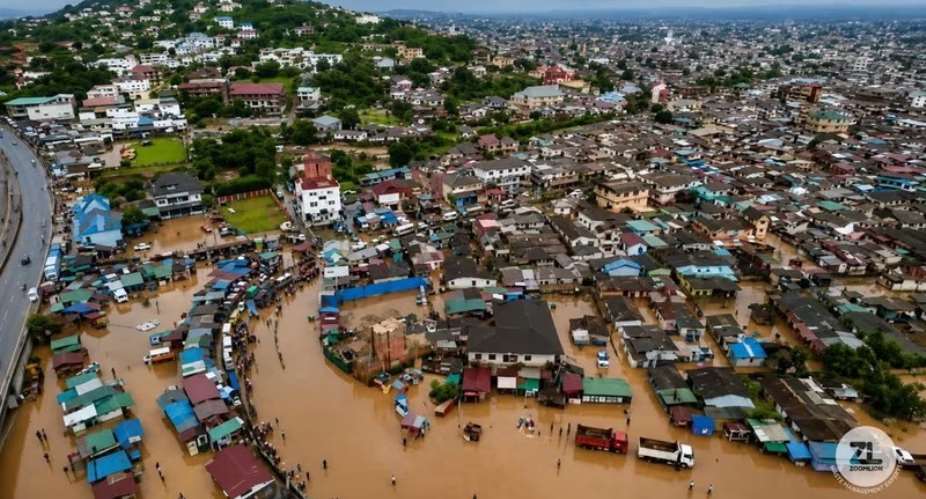
Accra has flooded again. While we often point to the intensity of the rainfall, it is time we have a more honest conversation about what is really happening beneath the surface. As an Environmental and Water Resources Engineer, I look at these scenes and see more than just a weather event; I see the predictable outcome of choices we have made.
Accra’s floods are not natural disasters; they are planning failures
Every time the skies open over Accra, the city grinds to a halt. We see the same devastating footage: submerged homes, stranded commuters, destroyed property, and, far too often, the tragic loss of human life. The public narrative quickly turns to the severity of the storm, as if nature alone is the culprit. But let us be clear: rainfall is a natural phenomenon. A flood disaster, however, is a human-made crisis. It is a failure to anticipate, accommodate, and manage the water that we know will fall. When I look at our city, I don’t just see rain; I see the legacy of decades of fragmented urban planning, neglected infrastructure, and the systematic erosion of our natural defenses.
The evidence is not hidden; it is everywhere
We have allowed our drainage channels to become choke points for plastic waste and sediment. We have treated our wetlands, our city’s natural shock absorbers, as empty land waiting to be filled and paved over. Buildings continue to rise within designated floodplains, often in direct defiance of regulations. By replacing permeable soil with vast stretches of concrete and asphalt, we have stripped the earth of its ability to absorb water, leaving the surface with nowhere to turn but into our streets and homes.
The Human Factor: A Crisis of Compliance
While the structural failures are clear, we must also have an honest conversation about our own role as citizens. No amount of engineering or sophisticated drainage systems can function if they are used as waste disposal sites.
The persistent practice of dumping refuse into drains, and the unchecked encroachment on natural waterways, is a form of civic indiscipline that turns minor drainage challenges into major catastrophes. When we discard plastic waste into gutters, we are effectively sealing the city’s fate before the first drop of rain even falls.
This is not just a government problem; it is a shared responsibility. We have a collective habit of bypassing sanitation regulations, assuming that our individual actions, a plastic bag here, a piece of construction rubble there, won’t matter. But in a city as densely populated as Accra, these individual choices aggregate into a city-wide system failure.
True flood resilience requires a social contract. The state must provide the necessary waste management infrastructure and enforce land-use laws, but as citizens, we must respect the function of our drainage systems. We cannot demand a flood-free city while simultaneously undermining the very infrastructure designed to protect us.
Moving Beyond Political Point-Scoring
Finally, we must recognize that flooding in Accra is a national headache, not a political football. For too long, the issue has been caught in the crosshairs of partisan rhetoric, with parties trading blame while the streets continue to submerge.
Let us be clear: flooding does not discriminate based on political affiliation. It destroys property and threatens the lives of citizens regardless of who they voted for. Using this tragedy to score cheap political points benefits no one and only serves to distract from the long-term, expensive, and often difficult technical work required to fix our city. We must stop treating flooding as a seasonal campaign tool and start treating it as a national emergency requiring a unified, nonpartisan, and sustained engineering commitment.
These are not acts of nature. They are decisions.
As an Environmental and Water Resources Engineer, I can no longer remain silent about the consequences of our unplanned urban expansion. While others may focus on the weather, the reality is that flooding in Accra is being managed as a seasonal emergency rather than the predictable, structural crisis that it is. We are trapped in a cycle of reaction when we should be operating in a state of foresight.
Climate change, of course, is a factor. More intense rainfall events are a reality we must navigate. But we cannot let climate change become a convenient scapegoat for failures that predate the current crisis. Many cities around the world handle similar, or even higher, rainfall volumes without the same level of catastrophic disruption. The difference is not in the clouds; it is in the systems built beneath them.
From Governance to Green Infrastructure
As an engineer, I view flooding as a governance issue as much as a hydrological one. We must stop thinking that building a drain after a disaster is a solution.
True resilience requires a paradigm shift:
Integrated Urban Water Management: We must move away from isolated, reactive drainage projects. Water management must be embedded into the core of urban planning and development, coordinating road construction and waste management so they work together as a single, functional system.
Adopting Nature-Based Solutions (NBS): Concrete alone cannot handle the volume of modern rainfall. We must prioritize “Blue-Green” infrastructure, restoring urban wetlands, creating flood-resilient parks, and utilizing permeable paving to naturally absorb and slow down surface runoff before it overwhelms our drains.
Rigorous Enforcement and Zoning Integrity: Engineering designs are useless if land-use laws are ignored. We need the political will to enforce “no-build” zones in floodplains and waterways. We must replace the culture of “permit-after-development’ with a system that prevents encroachment before it happens.
Accountability: When the same neighborhoods flood year after year, we must stop asking “what happened?” and start asking “who authorized this?” We need transparency regarding infrastructure priorities and rigorous enforcement of land-use regulations.
Flooding should not be accepted as a standard feature of life in Accra. It is not normal. It is not inevitable. And, most importantly, it is not solely the result of the rain. Until we dare to address the underlying structural and environmental failures that drive our vulnerability, we will remain trapped in this cycle of disaster and recovery.
The rain is the trigger, but poor planning is the architect of our catastrophe. It is time we change the blueprint.
 Police arrest alleged notorious land guard wanted over multiple criminal cases
 Alleged $8 million romance scam suspect Abu Trica extradited to United States
 Mahama announces maize processing factory for Sissala under Agro-Industrialisati...
 Mahama announces procurement process for new Wa Airport
 Former NAFCO CEO released by EOCO after airport re-arrest
 Bagbin refers constitutional amendment bill to committee following Council of St...
 'Ghana has been whether very apt or lucky to avoid terror attacks but threat rem...
 Regional Tribunal Bill will uphold human rights — A-G assures Ghanaians
 High Court injuncts Sunyani East NPP constituency election
 July 9: Cedi sells at GHS12.20 on forex market, GHS11.45 on BoG interbank

