




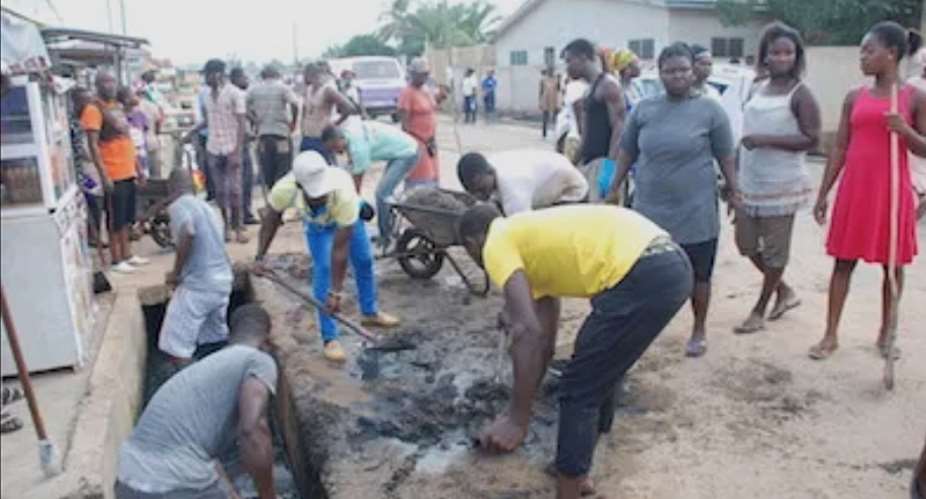
There was a time when communities across Ghana did not wait endlessly for governments before undertaking development projects.
Schools were built through communal labour, roads were maintained by residents, health centres were supported by local contributions, and bridges were repaired through the collective efforts of community members.
The spirit of self-help and communal responsibility was deeply rooted in our society.
Today, however, that culture is gradually fading.
Many communities have become overly dependent on government interventions, political promises, and external assistance. While governments have a constitutional duty to provide infrastructure and essential services, experience has shown that relying solely on government has often delayed development and left many communities struggling with poor roads, inadequate schools, insufficient healthcare facilities, and limited economic opportunities.
Development is a shared responsibility. Governments alone cannot meet every developmental need at the same time. Limited national resources, competing priorities, bureaucratic processes, changes in government, and economic challenges often delay the implementation of projects.
Consequently, communities that choose to wait indefinitely for government intervention may lose valuable years that could have been used to improve the lives of their people.
One of the greatest setbacks facing many communities is the cycle of political promises. Election campaigns frequently come with assurances of roads, schools, hospitals, irrigation projects, and employment opportunities.
While some promises are fulfilled, many remain uncompleted or are abandoned due to funding constraints, policy changes, or shifting political priorities.
In some cases, projects initiated by one administration are delayed or discontinued by another, leaving communities with incomplete infrastructure and stalled development.
This reality should not discourage citizens from demanding accountability from their leaders.
Rather, it should encourage communities to complement government efforts by taking initiatives that are within their own capacity.
Education is one area where community participation can make a remarkable difference. Parents, old students, local businesses, traditional authorities, and residents can come together to construct classroom blocks, provide desks and furniture, renovate dilapidated school buildings, establish libraries, support teachers' accommodation, and create scholarship schemes for brilliant but needy students.
Such investments directly improve educational outcomes and prepare the next generation for national development.
Healthcare is another sector that requires active community involvement. Communities can mobilise resources to support the construction of Community-based Health Planning and Services (CHPS) compounds, maternity wards, staff accommodation, waiting areas, boreholes, and sanitation facilities. Organising periodic health screening exercises and promoting preventive healthcare campaigns can also complement government efforts while improving the wellbeing of residents.
Agriculture, the backbone of many rural communities, equally benefits from collective action. Community members can establish irrigation schemes, construct warehouses for produce storage, rehabilitate feeder roads, support farmer cooperatives, and invest in shared agricultural equipment. Such initiatives improve productivity, increase household incomes, and strengthen food security.
Road infrastructure remains one of the greatest obstacles to rural development. Although major highways require government funding, communities can still organise communal labour to maintain feeder roads, repair small bridges, clear drainage systems, and construct simple culverts.
Better roads improve access to schools, health facilities, farms, and markets, while reducing transportation costs and encouraging local economic activity.
Communities can also work together to improve access to clean water, sanitation, environmental cleanliness, and public safety. These are areas where local commitment often produces immediate and lasting benefits.
Perhaps the greatest advantage of communal participation is the sense of ownership it creates. People are more likely to protect, maintain, and preserve projects that they helped to build. Public facilities cease to be viewed as government property and instead become community assets that everyone has a responsibility to safeguard.
This does not absolve government of its responsibilities.
Public officials must continue to honour their commitments, use public resources responsibly, and ensure equitable distribution of development across the country.
Citizens have every right to demand accountability and efficient delivery of public services. However, meaningful development is achieved when governments and citizens work together rather than depending entirely on one another.
Traditional authorities, assembly members, youth groups, women's associations, religious organisations, professionals, business owners, and philanthropists all have important roles to play in mobilising resources and inspiring volunteerism within their communities.
The future of our communities should never be held hostage by delayed budgets, political transitions, or unfulfilled campaign promises. Progress begins when people recognise that they possess the collective strength, skills, knowledge, and determination to solve many of their own challenges.
The time has come to revive the culture of communal labour, self-help, and shared responsibility. If every community commits itself to supporting projects in education, healthcare, agriculture, roads, water, and sanitation, the pace of development will increase significantly. Communities that invest in themselves not only improve the lives of their people but also become more attractive to government support, development partners, and private investors.
The message is simple: government intervention remains essential, but community participation is equally indispensable. Sustainable development will always flourish where citizens choose to unite, contribute, and take ownership of their collective future.

 Police arrest alleged notorious land guard wanted over multiple criminal cases
 Alleged $8 million romance scam suspect Abu Trica extradited to United States
 Mahama announces maize processing factory for Sissala under Agro-Industrialisati...
 Mahama announces procurement process for new Wa Airport
 Former NAFCO CEO released by EOCO after airport re-arrest
 Bagbin refers constitutional amendment bill to committee following Council of St...
 'Ghana has been whether very apt or lucky to avoid terror attacks but threat rem...
 Regional Tribunal Bill will uphold human rights — A-G assures Ghanaians
 High Court injuncts Sunyani East NPP constituency election
 July 9: Cedi sells at GHS12.20 on forex market, GHS11.45 on BoG interbank

