




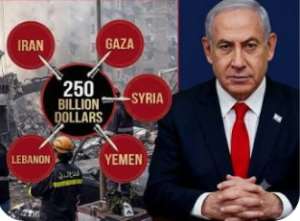
Nearly three years after Hamas's October 7, 2023 attack triggered the deadliest and most expensive military period in Israel's modern history, the bill has crossed a threshold that few in Jerusalem anticipated at the outset. According to a report by Zman Yisrael, the Hebrew-language service of The Times of Israel, citing Bank of Israel data, the combined economic cost of Israel's wars in Gaza, Lebanon, Syria and Iran since October 7 has reached nearly 205 billion dollars, making it, by a wide margin, the costliest conflict period in the country's history.
Breaking Down the Bill
The Bank of Israel figures paint a picture of a state whose finances have been reshaped by more than two years of continuous multi-front warfare. Direct government expenditure on the wars has exceeded 118 billion dollars. Of that, defence spending alone accounts for roughly 71.2 billion dollars, while compensation payments to affected citizens and businesses have reached 9.6 billion dollars. Civilian expenditures tied to the war effort, covering everything from evacuee housing to emergency services, stand at 16.7 billion dollars, and interest costs linked to the sharp rise in public debt taken on to finance the war add a further 5.5 billion dollars.
Beyond direct state spending, the report places the value of American weapons, ammunition and military equipment supplied to Israel since October 7 at around 26 billion dollars. Lost economic output is the third major component of the total. Between October 2023 and the end of 2025, the Israeli economy is estimated to have forfeited around 51.9 billion dollars in production, a figure the report projects could exceed 58.6 billion dollars once developments through 2026 are fully accounted for. Combining government expenditure, American military aid and lost production yields the near 205 billion dollar total.
Crucially, the report cautions that this figure does not capture individual losses left uncovered by the state or the full scope of private-sector damage, meaning the real economic toll to Israeli society is almost certainly higher, and will continue climbing for as long as the conflicts persist.
A Widening War, A Widening Bill
The 205 billion dollar estimate reflects a conflict that has expanded well beyond its starting point in Gaza. What began as a retaliatory campaign following the October 7 attack, in which Hamas killed roughly 1,200 people in Israel and took hostages, broadened over the following two years into a campaign against Hezbollah in Lebanon, strikes tied to the fall of the Assad government in Syria, and, most consequentially for the cost curve, a major escalation with Iran that began in early 2026 under what Israeli officials termed Operation Roaring Lion.
That confrontation alone was estimated at points to be costing Israel in the region of 200 million dollars per day, driven heavily by the economics of missile interception, with individual interceptor costs ranging from 700,000 to 4 million dollars against Iranian barrages that at times reached 400 missiles a day.
The fiscal consequences have been structural rather than temporary. Israel's debt-to-GDP ratio, once a stable 60 percent, has climbed to around 69 percent. Defence spending, which peaked at nearly 8 percent of GDP in 2024, has remained elevated, and the 2026 state budget, recently raised to 144 billion shekels, leaves little room for non-military priorities. To help cover the shortfall, Israel raised its value-added tax to 18 percent and eliminated a range of tax exemptions, changes that have squeezed middle-class households and weighed on small and medium-sized businesses already contending with a workforce disrupted by the prolonged mobilization of reservists.
The Human and Regional Cost Behind the Numbers
The financial figures sit alongside a devastating human toll that gives the spending its grim context. Gaza's Health Ministry and independent researchers have put the Palestinian death toll from Israel's campaign at more than 72,000, with some estimates running higher, alongside mass displacement and, according to United Nations officials, famine conditions that emerged in parts of the territory in 2025.
The United Nations has estimated that rebuilding Gaza, where the majority of buildings have been destroyed, could take decades and cost in the region of 70 billion dollars, a reconstruction bill that sits entirely outside Israel's own 205 billion dollar tally and will fall instead to Palestinian institutions and the international donor community.
Washington's own financial exposure has grown in parallel. Brown University's Costs of War project at the Watson Institute has tracked at least 21.7 billion dollars in direct US military aid to Israel since October 7, on top of billions more spent on US military operations across the wider Middle East, including the Navy-led campaign against Houthi attacks on shipping in the Red Sea. Separate American analysis of the 2026 Iran war alone projects that the United States could face a bill ranging from 200 billion dollars to as much as 1.1 trillion dollars by 2030, depending on whether the accounting includes long-term liabilities such as veteran care and war-debt interest, underscoring how a conflict that began in Gaza has drawn in costs far beyond Israel's own borders and balance sheet.
An Economy Under Permanent Strain
Israeli officials and economists increasingly describe the country as operating on a permanent war footing rather than moving through a temporary emergency. The Bank of Israel now forecasts 3.8 percent growth for 2026, a recovery from the sharp 19.4 percent annualized contraction recorded in the fourth quarter of 2023, and the shekel has held its value even as inflation has moderated to around 2 percent. Israel's hi-tech sector, still accounting for more than half of national exports, has proven resilient, with 2025 tech buyouts and mergers reaching a record 10.5 billion dollars, driven in part by international interest in what is being marketed as battle-tested defence technology.
Yet resilience is not the same as recovery. Construction and agriculture remain in semi-paralysis due to the continued exclusion of Palestinian workers from the Israeli labour market, a gap foreign labour has not filled, and housing starts have stalled even as home prices climb. As one Israeli economic analysis put it, the country's economy has survived its most significant stress test without collapsing, but for a nation that once aspired to lead the OECD in innovation, merely not collapsing is a low bar. With no clear end to hostilities across Israel's northern and eastern fronts, and with the twenty-sixth Knesset elections due no later than October 2026, the near 205 billion dollar bill accumulated since October 7 looks less like the final cost of a war and more like a running total that Israeli taxpayers, and by extension the wider region, will continue to pay for years to come.
Mustapha Bature Sallama.
Medical/ Science Communicator,
Private Investigator, Criminal investigation and Intelligence Analysis.
International Conflict Management and Peace Building.USIP
[email protected]
+233-555-275-880
References
The Times of Israel, "Total cost of war expected to amount to more than NIS 200 billion, Bank of Israel says," https://www.timesofisrael.com/liveblog_entry/total-cost-of-war-expected-to-amount-to-more-than-nis-2-billion-bank-of-israel-says/
TRT World, "Cost of Israel's wars since October 7 nears $205B: report," July 2026, https://www.trtworld.com/article/19b37e2a81f3
TRT World, "Iran war could cost economy about $3B a week: Israel," https://www.trtworld.com/article/5ae351181754
Al Jazeera, "The cost of genocide: Israel's war on Gaza by the numbers," February 2026, https://www.aljazeera.com/news/2026/2/19/the-cost-of-genocide-israels-war-on-gaza-by-the-numbers
Haaretz, "What Did Israel's Longest and Most Expensive War Really Cost?" January 2026, https://www.haaretz.com/israel-news/2026-01-03/ty-article-magazine/.premium/what-did-israels-longest-and-most-expensive-war-really-cost/0000019b-801e-dd73-abff-92de43150000
The Jerusalem Post, "Debt, defense, and disruption: The true cost of Israel's multi-front war," April 2026, https://www.jpost.com/jerusalem-report/article-892431
Al Habtoor Research Centre, "The Direct and Indirect Cost of the 2026 US-Israel War on Iran," https://www.habtoorresearch.com/publications/cost-of-us-israel-war-on-iran/
Costs of War Project, Watson Institute, Brown University, "United States Spending on Israel's Military Operations and Related US Operations in the Region," https://costsofwar.watson.brown.edu/sites/default/files/papers/Costs-of-War_US-Support-Since-Oct7-FINALv2.pdf
Arab Center Washington DC, "The Estimated Cost of the Gaza War on the Israeli Economy," https://arabcenterdc.org/resource/the-estimated-cost-of-the-gaza-war-on-the-israeli-economy/
Common Dreams, "Israel's War on Gaza and Beyond Has Cost US Taxpayers At Least $22.76 Billion: Report," October 2024, https://www.commondreams.org/news/costs-of-war-project-israel


 Nurse rescues mother and baby after unplanned delivery in bush
 McCarthy-Mallam road rehabilitation begins amid commuters’ complaints of heavy t...
 TOR briefs IMF on recovery efforts, inherited debt and sustainability plans
 Aseidu Nketia urges NDC contestants to unite after constituency elections
 EC yet to announce Dormaa Central NDC constituency results
 Baaba Cann questions Obuasi SHTS handling of sexual misconduct allegations again...
 Obuasi SHS headmaster case: “It is better to pay for sex with prostitute than ra...
 NDC not worried about NPP’s Kojo Bamba, he is small boy – Azorka
 Obuasi SHTS: 'Children are not buffet' – NPP’s Fatimatu confronts Zuba
 Resource exploitation fuelling Africa’s conflicts – Mahama


