




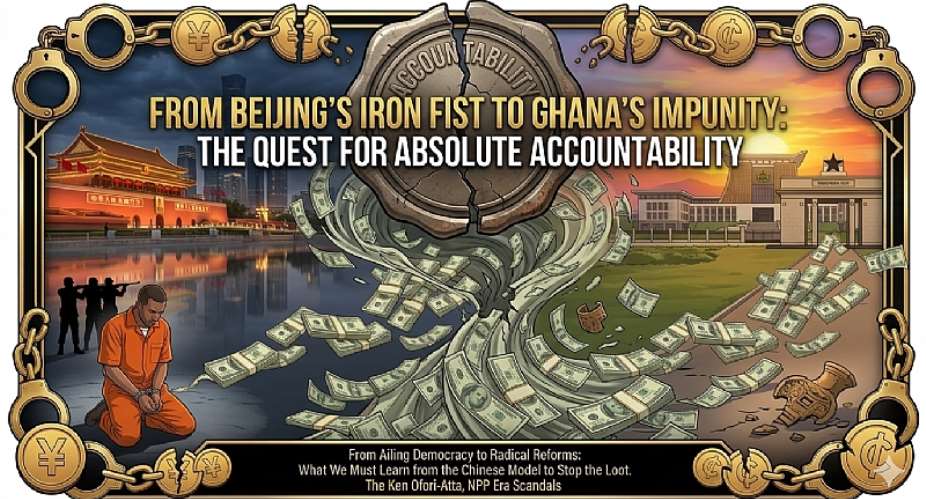
How the Death Penalty of Yang Youlin Exposes the Flaws of the NPP Era and the Quest for Uncompromising Accountability in the Fourth Republic.
A viral social media image depicting a Chinese official sentenced to death has sparked widespread conversation across Ghana. The man in the video is Yang Youlin, a former municipal official in Nanjing, China, who was handed a flat death sentence for accumulating over 2.2 billion yuan ($325 million USD) in bribes through engineering contracts and land transfers. For many Ghanaians, watching a global superpower enforce absolute accountability on its ruling elite triggers a profound sense of introspection.
As Ghana transitions into a new political chapter following the exit of the New Patriotic Party (NPP) administration led by President Nana Addo Dankwa Akufo-Addo and Dr. Mahamudu Bawumia, citizens are left evaluating the country’s own battle with systemic corruption. The staggering scope of allegations—most notably surrounding former Finance Minister Ken Ofori-Atta—has led to a rising, dangerous skepticism among the populace: Is Western democracy failing Africa, and does Ghana need a more authoritarian approach to justice?.
This article investigates the state of criminal malfeasance under the Akufo-Addo-Bawumia era, compares Ghana’s democratic accountability to international models, and maps out a definitive path forward to restore faith in the Fourth Republic.
The Anatomy of Malfeasance: The Akufo-Addo-Bawumia Legacy
While China acts with swift severity, Ghana’s democratic institutions have long been accused of slow, highly politicized responses to high-level corruption. The legacy of the previous administration is heavily defined by structural financial leakage, culminating in major legal actions:
- The Ken Ofori-Atta Fugitive Crisis: Former Finance Minister Ken Ofori-Atta, a central figure of the NPP government, was officially declared a fugitive by Ghanaian authorities after refusing to cooperate with the Office of the Special Prosecutor (OSP). He currently faces 78 corruption-related charges involving conspiracy and procurement violations.
- The Strategic Mobilization Ghana Limited (SML) Scandal: A primary driver of Ofori-Atta’s criminal summons is the controversial contract awarded to SML by the Ghana Revenue Authority (GRA). Prosecutors allege that over $1 million in state funds were disbursed without any proof of performance or legal procurement compliance.
- The National Cathedral and Disappearing Funds: The OSP's ongoing investigations also target massive financial irregularities tied to the National Cathedral project, a flagship initiative heavily championed by the executive but plagued by unverified procurement processes.
- Extradition and International Apprehension: Highlighting the globalized nature of Ghanaian corruption, Ofori-Atta was placed on an Interpol Red Notice and subsequently detained in Virginia by U.S. Immigration and Customs Enforcement (ICE) over status issues, while Ghana formally pursues his extradition.
- Stagnant Global Standings: Despite the creation of heavily funded oversight bodies, Transparency International’s Corruption Perceptions Index (CPI) shows Ghana's score has plateaued around a mediocre 43 out of 100 for over half a decade, demonstrating a complete failure to curb public-sector looting.
Democracy vs. Authoritarianism: Does Africa Need the "China Model"?
The swift execution of Yang Youlin often makes citizens look toward China's model with envy. However, equating authoritarian brutality with genuine justice is a dangerous trap.
- The Flaw of the Autocratic Model: In China, anti-corruption crackdowns are highly centralized. While billions are recovered, the system lacks transparency, and trials are often used by the ruling party to purge political rivals rather than protect human rights.
- The International Evidence: True accountability does not require firing squads; it requires unyielding institutional independence. Nations like Singapore and Denmark consistently rank as the least corrupt globally. They achieve this not through capital punishment, but through absolute transparency, automated public procurement, and completely autonomous judiciaries.
- The African Standard: Within Africa, countries like Seychelles, Cabo Verde, and Rwanda outpace Ghana on the CPI. Their success proves that strong governance, strict enforcement, and political will—not the abandonment of democratic freedoms—are the real solutions to African corruption.
Strategic Recommendations for Ghana
To bridge the gap between public frustration and institutional inertia, Ghana must radically reform its legal and anti-corruption architecture:
- Decouple the Ministry of Justice from the Attorney General: The current constitutional framework allows a political appointee to control public prosecutions, creating an inherent conflict of interest when investigating state actors. The Attorney General must become a fiercely independent, non-partisan office.
- Fully Operationalize Specialized Anti-Corruption Courts: To prevent high-profile figures from using infinite legal technicalities to delay trials, Ghana must finalize and utilize fast-tracked, specialized judicial divisions dedicated strictly to financial crimes.
- Enforce Complete Legislative and Oversight Separation: Parliament must ban the practice of appointing sitting Members of Parliament to executive ministerial roles, which completely dilutes the legislature's ability to police the executive branch.
- Enact Strict Political Party Financing Laws: Illicit wealth accumulation in Ghana is deeply tied to the exorbitant costs of political campaigning. Introducing state audits and strict caps on private political donations will reduce the immediate post-election urge to "recover campaign investments" via state contracts.
- Strengthen Asset Forfeiture Systems: Initiatives like the newly formed Operation Recover All Loot must be legally insulated from political interference. If a state official cannot explain the source of their wealth, those assets must be systematically frozen and returned to the state ledger.
The frustration felt by everyday Ghanaians is entirely justified. When state coffers are hollowed out by elite malfeasance, it is the ordinary citizen who pays through collapsing public infrastructure, a devalued currency, and diminished livelihoods. However, the solution to Ghana's governance crisis is not to wish for the execution squads of Beijing, nor is it to declare that Western democracy is fundamentally unsuited for the African continent.
Democracy itself is not the problem; the systematic weaponization of democratic loopholes by an untouchable political class is. The ongoing global pursuit of fugitives like Ken Ofori-Atta serves as a critical litmus test for the Fourth Republic. If Ghana’s legal systems can successfully prosecute top-tier political actors regardless of their family ties or partisan weight, public trust will be restored. True justice does not look like an autocracy; it looks like a democracy where the law applies equally to the street vendor in Accra and the Finance Minister in the Jubilee House.
✍️ Retired Senior Citizen
For and on behalf of all Senior Citizens of the Republic of Ghana 🇬🇭
Teshie‑Nungua
[email protected]


 Netanyahu warns US could 'destroy' Mideast power balance as Trump floats F-35 je...
 Anyone who uses the Bible to preach is not from God - Osofo Kyiri Abosom
 Police bust 44 suspects supplying narcotic products to University students in Ku...
 IMF appoints Silvana Tenreyro as new Chief Economist
 World Cup 2026: Switzerland beat Colombia on penalties to set up Argentina quart...
 Auditor-General reveals how GH¢7.4m was paid to four dead pensioners from 2019 t...
 Drug informants demand houses, money before sharing intelligence – NACOC
 Interior Minister reveals how some people within the system were involved in met...
 GRA hands over confiscated 18 diverted truckloads of cargo to School Feeding Pro...
 Farmers can only cultivate industrial cannabis – Interior Minister

