




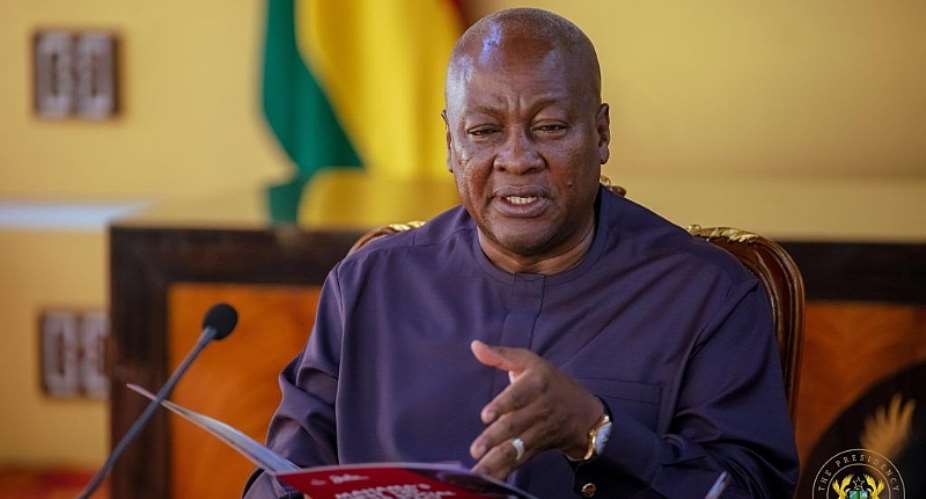
President John Dramani Mahama has directed the Ministry of Education to review a petition submitted by the African Chamber of Content Producers (ACCP), which is advocating the introduction of mandatory constitutional literacy in Ghana’s basic education curriculum.
The directive was contained in a letter dated July 2, 2026, signed by the Secretary to the President, Dr. Callistus Mahama, and addressed to the Minister of Education. A copy of the letter was also sent to the ACCP Secretariat.
According to a statement issued in Accra, the Presidency acknowledged receipt of the petition, which was submitted on June 25, 2026, and instructed the Ministry to examine the proposal and take the necessary action.
“The Ministry is requested to review the petition and take appropriate action on the petition,” the letter stated.
The President’s response came barely a week after the ACCP petitioned the government to make constitutional literacy a compulsory component of the country’s education system.
The Chamber argued that the long-standing legal principle that “ignorance of the law is no excuse” should be accompanied by a corresponding obligation on the state to educate citizens on the Constitution—the supreme law that governs the nation.
According to the ACCP, the proposal is grounded in research conducted across schools, prisons and communities in Ghana and several other African countries, rather than abstract legal theory.
The research, the Chamber said, revealed that many citizens complete their basic education without ever reading or studying the Constitution, yet remain subject to prosecution for breaching laws they were never formally taught.
The ACCP disclosed that interviews conducted with inmates in Ghana, Nigeria, Liberia, Uganda and Zimbabwe found that more than half of those surveyed said they were unaware that their actions constituted criminal offences at the time they were committed. Only about 10 percent admitted they knew their actions were illegal but proceeded regardless.
The study also found that more than 60 percent of junior high school students surveyed had never received any formal instruction on their country's Constitution.
Among adults interviewed, over 70 percent indicated they had never read any portion of their national Constitution, while more than 80 percent said they simply tried to avoid situations that could lead to legal problems because they lacked knowledge of the law.
According to the Chamber, these findings expose a contradiction in the justice system, where citizens are expected to know and obey laws they have never been systematically taught.
Reacting to the President’s directive, ACCP President Nana Dwomoh-Doyen Benjamin commended President Mahama for responding promptly to the petition.
“We are immensely grateful that President Mahama is a listening President, one who is ready to act in the interest of the state and its people,” he said.
He added that the President’s swift action demonstrated an appreciation of the importance of constitutional education.
“The principle that ignorance of the law is no excuse cannot be used to punish citizens for a failure that belongs to the state. The President has shown that he is willing to close that gap. This is leadership in action,” he stated.
The Chamber’s Head of Research and Development, David Adofo, also reiterated the organisation’s belief that constitutional education should form part of every Ghanaian child's academic development.
“Content is what shapes personality and perception. If ignorance of the law is not an excuse, then knowledge of the law must become an essential part of the educational content delivered to every Ghanaian child from basic school through senior high school,” he said.
He expressed optimism that the initiative could eventually influence civic education reforms across Africa, particularly as President Mahama prepares to assume the Chairmanship of the African Union in 2027.
Africa Image Ambassador and award-winning casting director, Mawuko Kuadzi, also welcomed the President’s decision, describing it as a significant step toward empowering young Africans with legal knowledge.
He pledged to use platforms such as the Africa Monologue Challenge to promote constitutional literacy and support related advocacy initiatives across the continent.
The ACCP’s petition outlines five key proposals, including making constitutional literacy compulsory from basic through senior high school, introducing constitutional and civic education as examinable subjects at both the Basic Education Certificate Examination (BECE) and the West African Senior School Certificate Examination (WASSCE), producing simplified and illustrated versions of the Constitution for younger learners, establishing an annual National Constitutional Literacy Day, and increasing budgetary support for the National Commission for Civic Education (NCCE) and the Information Services Department (ISD) to expand civic education.
The Chamber has also offered to support the implementation of the proposed reforms through its Africa Image Ambassador Programme and its educational wing, African Progressive Research and Innovations (APRIL), by producing youth-friendly educational materials, training teachers and supporting nationwide civic education campaigns.
With the petition now before the Ministry of Education, the government is expected to assess the proposals and determine the appropriate implementation framework.
The ACCP has reiterated its readiness to collaborate with the Ministry and other stakeholders to advance constitutional education in Ghana and, ultimately, across Africa.

 Chief Justice Baffoe-Bonnie is Mahama's surrogate to control the judiciary — Mar...
 Court gives OSP four more weeks to serve Ofori-Atta, Akore in US
 Dangote's $16bn Kenya refinery 'new chapter' for Africa
 Mahama to open national conference on housing finance
 NPP announces voter ID requirements for October 3 national conference
 Ghana rejects calls to abolish International Criminal Court , urges stronger act...
 September 30: Cedi sells at GHS12.20 on forex market, GHS11.70 on BoG interbank
 'Ghana is now training lawyers illegally' — Former Bar president
 Akyem Hemang residents demand justice for alleged military shooting of 29-year-o...
 Adenta-Accra morning travel time improves significantly in just 23 minutes under...


