




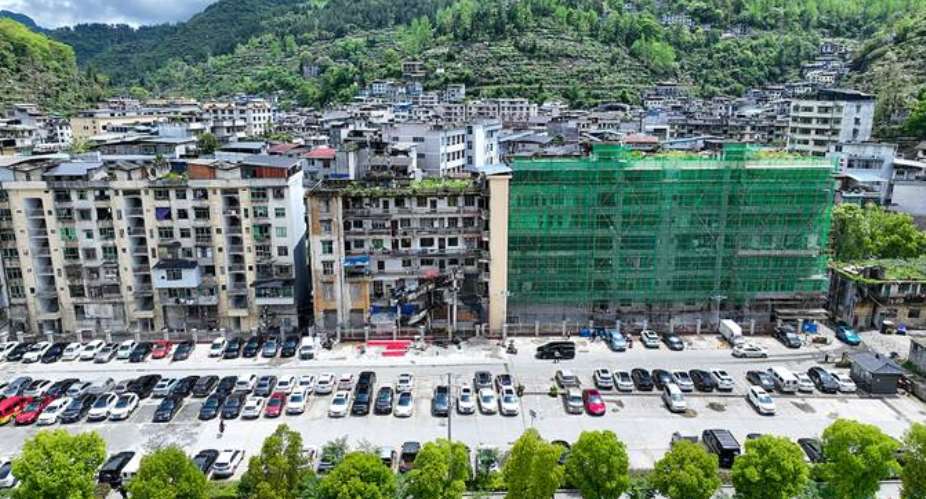
Stand in a Chinese metropolis like Beijing, and the visual contrast is immediate. Ancient cultural relics sit alongside hyper-modern skyscrapers, compressing centuries into a single frame. But step away from the tourist tracks and into the ordinary neighborhoods framing these monuments, and that romance quickly fades.
Layered city reality
In China, over 60% of residential compounds in the central districts of premier cities like Beijing and Shanghai were built before 2000 when urbanization started to accelerate. A similar reality is evident in Western cities, from New York, where 70% of residential units predate 1960, to London’s wealthy Kensington and Chelsea, where nearly half of the housing stock was built before 1900.
Troubles like deteriorating concrete, pipeline leaks, missing elevators, and jammed parking spaces often disrupted residents’ daily life. Also,legacy structures were not engineered for today’s environment much like the historic apartments of Europe that lack pre-designed cooling systems to withstand modern heatwaves this summer,
A new plan for a new future
Against this backdrop comes the latest urban renewal plan for 2026–2030, released this June. It is a precise continuation of the country’s ongoing five-year planning cycle, updated to tackle the urban hangover of aged communities in line with today's realities.
For the residential sector, the plan builds on a momentum that has already seen over 240,000 older communities renovated, stepping further to upgrade another 115,000 neighborhoods to improve daily life for millions of households nationwide. The priority is given to homes built before 2000, where the structural wear-and-tear is now most acute.
The strategy is far beyond cosmetic. One key move is from underground. That is approximately 770,000 kilometers of pipelines for gas, water, sewage, and heating. Once done, this massive pipeline network will not only make kitchens and bathrooms stronger, but also give cities the "breathing room" to absorb severe rainfall and prevent flash flooding that are getting more intense due to climate change. Along with the physical upgrade is digital infrastructure. This represents a functional smartness driven by an internet-of-things ecosystem, where embedded smart meters and neighborhood pressure sensors track water flow, gas levels, and fire safety in real time, feeding data directly into municipal command centers. As a result, cities can shift from reactive emergency repairs to predictive, data-driven maintenance. They are also the very infrastructure that is essential to enhancing the level of efficiency in use of energy and water.
The blueprint also targets public spaces and historic architecture and extends into the fabric of everyday urban life. Over the next five years, the plan aims to renovate 5,000 neighborhoods nationwide, with an emphasis on stitching public services—elderly care, childcare, and shared facilities—back into neighbourhood life. The idea is not just better housing, but better blocks: more pocket parks, more green space, more room for daily interaction in cities. It also targets surrounding infrastructure of daily life—reworking road networks to improve flow, adding parking capacity, and making short-distance movement within cities more efficient and predictable.
For industrial land, one focus is called "industry going upstairs", which dismantles the traditional assumption that manufacturing requires sprawling, single-story suburban sheds. In hyper-dense manufacturing hubs where new land is extremely scarce, local governments are helping enterprises expand vertically rather than horizontally. For instance, in Anhui Province, eastern China, Ma’anshan Shangdian Electrical Co consolidated its old plots and built upward, structurally reinforcing upper floors to withstand heavy industrial machinery loads of one metric ton per square meter. This engineering feat successfully doubled their usable floor space on the exact same geographic footprint.
Another key focus of the blueprint involves breathing life into underutilized industrial zones by transforming them into vibrant tourism or recreational hubs. Inspired by the pioneering success of Beijing's Shougang Park, where a massive, century-old steel mill was transformed into a bustling hub for sports, culture, and major exhibitions, the ArxanTaikang Art Center in Inner Mongolia follows a similar playbook. Once an abandoned thermal power plant, the local government creatively adapted the idle state asset by preserving its raw industrial elements rather than erasing them. Today, the old industrial shell breathes new life as a vibrant lifestyle landmark, housing contemporary exhibition halls, lecture spaces, a music venue, immersive science displays, and even a cozy café embedded directly within its historic machinery.
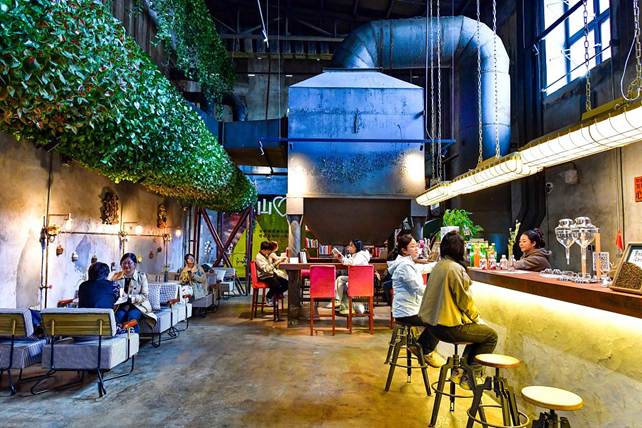
On May 18, 2026, tourists relax at the café in the Arxan Taikang Art Center. [Photo: cfp.cn]
While some former industrial sites unlock value through tourism-led reinvention, others hold historical and cultural significance that calls for preservation and continuity. In eastern China’s Jingdezhen, a city with over a thousand years of porcelain-making history and a dense legacy of historic kilns and traditional workshops, its Taoxichuan District has built on this manufacturing heritage to incubate more than 4,500 independent ceramic brands, drawing a vibrant community of over 33,000 young creators from across the country.
Jingdezhen is far from an isolated case; it is a vital part of a vast national tapestry that includes 145 designated historic cities, over 1,300 cultural districts, and some 72,000 recognized historic buildings across China. To manage a legacy of this scale without turning these vibrant areas into sterile, open-air museums, the overarching strategy has shifted toward what urban planners call "holistic preservation." The goal is to protect not just an isolated ancient temple or a standalone monument, but the entire historic fabric—the centuries-old street grids, the tight networks of traditional alleyways, and the broader skyline of the old town itself, ensuring that urban renewal honors historical continuity while fueling cultural prosperity.
Ultimately, the goal of China’s vast and complex urban renewal plan over the next five years is simple: to make transformation tangible in everyday life, and to ensure that the changing city delivers greater dignity, security, and a sense of belonging to its residents.
By Wang Yangyang, CGTN journalist based in Beijing covering China and global affairs.
 'There was no request for a state visit to Ghana' — South Africa clarifies over ...
 Assemblies accused of taking penalties instead of demolishing illegal buildings ...
 NACOC directs businesses dealing in precursor chemicals to obtain licences by Ju...
 Decision to defer Ramaphosa's visit a right one — Former Ghana High Commissioner...
 GNFS recovers body from flooded drain channel at Kpando
 BoG injects $2.01bn into forex market in June
 Police warn against unauthorised use of sirens, strobe lights on vehicles
 'Fake' — GES debunks statement announcing 2026 BECE results, school placement ex...
 Ex-Black Stars player Charles Taylor accuses GFA of abandoning him in US after f...
 Arthur Kennedy urges Supreme Court use case on delegates system of political par...

