




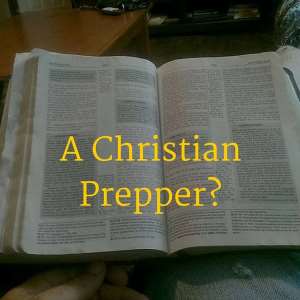
Let me ask you something, my friend, before you keep scrolling: when did "get right with God" start coming bundled with a discount code?
Because that is precisely the moment we are living in. Across America, the United Kingdom, and increasingly here in Africa through WhatsApp forwards and YouTube algorithms, a new kind of ministry has taken root — one where end-times prophecy, homestead survivalism, and wellness commerce are fused into a single, highly monetized package. Bunkers and Bible verses. Prayer altars and protein powders. Deliverance sessions and detox kits, all sold under the same banner of faith. I call it, for lack of a gentler term, prepper Christianity — and it deserves an honest look, not a dismissive one.
PART ONE: WHY THIS MOVEMENT EXISTS, AND WHY IT'S GROWING
We should not pretend this rose out of nowhere. The past five years have genuinely shaken people — a global pandemic, economic instability, wars in multiple regions, rapid technological change, and a general sense that institutions (governments, media, even churches) cannot always be trusted to tell the full truth. Into that vacuum steps a compelling figure: someone who claims direct revelation from God, positions themselves as having been right when the "establishment" was wrong, and offers both spiritual reassurance and a physical action plan — stock your pantry, buy this supplement, prepare your bunker, and above all, trust me because the mainstream lied to you before.
This is a powerful narrative, and I understand its appeal. Scripture itself does not shy away from apocalyptic language — the books of Daniel and Revelation are full of symbolic warnings about beasts, systems of control, and coming tribulation. Preachers who lean into this material are drawing on a real and ancient thread of Christian theology. That much is not in dispute.
PART TWO: WHERE IT BECOMES A PROBLEM
The trouble begins when specific, falsifiable medical claims get wrapped in the authority of prophecy — when "God showed me in a dream" is used to validate a drug dosage, a vaccine theory, or a supplement's effectiveness against a named disease. Prophecy and pharmacology are not the same category of truth claim, and collapsing them into one is dangerous, however sincere the person delivering the message may be.
Consider the pattern: a claim is made that a specific over-the-counter or prescription remedy cures a broad range of unrelated illnesses — viruses, cancer, autoimmune disease — with no distinction between conditions that share almost nothing in their biology. Reputable clinical trials on these exact claims, where they exist, generally have not supported such sweeping conclusions. That is not a matter of opinion; it is what the published research record shows. When a claim contradicts the weight of peer-reviewed evidence, sincerity of belief does not make it true, and audiences deserve to know that distinction clearly.
PART THREE: THE PARASOCIAL TRUST PROBLEM
Here is what makes this genre so effective, and so risky: audiences are not evaluating claims on evidence. They are evaluating them on relationship. If someone has prayed for you, prophesied over your life, or made you feel personally seen in a way institutions never did, you are far more likely to accept their next claim — about a virus, a vaccine, a supplement — without scrutiny. That is not stupidity on the listener's part. It is basic human psychology. We trust people who make us feel cared for. But that same trust can be, and sometimes is, redirected toward products, donations, and unverified medical advice.
PART FOUR: GHANA'S OWN VULNERABILITY
Now let me bring this home, because I do not write this column purely to critique America from a distance. Ghana has its own deep charismatic Christian tradition, an enormous and often unregulated pool of prophetic ministries, and a public health infrastructure that, frankly, many citizens already distrust — not without some historical reason. That combination is fertile ground for the same pattern to take root here: a trusted spiritual voice, a health claim wrapped in prophecy, a product to buy, and a congregation primed by genuine anxiety to accept all three without question.
We saw shades of this during COVID-19, when unverified cures circulated on Ghanaian WhatsApp groups faster than the Ghana Health Service could correct them. That should have been a warning shot. It is worth asking now, before the next crisis arrives: do our own church communities have the media literacy to separate a pastor's spiritual authority from a pastor's medical claims?
PART FIVE: TEST THE SPIRITS — A PRACTICAL TOOLKIT
This is why Scripture itself instructs us not to accept every claim at face value. The apostle John did not tell believers to swallow every spiritual message whole:
"Dear friends, do not believe every spirit, but test the spirits to see whether they are from God, because many false prophets have gone out into the world." — 1 John 4:1
Testing is not a lack of faith. Testing is obedience. Here is how to do it, practically, the next time a health claim lands in your family's WhatsApp group.
Red flag one: The claim covers too much ground. Be cautious of any remedy — herbal, pharmaceutical, or otherwise — presented as effective against a huge, unrelated list of conditions: viruses, cancer, autoimmune disease, parasites, all in one product or protocol. Real medicine is almost always narrower and more specific than that. A treatment that "cures everything" should raise your suspicion, not your excitement.
Red flag two: "They don't want you to know this." Genuine medical consensus is usually boring, published, and repeated by many independent sources — not something a single dramatic voice has uniquely uncovered while "everyone else" supposedly conspires to hide it. Be especially cautious when a claim's main evidence is that authorities are suppressing it, rather than that independent researchers have actually tested and confirmed it.
Red flag three: Prophecy is used to validate a medical fact. This is the big one. "The Lord showed me in a dream that this cure works" is a claim about personal spiritual experience. It is not a clinical trial. A sincere spiritual experience and a scientifically verified medical fact are two entirely different categories of truth, and a wise believer holds them differently. You can trust that someone had a dream without concluding that the dream proves a pharmacological fact.
Red flag four: There's something to buy at the end. This does not automatically make a claim false — plenty of legitimate ministries and businesses coexist honestly. But when a health claim, a prophecy, and a discount code arrive in the same breath, ask yourself whether the incentive to convince you might be financial as well as spiritual. Paul warned about exactly this dynamic:
"For there are many rebellious people, full of meaningless talk and deception... They must be silenced, because they are disrupting whole households by teaching things they ought not to teach — and that for the sake of dishonest gain." — Titus 1:10-11
Red flag five: Ordinary medical advice is reframed as spiritual weakness. Be wary of any teaching that frames basic disease prevention, medical treatment, or established public health practice as a sign of spiritual bondage, government control, or a "program doctor" mindset. Wisdom and discernment do not require rejecting all conventional medicine — Scripture itself shows Jesus commending the practical acts of feeding and caring for the body, not treating physical need as beneath spiritual concern.
How to actually check a claim: You do not need a medical degree to do basic due diligence. Ask yourself: Has this been studied in more than one independent trial, by researchers not connected to the person or ministry making the claim? Do reputable public health bodies — the WHO, Ghana Health Service, or equivalent — confirm this, contradict it, or say the evidence is mixed? Is the person making the claim a specialist in this specific area, or speaking outside their expertise? If you cannot answer these questions, the honest response is not blind acceptance or blind rejection — it is patience. Do not forward it. Do not act on it. Wait for confirmation.
PART SIX: A WORD OF BALANCE, AND A WORD TO OUR PASTORS
I want to be fair here. Prophetic ministry, prayer, and genuine spiritual encouragement have real value in people's lives — value that a purely secular, data-only worldview often fails to account for. My concern is not with faith, prayer, or even eschatology. My concern is narrower and sharper: when specific medical claims are presented as settled fact on the authority of revelation rather than evidence, and when that authority is used to sell products, the burden of proof does not disappear just because the message is delivered from a pulpit instead of a laboratory.
Many of our spiritual leaders carry real integrity, and I do not paint the whole house with one brush. But I would ask, respectfully: when you step outside your calling into medical claims, please say so plainly, and please encourage your congregation to verify independently. Your spiritual authority is real. It is not the same as clinical authority, and conflating the two — even unintentionally — can put real people at real risk.
FINAL WORD
I do not think most people drawn to these ministries are foolish. I think they are afraid, and they are looking for someone who takes their fear seriously. That is a legitimate need. But Ghana, we must learn to hold two things at once: respect for genuine faith and prophetic gifting, and healthy skepticism toward any specific medical claim — however it is dressed up — that has not been tested and confirmed outside the four walls of a single ministry.
The Bereans, when the apostle Paul himself came preaching to them, did not simply accept his word because of his standing:
"Now the Berean Jews were of more noble character than those in Thessalonica, for they received the message with great eagerness and examined the Scriptures every day to see if what Paul said was true." — Acts 17:11
If the Bereans could test even an apostle, surely we can test a YouTube preacher, a viral voice note, or a WhatsApp forward before we act on it — and before we pass it to the next family group. The question I leave with you is this: when the next crisis comes, and it will, will we know how to tell the difference between a shepherd feeding the flock and a shepherd selling to it?
Chief Tutu Baffour Asare Brownsy Williams is a columnist, author, and founder of Brownsy Silva Company, a multi-disciplinary Ghanaian creative enterprise. He writes on faith, culture, and the forces shaping African and global identity.

 Israel votes in first election since October 7 attack as Netanyahu faces crucial...
 US-EU trade truce at risk over $3.4 billion Airbus loan, Trump official warns
 Flavio Bolsonaro vows to lead opposition after Brazil court imposes travel ban
 Mecca pact nations hold talks with Iran to prevent renewed Middle East war
 New DStv sports package will save subscribers over Ghc500 monthly – Sam George
 Your past prescriptions never helped developing countries - TOR MD tells IMF
 Crude Distillation Unit turnaround was funded from TOR's internally generated fu...
 Trump offers $1 million for tipoffs leading to vote fraud conviction as midterms...
 UN cites 'ethnic cleansing' concerns around Israel's Palestinian displacement op...
 'Irresponsible media coverage is hurting Obuasi SHTS abuse probe' – Gender Minis...


