




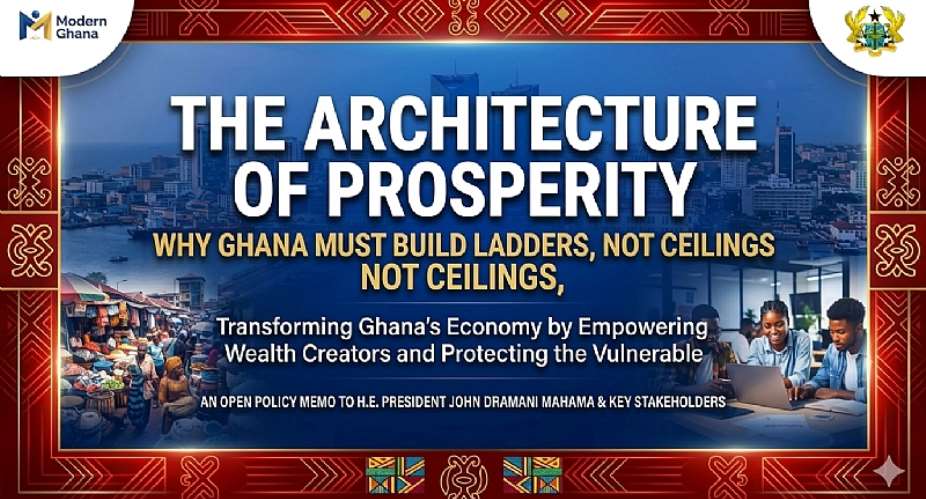
"Calvin Coolidge’s 1914 economic philosophy offers a vital blueprint for Ghana’s current development."
Ghana stands at a critical economic crossroads, demanding a radical shift from reactive survival to deliberate, structural transformation. For decades, our national discourse has been trapped in a zero-sum illusion: the false belief that to lift the poor, we must restrict or heavily penalize the wealthy and successful. This mindset breeds over-regulation, unpredictable taxation, and a hostile environment for the enterprise engines that drive national growth.
To break this cycle, Ghana must look to a timeless truth articulated in 1914 by former US President Calvin Coolidge: "Don't expect to build up the weak by pulling down the strong." True economic justice is not the forced redistribution of scarcity, but the aggressive creation of new wealth. We cannot tax our way into prosperity, nor can we build a resilient nation by cutting down the corporate giants that anchor our financial ecosystem. The path forward requires a balanced dual strategy: building an unshakeable social safety net for our most vulnerable citizens while simultaneously clearing a high-speed runway for our largest business conglomerates to scale, innovate, and compete globally.
Core Recommendations to H.E. President John Dramani Mahama
- Rationalize the tax regime: Halt the introduction of ad-hoc levies on thriving corporate entities and streamline existing business taxes to ensure fiscal predictability.
- Establish a presidential council: Create a direct, recurring dialogue framework between the Presidency and Ghana’s top 50 indigenous and multinational employers to co-design growth policies.
- De-risk local commercial credit: Launch targeted state-backed guarantee schemes to help commercial banks lower interest rates for strategic industrial sectors.
- Enforce regulatory stability: Guarantee that economic policies, import-export rules, and foreign exchange regulations remain consistent for minimum three-year blocks to attract long-term investment.
- Shield the vulnerable directly: Strengthen targeted social interventions like the Livelihood Empowerment Against Poverty (LEAP) program using digitized, leak-proof distribution channels rather than broad market interventions.
Actionable Strategies for Business Conglomerates
- Localize supply chains: Intentionally transition raw material sourcing and intermediate services to local MSMEs to foster a robust internal economic multiplier effect.
- Champion structural skills transfer: Partner directly with technical universities to co-fund specialized research hubs, ensuring the Ghanaian workforce matches modern industrial needs.
- Expand corporate social investments: Move from superficial donations to funding high-impact infrastructure, such as community digital labs and solar-powered agro-processing centers.
- Drive regional export expansion: Utilize the frameworks of the African Continental Free Trade Area (AfCFTA) to position Ghana as the manufacturing and logistical hub of West Africa.
Mandates for Institutional Stakeholders and Regulatory Bodies
- Shift from policing to facilitation: Reform agencies like the Ghana Revenue Authority (GRA) and the Food and Drugs Authority (FDA) to prioritize business growth over aggressive penalty collection.
- Simplify formalization bottlenecks: Digitize and collapse bureaucratic processes required for formal business registration, licensing, and land title acquisition into a single-window system.
- Stabilize macro-economic fundamentals: The Bank of Ghana must maintain a laser focus on taming inflation and curbing currency volatility to allow for accurate corporate planning.
Ghana’s economic redemption will not be achieved through corporate envy, bureaucratic bottlenecks, or the penalization of commercial success. As President Mahama steers the nation forward, the collective focus of leadership, labor, and capital must align on growth rather than restriction. We must boldly protect the rights of the weak by giving them tools, education, and dignity, while enthusiastically helping our powerful corporations better serve the populace. When we stop pulling down the strong, we allow them to build the sturdy economic ladders that will lift every Ghanaian into sustainable prosperity.
✍️ Retired Senior Citizen
For and on behalf of all Senior Citizens of the Republic of Ghana 🇬🇭
Teshie‑Nungua
[email protected]


 'EOCO attempted arrest of Baffour Awuah was unprofessional' — James Agalga
 'Building a congregation of 20,000 will kill you' – Duncan-Williams tells young ...
 September 29: Cedi finishes day selling at GHS12.20 on forex market, GHS11.67 on...
 ‘We’ll explore another constitutional option for narcotics probe’ – Minority on ...
 Speaker Bagbin adjourns Parliament indefinitely after rejecting narcotics probe ...
 Food Buffer Stock seeks stronger liquidity buffer despite record GH¢91.7 million...
 Ex NAFCO Boss trial: Court adjourns trial to hear application for return of seiz...
 Bagbin backs Mahama’s call for national dialogue on social media insults


