




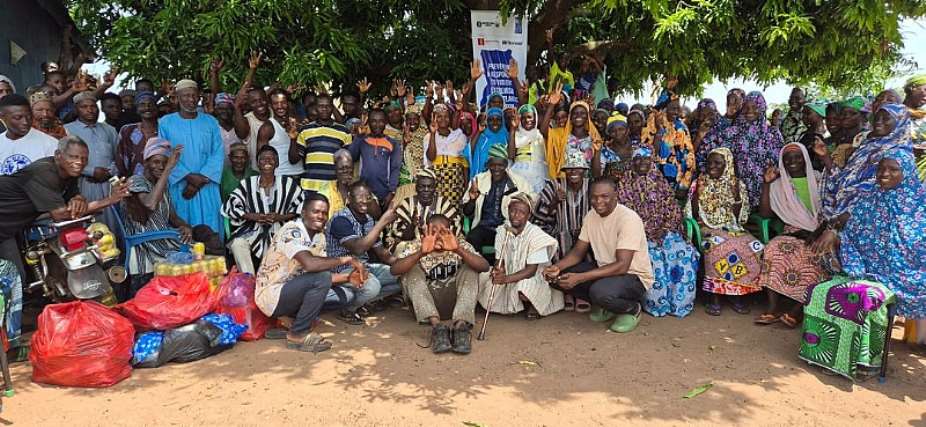
The Savannah Regional Peace Council has established five additional Local Peace Committees in five communities across three districts in the region to help address issues of conflict.
Each Local Peace Committee comprises nine members, including women, youth, representatives of traditional authorities, farmers, herders (Fulbe), and assembly/unit committee members in the respective communities.
The communities are Chache and Donkorkura in the Bole Municipality; Cheayiri and Jang in the Sawla-Tuna-Kalba District; and Mempeasem in the North Gonja District.
A community-based dialogue on peacebuilding and social cohesion was also held at Donayiri in the Sawla-Tuna-Kalba District, but the Local Peace Committee is yet to be established there due to certain community dynamics.
The initiative in the various towns was undertaken with support from the Governments of Denmark and Norway through the United Nations Development Programme (UNDP).
The dialogues involved more than 600 participants, including traditional and religious leaders, assembly and unit committee members, persons with disabilities, women, youth groups, and minority groups, notably the Fulbe.
The Local Peace Committees are expected to support existing local structures in preventing and managing conflicts through early warning mechanisms.
They are also to serve as a link between the communities, the local assemblies, and the Peace Council on issues of peace and development.
The formation of the Local Peace Committees followed a series of community-based dialogues on peacebuilding and social cohesion organized by the Savannah Regional Peace Council.
Mr. Kennedy Atiibo, Executive Secretary of the Savannah Regional Peace Council, speaking during the dialogues and the establishment of the Committees, said the next phase of the intervention would involve training members of the Committees and fully operationalizing them.
He added that there would be further engagement with the leadership of the Donayiri community to deepen understanding among them and address any misconceptions to facilitate the formation of the Local Peace Committee there.
Mr. Atiibo said the dialogues were held under the Preventing and Responding to Violent Extremism in the Atlantic Corridor project, which aims to build the capacities and resilience of border and at-risk communities against violent conflicts and extremism.
He noted that the dialogues sought to identify the various factors affecting peace and social cohesion at the community level and to generate practical, community-led solutions to address them.
Across the six communities, the most common threat to peace and social cohesion was farmer–herder-related disputes, which are pervasive not only in the target communities but across the region and beyond.
During the dialogues, measures such as the construction of kraals, the elimination of night grazing, the establishment of community-based dialogue platforms, continuous education and sensitization, regular community dialogues, and inclusive participation were proposed to address the drivers of conflict at the community level.
Participants expressed gratitude to the partners for organizing the dialogues and pledged to support and sustain the initiatives beyond donor funding.
 Titus‑Glover Slams July 1 Thanksgiving: “Ghana Should Be Mourning Flood Victims,...
 NADMO Begins Nationwide Relief Distribution Today as Government Ramps Up Support...
 Afotey‑Agbo Blasts Authorities: “Desilt the Drains Now — Accra’s Floods Were Pre...
 Massive Crowds Flood Tehran as Iran Begins Week‑Long Funeral Rites for Slain Sup...
 Adwoa Safo Breaks Silence: “I’m Only Defending My Father’s Final Wishes — Not Fi...
 Jordan Ayew Urges Patience After Ghana’s World Cup Exit: “Queiroz Needs Time”
 Mahama pays tribute to senior citizens, pledges better healthcare and pensions
 Pope urges Europe to protect migrants in visit to island frontier
 Mali hit by new wave of coordinated attacks
 United States at 250: Looking beyond the founding fathers to unsung revolutionar...
