




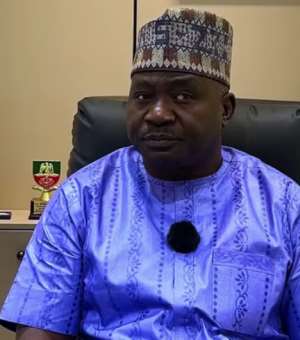
When DW's Under the Baobab put the question of Nigeria's security architecture to Defence Minister General Christopher Musa (Rtd), it went to the heart of a debate that has followed the country for over a decade: can any security force, however equipped, subdue an enemy that hides in terrain the size of small nations
Musa did not shy from the scale of the problem. Nigeria's insurgent and banditry threat is no longer confined to the north-east's Sambisa forest theatre; it now stretches across the Zamfara-Katsina-Sokoto axis, into the North Central farmer-herder corridor, and increasingly touches the south. Transnational criminal networks now link instability in the Sahel with the forests of Zamfara and the creeks of the Niger Delta, a geography no single military command can blanket with boots on the ground.
The Abduction Wave
The minister inherited his portfolio at a moment of acute crisis. By late November, Borno had recorded the kidnapping of a dozen teenage girls in Askira/Uba, while over 315 students and teachers had been abducted from a school in Niger State, alongside dozens of wedding guests seized in Sokoto. That surge was severe enough that President Bola Tinubu declared a "nationwide security emergency," a rare admission of the scale of the challenge from the top of government.
Musa's own account of why such attacks persist centers less on military capacity than on community complicity. He has repeatedly argued that bandits and insurgents cannot survive in the bush without local logistics chains food, fuel, and intelligence on troop movements supplied by sympathizers or coerced villagers. He has said the security men "cannot be everywhere," and that communities which decide not to support armed groups become genuinely free of them.
Rejecting the "Ineffective" Label
Pressed on whether the military is losing the war, Musa has consistently pushed back. He has given Nigeria's security effort a performance score of between 65 and 70 percent, arguing terrorism has drastically reduced compared to previous years even though isolated attacks continue. His explanation for the gap between official confidence and public perception rests on the tactics of the insurgents themselves: wherever troops clear and advance, remnants circle back behind them to strike soft targets, manufacturing a sense of insecurity even as the broader trend improves.
He has also pointed to funding and political economy as the deeper obstacle, arguing that illicit financial flows sustain terrorism and that international partners must help track and choke those channels.
A Minister, Not a Commander
It is worth noting the institutional shift Musa himself has had to navigate. As Chief of Defence Staff he issued operational orders directly; as Minister of Defence he now operates in a politically moderated, bureaucratic environment where he no longer commands troops or issues operational directives.
The Verdict Nigerians Are Still Waiting For
Musa's case is coherent: terrain that swallows conventional firepower, insurgents who exploit civilian intermediaries, and a financing architecture that outlasts any single clearance operation. Yet the scorecard he offers sits uneasily beside the lived reality of families in Sokoto, Niger, Borno, and Zamfara states who continue to bury loved ones or await ransom calls. Whether Nigeria's security forces can keep citizens safe is, on the evidence, less a question of manpower or resolve than of breaking the financial and logistical umbilical cord that keeps banditry and insurgency alive in Nigeria's forests a task that outlasts any one minister's tenure.
Mustapha Bature Sallama.
Medical/ Science Communicator,
Private Investigator, Criminal investigation and Intelligence Analysis.
International Conflict Management and Peace Building.USIP
[email protected]
+233-555-275-880
References
DW. Under the Baobab interview with Nigeria's Defence Minister, Gen. Christopher Musa, on security challenges, forests/terrain, and abductions. dw.com.
The Africa Report. "10 things about General Christopher Musa, Nigeria's new defence minister." December 8, 2025.
Punch Nigeria. "Musa confronts Nigeria's security challenges as minister." December 12, 2025.
Punch Nigeria. "New Defence Minister: Nigerians must see results." December 8, 2025.
The Africa Report. "Nigeria names former top general Christopher Musa as defence minister." December 2, 2025.
Politics Nigeria. "Christopher Musa Discusses Nigeria's Security Progress." January 16, 2026.
Daily Post Nigeria. "Insecurity: 'Terrorism drastically reduced' Defence Minister Musa claims." May 29, 2026.
Arise News. "Christopher Musa: Nigeria Closer To Lasting Security Than Ever, Coups Must Never Return." January 16, 2026.
PRNigeria. "CG Musa: The Return of a Battle-Tested General." December 7, 2025.
Wikipedia. "Christopher Gwabin Musa." Accessed July 2026.

 Titus‑Glover Slams July 1 Thanksgiving: “Ghana Should Be Mourning Flood Victims,...
 NADMO Begins Nationwide Relief Distribution Today as Government Ramps Up Support...
 Afotey‑Agbo Blasts Authorities: “Desilt the Drains Now — Accra’s Floods Were Pre...
 Massive Crowds Flood Tehran as Iran Begins Week‑Long Funeral Rites for Slain Sup...
 Adwoa Safo Breaks Silence: “I’m Only Defending My Father’s Final Wishes — Not Fi...
 Jordan Ayew Urges Patience After Ghana’s World Cup Exit: “Queiroz Needs Time”
 Mahama pays tribute to senior citizens, pledges better healthcare and pensions
 Pope urges Europe to protect migrants in visit to island frontier
 Mali hit by new wave of coordinated attacks
 United States at 250: Looking beyond the founding fathers to unsung revolutionar...
