




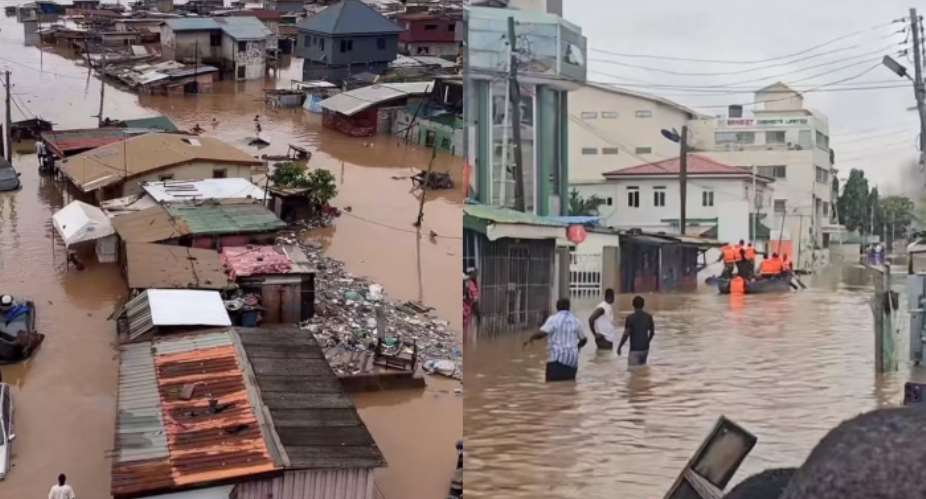
Ghana's worst rains in three decades did more than flood Accra and the Central Region this June. They exposed a procurement system so slowly that the government itself had to bypass it to respond, raising a hard question about whether the country's flood losses are truly unavoidable.
A Night Accra Won't Forget
It started as rain. By morning, it had swallowed a highway.
On the night of Sunday, June 28, 2026, rain began falling over Accra and did not stop. By dawn, floodwater had reached car windows on the N1 Highway, swallowed the Kwame Nkrumah Circle interchange, and turned the Accra to Kasoa road into a river that no vehicle could cross. Ambulances stalled where they stood. Market women waded through waist-deep water, clutching sacks of rice and cartons of tinned tomatoes above their heads. In Alajo and Odawna, pharmacists locked their shops because there was, quite literally, nowhere left for a customer to stand.
Two days later, when Interior Minister, Hon. Muntaka Mohammed-Mubarak, rose in Parliament to brief the House, the figures he read out told their own story. Ghana had recorded 593.2 millimetres of rainfall in June, the highest monthly total since records began in 1995, well past the previous high of 420.6 millimetres set in 2002. On June 29 alone, 169.2 millimetres fell in a single day, the fourth highest daily total the country has ever measured. Twelve people were confirmed dead, and seven remained missing in Greater Accra, with 38,802 people across 7,761 households displaced. In the Central Region, a further eighteen lives were lost after fifty-eight houses, many of them century-old mud and brick buildings, gave way under weeks of relentless rain.
A Familiar Disaster
This is not Ghana's first flood, and that is exactly the problem.
Accra has flooded in some form in 2010, 2015, 2016, 2022, 2023, 2025, and now again in 2026, with the same low-lying communities around the Odaw River, Alajo, Kaneshie, and Weija bearing the brunt each time. The June 2015 disaster, worsened by a fuel station explosion near Circle, killed more than two hundred people in a single night. Records stretching back nearly ninety years show over three thousand flood-related deaths and more than seven hundred thousand Ghanaians displaced by flooding. A country does not need new rain to have an old problem.
When Rain Becomes a Supply Chain Problem
The real damage isn't only in the water. It's where the water stops moving.
What tends to get lost in the coverage of events like this is that flooding in Southern Ghana is not only a humanitarian emergency. It is a supply chain emergency, and increasingly, a procurement emergency. Consider the pharmacist in Cape Coast who could not restock antimalarial drugs because her supplier's van could not reach her shop for four days. Or the hospital procurement officer in Tema who watched a shipment of intravenous fluids sit stranded in a flooded warehouse. Or the haulage firm whose trucks, loaded with cement and steel bound for a Central Region road project, had to be rerouted for a week because the direct route through Twifo Hemang had simply washed away. When the water rises, it does not just flood homes. It cuts the arteries through which food, medicine, fuel, and building material move across the country's busiest economic corridors.
That distinction matters because it changes where responsibility sits. The hazard itself, unusually intense rainfall driven by shifting regional weather patterns, is largely beyond any single government's control. But what happens next is not. Which drains get cleared before the rains arrive, which suppliers are pre-approved to respond in an emergency, which warehouses get sited on high ground rather than a floodplain, and how quickly a procurement system can move once the water starts rising: these are choices, made well before a single drop falls.
The Admission That Says It All
One line from the Interior Minister's briefing explains more than any statistic.
It is worth pausing on one admission the Interior Minister made to Parliament. Rather than routing emergency drainage and road works through Ghana's normal procurement system, the government deployed the Ghana Armed Forces' 48 Engineers Regiment directly, a decision the Minister defended on the grounds that it would help “avoid lengthy procurement procedures and speed up emergency works.” Read that again. A senior government minister, explaining the country's flood response, treated Ghana's own procurement rules not as a tool for getting help to people quickly, but as an obstacle to be worked around. That is not a criticism of the men and women who cleared drains in the rain. It is a warning about the system they had to bypass to do it.
Four Ways the Chain Breaks
Roads, warehouses, markets, and paperwork all fail in the same flood, for different reasons.
The pattern repeats itself in miniature across four fronts. Roads are severed first and hardest, cutting off entire suburbs and towns from the markets and depots that supply them, often with no viable detour because the alternative route floods too. Warehouses and hospitals, some built in the same low-lying zones as the homes around them, watch stock and medicine spoil or sit unreachable at the exact moment demand for both spikes. Traders in markets like Kaneshie and Makola, operating on thin working capital with little or no insurance, lose goods that represent not a bad week but months of savings; the United Nations Development Programme has bluntly described Accra's flood pattern as one where each major flood wipes out small business capital. And emergency procurement itself moves too slowly to matter, forcing the kind of ad hoc, rules-bypassing response Ghana saw this June again.
Lessons From Elsewhere
Other flood-prone countries have already solved the speed problem. Ghana has even piloted the solution and shelved it.
Other countries facing similar exposure have shown there is a different way to do this. The Netherlands funds pre-authorised emergency works that do not require case by case approval once a flood is underway. Bangladesh, despite facing far greater flood exposure than Ghana, has invested in community-level early warning systems and pre-positioned relief stock that shrinks the gap between a warning and a response. Ghana itself has already piloted a parametric flood insurance scheme for Greater Accra with UNDP support, a mechanism that would release funds automatically once a rainfall threshold is crossed, rather than waiting on a parliamentary briefing and a discretionary decision. That pilot exists, has been tested, and remains largely unused at scale, which is its own kind of answer to the question of what Ghana is missing. It is not technical knowledge. It is the discipline to turn a pilot into policy and an emergency bypass into a standing procedure.
What Ghana Can Do Now
None of these fixes requires new inventions, just the will to make them standard practice.
There are concrete steps within reach. The Ministry of Roads and Highways, the Public Procurement Authority, and NADMO could establish a standing emergency framework contract for flood season drainage and road repair, one that activates automatically once the Ghana Meteorological Agency issues a defined rainfall warning, rather than waiting for a crisis to force an exception to the rules. FMCG and pharmaceutical distributors would be better served by dual sourcing and simple GIS mapping that shows, before the rains arrive, which of their suppliers and warehouses share the same flood risk. Hospitals could treat medicine pre-positioning and cold chain backup as a routine item on the annual calendar ahead of the May to June and October to November flood peaks, not a response triggered only once supplies are already cut off. And the demolitions already announced by the Cape Coast Metropolitan Assembly will mean little without zoning rules that are actually enforced, since tearing down unsafe structures on a floodplain solves nothing if new ones simply take their place.
A Matter of Choice
The rain will come back next year. Whether the same failures occur is up to Ghana, not the weather.
The floods that submerged Accra, Tema, Kasoa, and the Central Region this June were, in the most literal sense, caused by rain. But the roads that vanished beneath that water, and the medicine, food, and fuel that could not reach the people waiting for them, point to something more specific than bad weather. Ghana already knows, in considerable and well-documented detail, exactly where its systems are weakest. The rain will return next season, as it does every year. Whether the roads and the supply chains that depend on them disappear along with it is no longer a matter of climate. It is a matter of choice.
Dr. Emmanuel Norgah Bukari lectures in Procurement and Supply Chain Management at KAAF University and serves as Chief Quantity Surveyor at Ghana's Ministry of Roads and Highways.
Dr. Nancy Maame Akua Erskine-Sackey is the MBA Programme Coordinator at KAAF University's Graduate School, holding a PhD in Marketing from the University of Professional Studies, Accra, with research interests in customer experience and service delivery.


 Adu-Boahene’s lawyers ask court to strike out fabricated, invented evidence in D...
 'He is part of National Film Authority' – Kwasi Kwarteng exposes Obuasi SHTS hea...
 'Mahama should have appointed Edudzi Tameklo to EC to teach hypocrite NPP some s...
 'You have no moral right to complain about cost of living' – Prof Anankware to B...
 'You did the same thing' – Solomon Owusu defends EC appointment
 GFL vows to pursue justice for worker who lost five fingers at Afienya Industria...
 State to call first witness on January 12 in Canadian murder case
 Haruna Iddrisu refers Obuasi SHS headmaster's sexual misconduct allegations to C...
 Bawumia is a ‘prophet of pocket economy’ in opposition, ‘priest of paper economy...
 Bolgatanga Technical University Council Chairman allegedly locks up Vice-Chancel...



Comments
Surface gutters alone will never solve Accra's flooding problems. During intense rainfall, they quickly become overwhelmed. What Accra needs is a comprehensive underground stormwater drainage system, including large storm tunnels designed for urban flood management, with diameters ranging from about 1.5 metres to well over 3.2 metres where necessary. At the same time, Ghana must confront the growing menace of single-use polythene bags. A law should require supermarkets, food marts, and other ...