




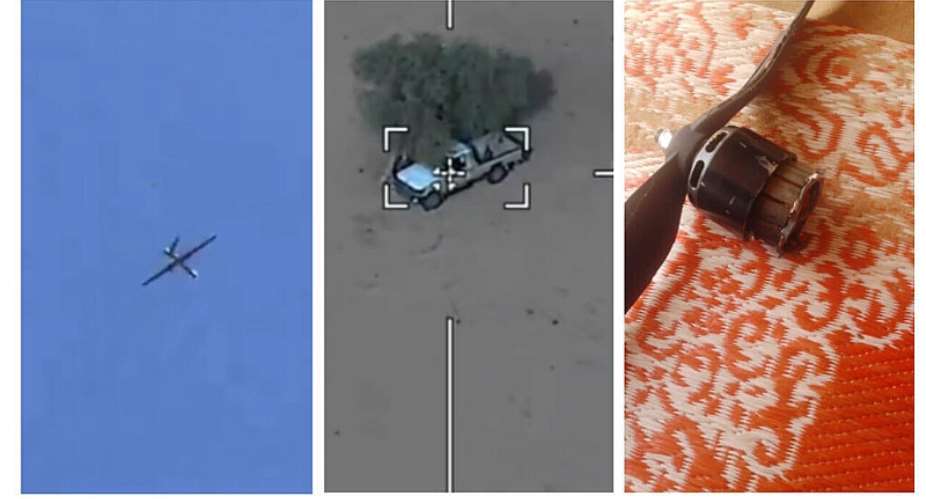
At first glance, the image seems to show nothing more than a few pieces of metal strewn across the sands of the Malian desert. However, these photos, sent to the FRANCE 24 Observers team by an anonymous source from within the Azawad Liberation Front, show the debris from a Russian kamikaze drone that is being deployed for the first time in Mali.
On April 15, the Azawad Liberation Front (FLA) – a separatist movement – seized the strategic city of Kidal while carrying out an offensive alongside fighters from JNIM, a jihadist group based in the Sahel. Since being pushed out of the city, Russian mercenaries from the Africa Corps and the Malian army have been carrying out increasing numbers of drone strikes against the two rebel groups with devices that, up until now, had mainly been used in Ukraine.
Read more Street battles and withdrawal of Russian mercenaries: Inside the 48-hour fall of Mali's Kidal
The FLA source who spoke to the Observers team told us that this drone strike took place in the region near Timbuktu. They said that the drone targeted a civilian vehicle, though we were unable to independently verify this. This image showing drone debris was sent to our team by an anonymous source.
Our team analysed the image and determined that it shows the wings from the Lancet, a Russian loitering munition. This is an image of the Lancet loitering munition published by its manufacturer, the Zala Aero group.
The Lancet is like a small missile with a built-in motor that can remain airborne for a relatively long period of time. It is equipped with a camera that enables an operator to pilot it. The drone is manufactured by the Zala Aero group, a subsidiary of the famous Russian Kalashnikov group. The Russian army has been using the Lancet since 2020.
A Ukrainian resale website helps us identify a drone being used in Mali
The Ukrainian online resale site Reibert.info is, perhaps surprisingly, chock full of people selling Lancet debris. After the Russian invasion of Ukraine in 2022, this site opened a platform for buying and reselling Russian equipment. Ukrainian soldiers auction off their war trophies, including the debris from loitering munitions like the Lancet. Images posted on the site look just like the image of the debris that our Malian source shared with us. Above is the image shared with us by the source with links to the FLA. Below is an image of Lancet wings published on the online resale site Reibert.info on December 4, 2023. At right is an image of Lancet debris found in Mali. At left is an image of the same piece of the Lancet posted on the Ukrainian resale site Reibert.info. This piece in particular covers the battery in the Lancet's engine.
Vincent Tourret, a researcher at the think tank the French Institute of International Relations (IRFI), says that the Lancet wasn't designed for the Malian context:
“The Lancet is a drone used in Ukraine mainly to strike armoured vehicles or artillery. It's not a weapon conceived to fight against an insurrection like in the Sahel. But the Russians can use it against the armed groups' pickup trucks. The Lancet is used like a rocket or a small missile.
It's often used in tandem with reconnaissance drones. The reconnaissance drones will fly over an area and find the target and then transfer the position to the Lancet, which will then carry out the strike.”
A video that helps to identify two never-before-seen drones in Mali
On June 19, the Africa Corps shared a video on its X account showing a kamikaze drone attack on a pickup truck.
Détruction d'un pick-up appartenant à des terroristes qui effectuaient une surveillance sur les objectifs militaires dans la région de Tombouctou, suite à une frappe d'un drone.@TheAfricaCorps pic.twitter.com/as7xtPbBO0 — The African Corps (@TheAfricaCorps) June 19, 2026
We were able to identify that the footage in the first part of this video was taken by a Lancet camera by comparing it with other videos from Lancet cameras posted on Telegram by its manufacturer. At left is a screengrab of a video taken by a Lancet used by the Africa Corps in the region around Timbuktu. The image at right is a screengrab of a video also taken by a Lancet shared by its manufacturer Zala on Telegram on June 25. This video shows the drone targeting a Ukrainian tank.
The Lancet then crashes into the pickup truck – a moment that is not captured by its onboard camera. But the second half of the video, filmed by another drone, shows the Lancet striking the vehicle. We were also able to identify the second drone from the footage it captured: it's the Zala Z-16, a reconnaissance drone often used alongside the Lancet. At left is a screengrab of the video posted on June 19 by the Africa Corps. At right is an image taken from another video posted on June 19 by the Rubicon, one of the Russian army's drone warfare units operating on the frontlines in Ukraine. These two images show the interface of the Zala Z-16 drone. A Russian soldier deploys the ZALA Z-16 reconnaissance drone.
The Garpiya, an unexpected drone in Mali
A video from May 17 shows yet another model. In the footage, men, possibly from the JNIM, are seen inspecting drone debris.
An unknown drone crashed yesterday somewhere in Mali and was discovered by JNIM militants, it appears to be the remains of a Russian Garpiya-A1 UAV, likely used by the Africa Corps. pic.twitter.com/COMauPcn5s — Brant (@BrantPhilip_) May 18, 2026
The drone on the ground is rare: it's a Garpiya-A1, a Russian long-range attack drone that was modelled after the Iranian Shahed drone. In this screengrab taken from a video posted on May 17, you can see the Garpiya drone's identification number: “ КК18095”.
According to the specialised site Defence blog, the drone carries a bomb that explodes above a target instead of on impact, the same as the Iranian Shahed drone or its Russian equivalent, the Geran-2.
Justin Bronk, a senior research fellow at the Royal United Services Institute (RUSI), says that it is surprising that this drone, which is more often used in Ukraine, has been deployed to Mali:
“The Garpiya-A1 is a derivative of the Geran, which is itself a Russian copy of the Iranian Shahed drone. In Ukraine, drones of this type are used by the Russians to carry out long-range attacks against fixed targets. However, this is not a configuration that is found in Mali.”
The Garpiya-A1 was designed to target solid infrastructures, but the insurgent groups in Mali are mobile and don't have fixed locations or infrastructure.
The Orion: A drone well-suited for counterinsurgency
While the fact that the Russians are using Lancet drones in Mali is surprising, the Orion drones in use there are much better suited for counterinsurgency. @sahelwood #malitiktok🇲🇱 #tiktokmali🇲🇱223 #funny #pourtoi ♬ original sound - lovely pet
The Africa Corps used Orion drones in an offensive against insurgents on April 25. You can recognise the drone's interface in a video that the Africa Corps posted on its Telegram channel on April 26 that shows a drone flying over the town of Kati and targeting pickup trucks. This screengrab of a video filmed by an Orion drone in the town of Kati in late April 2026 shows the drone attacking a group of people travelling in pickup trucks. Location:12.736020642953132, -8.050972101832732
Bronk says that the Orion drone better fits the counterinsurgency needs in Mali:
“It is logical that the Russians are deploying the Orion drone. It meets the need to support ground troops with armed reconnaissance. It is a drone designed for ISR [Editor's note: Intelligence, Surveillance and Reconnaissance], it will remain in the air for a long period of time in order to observe roads and inhabited areas with the aim of detecting the activity of armed groups.
Deploying the Orion in Mali is a good calculation, because the drone is no longer active in Ukraine, as it is too vulnerable to medium-range air defence systems. Therefore, it does not bother the Russians to deploy it in Africa.”
Whatever model you are talking about – the Orion, the Garpiya or the Lancet – the war in Ukraine has a big influence on the deployment of Russian material in Africa, says Bronk:
“Whether it is the Lancet or the Shahed, these are two weapons that Russia produces in large quantities as part of its war in Ukraine. It is therefore normal that it draws from its stocks to supply the Africa Corps group in Mali. Moreover, these are inexpensive systems that allow the Russians to increase their firepower while expending a minimum amount of resources.”
This article has been translated from the original in French by Brenna Daldorph.


 Ahafo Ano South West MP involved in road accident
 Constitutional Review alone will not solve Ghana’s problems – Kwesi Pratt Jnr.
 East Legon Football Academy applauds NPA Boss for supporting youth football
 Gov't didn't show NPP enough respect in constitutional review process – Martin K...
 September 18: Cedi sells at GHS12.15 on forex market, GHS11.53 on BoG interbank
 Lawyer challenges two-week remand of Salomey over connection to wanted 'Ghana Jo...
 Minority calls for NSA boss Ampofo Ankrah, others to be dismissed over alleged 2...
 ‘You gave us GH¢60,000 to run 66 offices nationwide and expect us to function?’ ...
 Russia seizes assets of Swiss food giant Nestle and three French firms
 Russia votes in parliamentary election as war in Ukraine drags on


