




Nigeria's economic hub, Lagos, ranks among the fastest-growing cities in the world. Its huge population – estimated at around 20 million – and its rapid urbanisation contribute to a sense of life where survival hinges on improvisation and ingenuity.
Nigerian musician Fela Kuti captured the megacity's chronic difficulties with the expression “impossibilityism”. Yet, Lagos is also widely regarded as a place brimming with possibility.
My research as an anthropologist with a focus on religion shows that a significant number of Lagosians turn to religion in the hope of converting the impossible into the possible. Religion is not only for spiritual purposes, but also a practical way to solve problems.
For a better life in Lagos, there are difficulties to overcome: economic uncertainties, infrastructure failures, governance issues, inequality and crime. To maximise their chances of success, a growing number of Lagosians combine elements from different religious traditions. A prominent example is Chrislam, which emerged in Lagos in the 1970s. It fuses Christian and Muslim beliefs and practices.
Although relatively small compared to the Pentecostal churches and reformist Muslim organisations that have mushroomed in Lagos in recent decades, Chrislam needs to be understood within a broader religious transformation.
This transformation is difficult to map. Scholars of religion tend to emphasise fixed religious boundaries rather than the improvisational ways in which people practise religion. In the media, religious encounters are often reduced to conflict and violence.
Chrislam may appear to be a marginal phenomenon, but understanding it is useful for developing a new perspective. It illuminates how urban Christians and Muslims live their religion and interact with one another in ways that exceed the stereotypical images of Nigeria.
Religious shopping
“Welcome to Lagos; here everything is possible,” were the words my research collaborator, Mustapha Bello, greeted me with when I first arrived in the megacity in 2010. I soon discovered what “everything is possible” means when I met the founder of Chrislam.
Nigeria is divided almost equally between Muslims and Christians along a predominantly north-south axis. Muslim-Christian relations in the south-west, with Lagos as its centre, are far more dynamic.
In this region, Muslims and Christians have long lived side by side, often in close interaction with practitioners of Yoruba religious traditions. The latter believe that the material world is shaped by unseen powers, including the òrìṣàs (personalised deities) who are held responsible for good fortune. It is this particular religious mix that created the conditions in which Chrislam could emerge.
There are two main Chrislam movements. Ifeoluwa (“The Love of God Mission”) has a small congregation of about 50 followers. Oke Tude (“Mountain of Losing Bondage”) has grown to over 1,000 adherents.
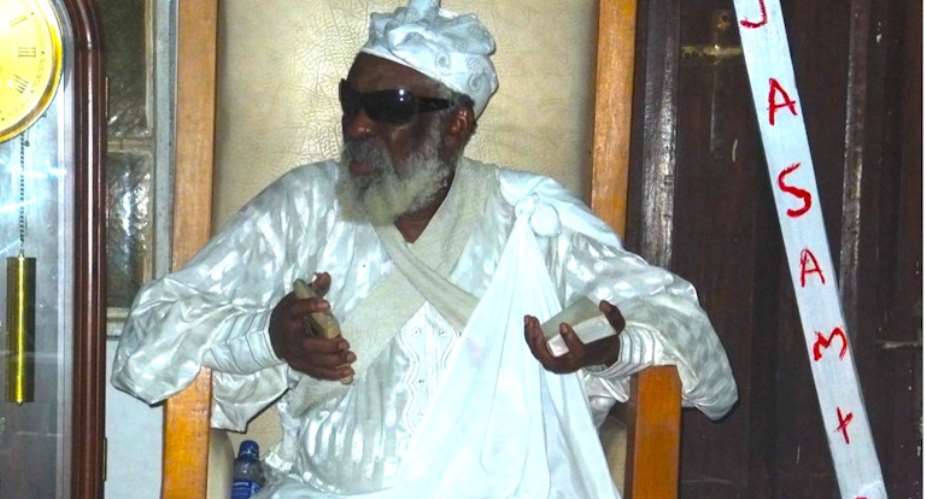
In addition to their Yoruba names, they use “Chrislam” as a way to describe their faith. While the two movements share certain practices – like drawing on both the Bible and Qur'an and invoking Jesus and the Prophet Muhammad in their prayers – they also differ. The founder of Ifeoluwa, Tela Tella, lives a secluded life in a densely populated suburb of Lagos. The founder of Oke Tude, Prophet Dr Samsindeen Saka, uses modern media to spread his message of unity between Christians and Muslims.
This mixing and matching is locally described as “religious shopping”. According to the hundreds of self-identified religious shoppers I've interviewed over the past 15 years, those seeking health and wealth cannot afford to be picky.
Chrislamists, for example, explained that their faith enabled them to “hedge their bets” by “combining the powers in Christianity and Islam”, doubling their chances of achieving a “good life”. And the Oke Tude imam told me that he prayed eight times a day – five times in the Muslim way and three in the Chrislam way – in order to benefit from the cumulative power of prayer.
The Chrislam prayer involves running seven times around a replica of the Ka'bah – the most sacred site in Islam – while shouting “Hallelujah” and “Allahu Akbar” (God is great).
The Chrislamists I studied actively crossed religious boundaries. This needs to be understood against the backdrop of an urban environment marked by uncertainty and instability, where two-thirds of Lagosians live below the poverty line.
In this context, it's both pragmatic and strategic to draw on the perceived potency of both Christianity and Islam.
Debunking stereotypes
Chrislam challenges portrayals of Nigeria as a country defined by Islamist-Christian clashes. While religious violence is a serious concern in the country, my research shows that Christian-Muslim relations cannot be reduced to conflict alone.
Chrislam is far from an isolated case. Across multifaith settings in Africa (and beyond), one finds movements that combine elements from different religious traditions. They defy neat classification.
A notable example is the Afrikania Mission, which emerged in Ghana in the 1980s. It blends elements of Christianity with so-called African traditional religion. Religious boundary-crossing is an integral feature of contemporary religious life in Africa.
It's not that religious differences don't matter in these movements. They do, but religious divergence does not automatically give rise to violence or polarisation. It can just as readily serve as a basis for copying, competition, and mutual exchange.
Indeed, Chrislamists see Christianity and Islam as complementary rather than contradictory. For instance, a dedicated Chrislamist responded to my question about whether he worshipped Jesus as the son of God (as in Christianity) or as a prophet (as in Islam) by saying “he is both”.
The founder of Ifeoluwa, Tela Tella, preached:
Jesus Christ is on my right-hand side, the Prophet Muhammad is on my left-hand side; they are two of my best friends.
Why this matters
In my view it's time to rethink how we study religion in Africa by moving beyond western, Christian-derived conceptions of religious traditions as fixed and bounded.
An Afrocentric lens begins with African forms of knowledge, practice and meaning – how African religious practitioners actually live, blend and interpret religious traditions.
Viewed through this lens, Africa does not appear as a passive recipient of the so-called world religions but as a powerhouse of religious creativity and innovation.
Chrislam is then no longer an oddity or contradiction, but a political resource in a place where religious identities are often weaponised.
It provides a lesson that today's fractured world urgently needs. Religious boundaries need not function as battle lines; they can also serve as meeting points.
Marloes Janson received research funding from the Federal Ministry of Education and Research (BMBF) in Bonn, Germany, and Forum Transregionale Studien in Berlin, Germany.
By Marloes Janson, Professor of West African Anthropology, SOAS, University of London
 Adu-Boahen’s properties inconsistent with known earnings — EOCO investigator tel...
 "We are losing huge capital amidst debts and hypertension" — Relocated Takoradi ...
 Lifeless body found in Trotro at Alajo after Accra floods
 Sierra Leone's PDL expresses solidarity with Ghana over Monday flood disaster
 Political drama deepens as The Base Ghana First disowns July 3 walk, vows court ...
 GoldBod introduces new LBMA-based pricing regime for gold purchases
 'Politicians in the Fourth Republic have failed us on flooding' — Dr. Asah-Asant...
 One dead after diesel tanker bursts into flames at Asutuare Junction
 Mahama urges Ghanaians to match prayer with hard work for national development
 Fuel prices fall again as OMCs cut pump prices in July's first pricing window
