




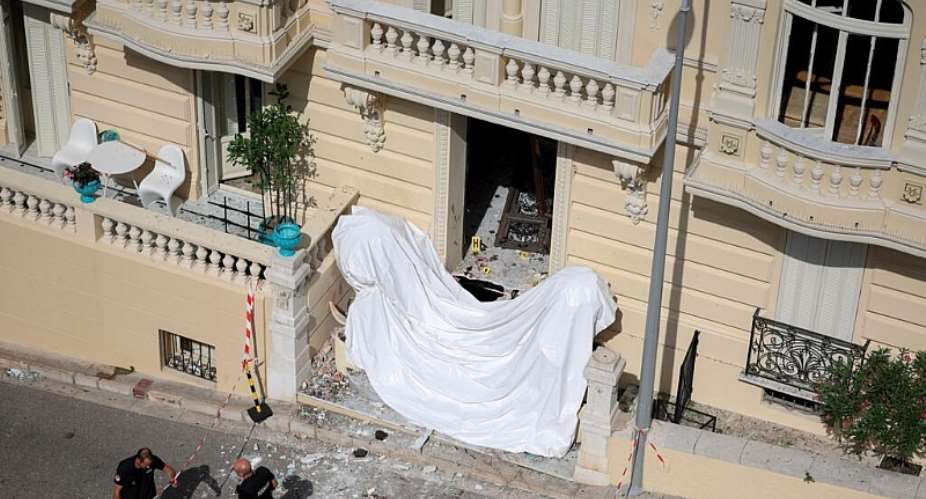
For Monaco's public prosecutor Stéphane Thibault, it almost beggars belief.
“To my knowledge, it's the first time in history that such a thing has happened in the principality,” he said in a press conference Tuesday, the morning after an explosion rocked the heart of the wealthy, ultra-safe micro-state in France's south.
Just before 9pm, a powerful explosion ripped through the ground floor of a block of flats, wounding three people including a 13-year-old child. For now, local authorities are treating the incident as an “attempted murder”, Thibault said, stressing that no suspect had yet been found.
The construction king of Dnipro
Monegasque authorities have refused to identify the victims of the attack, revealing only that they lived on the building's ground floor and had arrived in the micro-state in 2021.
But information obtained by French news station BFMTV and confirmed to AFP by a source close to the investigation suggests that one of the three people was Vadym Yermolaiev, a wealthy oligarch from Ukraine.
Ryhor Nizhnikau, a specialist in Ukraine and the broader post-Soviet world at the Finnish Institute of International Affairs, said that Yermolaiev had been an influential figure in the country's industrial east during the 1990s before falling into disgrace.
“He is a very typical oligarch from the 1990s,” he said. “He was probably in the top five oligarchs in the Dnipro region – which is one of the richest regions.”
Yermolaiev was targeted with Ukrainian sanctions in 2023 for having continued his business dealings in Crimea – annexed by Russia in 2014 – even after Moscow launched its full-scale invasion of Ukraine in 2022.
The multi-millionaire first made a name for himself as “Mr Shopping Mall” in the thriving city of Dnipro in Ukraine's south-east, inaugurating what was at the time the country's largest shopping complex – Most-City – in 2006.
Not content to build malls, Yermolaiev threw himself into a slew of ambitious infrastructure projects in Dnipro, which now finds itself on the front line of the grinding war. He remade an entire neighbourhood in the city's historic centre, earning him a reputation in local media as “the man who changed the face of Dnipro”.
Yermolaiev has since diversified his businesses. The Alef Group, the parent company of his business empire, controls companies in 19 industries, as reported in the mid-2010s by UBR, a Ukrainian business magazine no longer in circulation.
The grapes of wrath
With interests ranging from commercial real estate to the manufacture of dental implants, agro-food production to river transport, Yermolaiev steadily built up a vast portfolio that allowed him to build a fortune estimated at more that $300 million by the mid-2010s – and enter the closed-off club of Ukraine's 100 richest people.
In the end, it was drink that led to his ruin.
Yermolaiev has been accused of continuing to profit from his wine-making business in Crimea following the peninsula's annexation by Russia, and even two years after Moscow's full-scale invasion.
Worse, a portion of his Crimea-based companies' revenue allegedly went to Moscow in taxes, leading to accusations that the oligarch was directly financing the Russian war effort.
Even before he found himself on a list of sanctioned businessmen, Yermolaiev had left the country. In 2019, he renounced his Ukrainian nationality in favour of Cypriot citizenship.
Nizhnikau said that Yermolaiev's trajectory was typical of many oligarchs who had made their fortunes in the chaotic years following the collapse of the Soviet Union, only to lose influence with President Volodymyr Zelensky's abrupt rise to power and the outbreak of the war with Russia.
He said that Yermolaiev was far from the only oligarch in the country who had continued to earn money from ongoing business activity in Crimea.
“You're not allowed – it's illegal, obviously,” he said. “But the point is that it's like a conditional secret – you had a business before in Crimea, so what are you going to do? You register or create a fictional company, and you basically give your Crimean or Russian assets to this company.”
Nizhnikau suggested that the oligarch's inclusion on Kyiv's sanction lists in 2023 was likely influenced by other factors – potentially a lobbying campaign by a young, ambitious rival.
For now, the investigation is generating more questions than answers. Authorities in France and Monaco on Tuesday were searching for a man in a black bucket hat who was seen in surveillance footage leaving a backpack at the foot of the building shortly before the explosion.
If authorities do manage to lay hands on a suspect, Nizhnikau said, it would be interesting to see if he had his own links to Dnipro or Crimea.
This article has been adapted from the original in French.
 Adu-Boahen’s properties inconsistent with known earnings — EOCO investigator tel...
 "We are losing huge capital amidst debts and hypertension" — Relocated Takoradi ...
 Lifeless body found in Trotro at Alajo after Accra floods
 Sierra Leone's PDL expresses solidarity with Ghana over Monday flood disaster
 Political drama deepens as The Base Ghana First disowns July 3 walk, vows court ...
 GoldBod introduces new LBMA-based pricing regime for gold purchases
 'Politicians in the Fourth Republic have failed us on flooding' — Dr. Asah-Asant...
 One dead after diesel tanker bursts into flames at Asutuare Junction
 Mahama urges Ghanaians to match prayer with hard work for national development
 Fuel prices fall again as OMCs cut pump prices in July's first pricing window
