




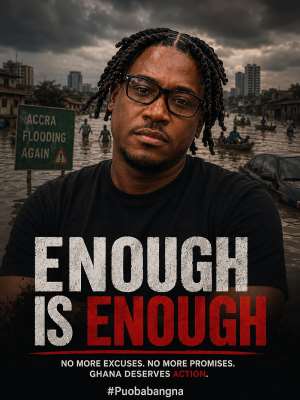
"We should not behave like the proverbial vulture that says it will repair its roof after the rains, only to forget about it once the weather clears."
Those were President Mahama's words following yesterday's devastating floods in Accra. It is a powerful proverb and one that every Ghanaian can relate to. The difficulty, however, is that many Ghanaians will hear those words and wonder whether they have become a description of successive governments rather than a warning to the nation.
This is not the first time President Mahama has witnessed Accra submerged under floodwaters. It is not even the second or third. Between his first four years as President and his current term, he has now spent about six years as Ghana's President while this same tragedy has repeatedly unfolded. Beyond that, he spent eight years as Leader of the Opposition, where he consistently criticized the previous Akufo-Addo administration for failing to tackle the perennial flooding in Accra. He spoke about the lack of political will, the failure to remove buildings on waterways, poor drainage systems, weak enforcement of planning laws, and the absence of long-term solutions. Those criticisms were valid. The unfortunate reality is that they remain just as valid today.
That is why this conversation must rise above party politics. This is no longer about the NDC or the NPP. It is no longer about who inherited the problem or who created it. After decades of recurring floods, every administration that has occupied the Jubilee House must accept its share of responsibility. President Kufuor, President Mills, President Mahama, President Akufo-Addo, and now President Mahama once again have all had the opportunity to confront this challenge. Yet, every rainy season, the same painful story repeats itself. Lives are lost. Families are displaced. Businesses collapse overnight. Roads become rivers. Billions of cedis in investments are washed away, only for another round of promises to follow once the waters recede.
Yesterday's floods were among the worst in recent memory. Homes were submerged within hours. Entire communities were cut off. Vehicles floated through the streets like abandoned boats. Parents desperately searched for their children. Families watched helplessly as years of hard work disappeared before their eyes. Others were left mourning loved ones who never made it home. These are not just statistics. They are fathers, mothers, children, friends, neighbours, and breadwinners whose lives have been changed forever.
In moments like these, citizens are not looking for politics. They are looking for leadership. They are looking for urgency. They are looking for reassurance that every available national resource is being deployed to save lives.
That is why the President's decision to inspect the flooded areas from a helicopter has generated so much public debate. Leadership must be visible, but before it is visible, it must first be felt. If people are still trapped in their homes, if families are stranded on rooftops, and if floodwaters are still carrying away lives and property, then the immediate priority should be rescue, not reconnaissance.
Many have described the aerial tour as "content creation," "showmanship," or simply another political photo opportunity. Whether that was the President's intention is not the point. Leadership is judged not only by intentions but by decisions, priorities, and public perception during moments of national crisis. The optics were unfortunate.
One cannot help but ask a few simple questions. If a helicopter was available, could it have been deployed alongside rescue teams to identify stranded residents, transport emergency personnel and supplies, or support rescue operations where practical? Could additional canoes, inflatable boats, life jackets, ambulances, and other emergency resources have been mobilized even more aggressively before an aerial inspection? Once every stranded resident had been rescued and immediate danger had passed, the President could still have toured the affected communities to assess the destruction firsthand. Leadership during disasters is remembered less for the images it creates and more for the lives it saves.
This issue is deeply personal to me because I have lived through it. I grew up in Awoshie, from Mangoase through Awoshie Station to the Bandyard area during the late 1990s and early 2000s. I watched homes disappear beneath floodwaters. I saw families lose everything they had worked for. I witnessed vehicles and household belongings carried away by raging water. I remember the fear that gripped entire communities whenever dark clouds gathered because we already knew what was coming. Most painfully, I remember lives being lost. One of those lives was a friend who was swept away in the large drains around Awoshie Station on the stretch toward Odorgonno. Those memories never leave you. They remain with you long after the floodwaters have disappeared.
That is why I cannot reduce this issue to politics. Flooding is not an NDC problem. It is not an NPP problem. It is a Ghanaian problem. Floodwaters do not ask for party cards before entering people's homes. They do not distinguish between those who voted for one political party or another. They destroy everything in their path.
Sadly, every rainy season has become predictable. Politicians trade blame while ordinary citizens count their losses. One government blames the one before it. The opposition criticizes the government of the day. The government responds by pointing to inherited challenges. Social media becomes a battlefield of political arguments while families search for missing relatives, business owners calculate devastating losses, and affected communities wonder whether anyone has truly learnt anything from previous disasters.
The painful truth is that Ghana does not lack knowledge. We do not lack engineers. We do not lack hydrologists. We do not lack urban planners. We do not lack environmental experts. We have produced reports. We have commissioned studies. We have formed committees. We have announced budgets. We know the causes of flooding. We know where the waterways are. We know the drains that need expansion. We know the communities most at risk. We know the buildings that should never have been allowed to stand. The problem has never been a lack of knowledge. It has been a lack of sustained political courage, continuity, enforcement, maintenance, and accountability.
Illegal structures continue to appear in waterways. Drains remain choked with waste. Natural watercourses continue to disappear beneath concrete. Planning regulations are ignored until disaster strikes. Desilting exercises often become seasonal activities instead of continuous maintenance. Every administration promises permanent solutions. Every administration blames those before it when those solutions fail to materialize.
Mr. President, your own proverb about the vulture should become more than a statement delivered after another national tragedy. It should become the guiding principle of your administration. The same challenge applies to every government that will come after yours. Ghana cannot continue repairing the roof only after the rains have destroyed lives. We cannot continue responding to floods as though they are unexpected when they have become one of the country's most predictable disasters.
History will not remember who delivered the most passionate speeches or who blamed their predecessors most effectively. History will remember the leader who finally found the courage to do what others could not. History will remember the government that placed national interest above political convenience and implemented solutions that survived changes in government.
Yesterday's floods should not become another headline that disappears with the next news cycle. They should become the moment Ghana finally decides that enough is enough. Let this be the last generation that grows up expecting Accra to flood whenever the rains become heavy. Let this be the last generation that buries loved ones because we failed to act on problems we have understood for decades.
The time for rhetoric has passed. The time for excuses has expired. The time for blaming one another has run its course. What Ghana needs now is leadership that plans before disaster strikes, acts before lives are lost, and delivers solutions that outlive governments and political parties.
Until then, every rainy season will continue to expose not just the weaknesses in our drainage systems, but the failures of our collective leadership.
Victor Raul Puobabangna Plance
From Eggu in the Upper West Region of Ghana 🇬🇭
#Puobabangna


 Mysterious illness leaves children struggling to walk, hear in Mafi Kope
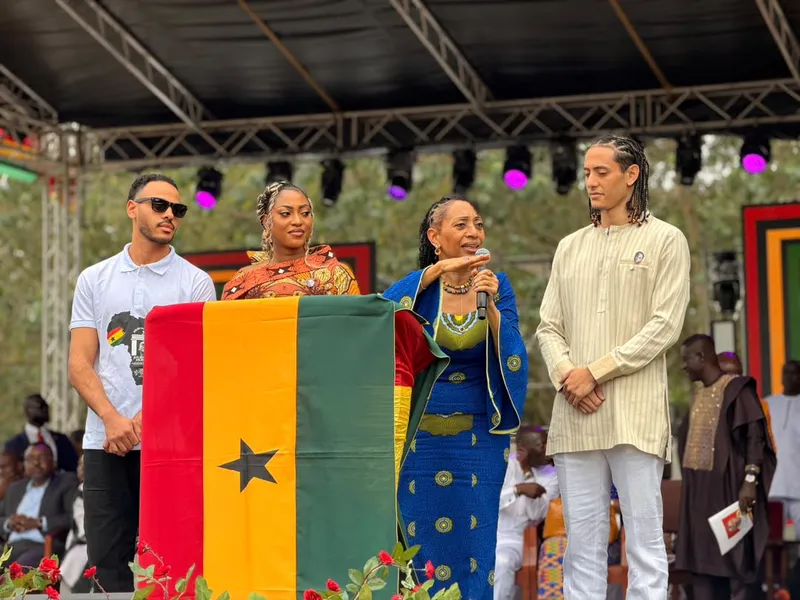 ‘We’ve come back to make sure our father's ideas never die’ – Nkrumah family
 Ghana Jollof: Akosua Manu appeals to Naana Jane to use her influence to free Sal...
 Yellow fever confirmed in Sissala East after 21 mysterious deaths
 Kenyasi man allegedly attacked by prison officers and inmates over yam theft cla...
 Germany’s far-right AfD makes strong gains in two state elections
 Savannah Regional Minister, IGP Yohuno visit Gbindabuor following lynching of po...
 Jehovah's Witnesses make blood component decisions a matter of personal conscien...
 Road contractors fed on contracts for years without completing projects – Alhass...
 Ghana Jollof saga: ‘She has no right to do what she’s doing’ – Inusah Fuseini


