





British Council’s perspective on inclusive language policy and practice, examining how education systems can respond effectively to diverse linguistic contexts.
Language is central to learning. Across many contexts worldwide, schools and classrooms bring together learners with diverse linguistic backgrounds and identities. This diversity enriches communities but also requires careful decisions about which languages are used in education, and how. In multilingual contexts – including those shaped by colonial histories or high mobility – these decisions are often complex.
Globally most education systems share a common ambition: to equip learners with the communication skills needed to succeed locally and globally. Evidence shows that inclusive language‑in‑education policies help achieve this goal when they are supported with appropriate resources. Our updated, language-responsive, position (Language-responsive education: The British Council’s position on inclusive language policy and practice.) forms part of the British Council’s ongoing effort to understand what inclusive language policy and practice look like in varied contexts, and to learn from systems responding effectively to learners’ linguistic realities.
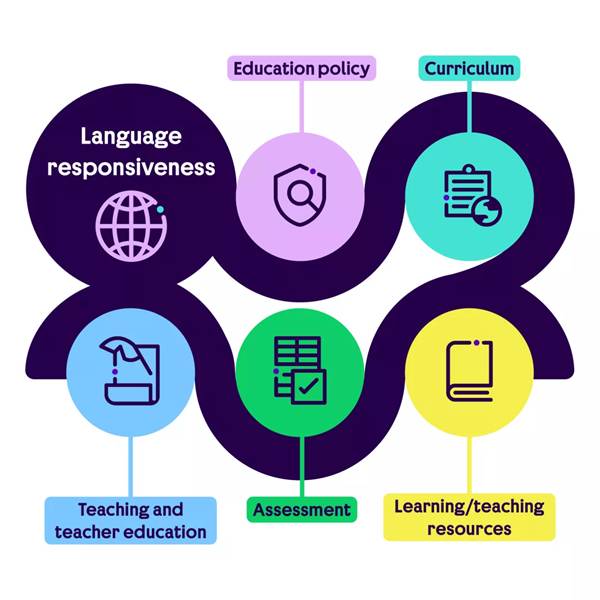
We do not advise as to when or whether countries should transition to English medium education. Instead, we emphasise that decisions about language in education must be made locally, shaped by contextual, social, economic, political and historical factors. What matters most is how well systems support learning. Learners need strong foundations in both a familiar language and English; teachers require appropriate support and preparation; and schools need suitable teaching and learning materials and assessments. Language is a fundamental consideration across policy, curriculum, assessment, teaching and teacher education.
Language policy and practice: A review of the literature on English in education
Our updated position is informed by a comprehensive global literature review conducted for this project. The review, titled, Language policy and practice: A review of the literature on English in education shows that outcomes depend on teacher proficiency, pedagogical quality, system capacity and alignment with local linguistic and cultural realities. It also highlights the risks of poorly supported transitions to English medium education and the importance of strong English as a subject provision.
These insights reinforce the need for context‑sensitive, evidence‑informed approaches and whole‑system commitment to language‑responsive, inclusive and high‑quality education for all learners.
 Bolgatanga: Police arrest three for trafficking young girls into prostitution, f...
 GoldBod introduces new LBMA-based pricing regime for gold purchases
 'Politicians in the Fourth Republic have failed us on flooding' — Dr. Asah-Asant...
 One dead after diesel tanker bursts into flames at Asutuare Junction
 Mahama urges Ghanaians to match prayer with hard work for national development
 Fuel prices fall again as OMCs cut pump prices in July's first pricing window
 If the economy is doing so well, why burden Ghanaians with heavier tariff — Samm...
 Minority NPP summons Health Minister for briefing on post-flood disease risks
 Responsible citizenship and hard work surest path to national development — Maha...
 Our nation has made remarkable progress — Mahama
