




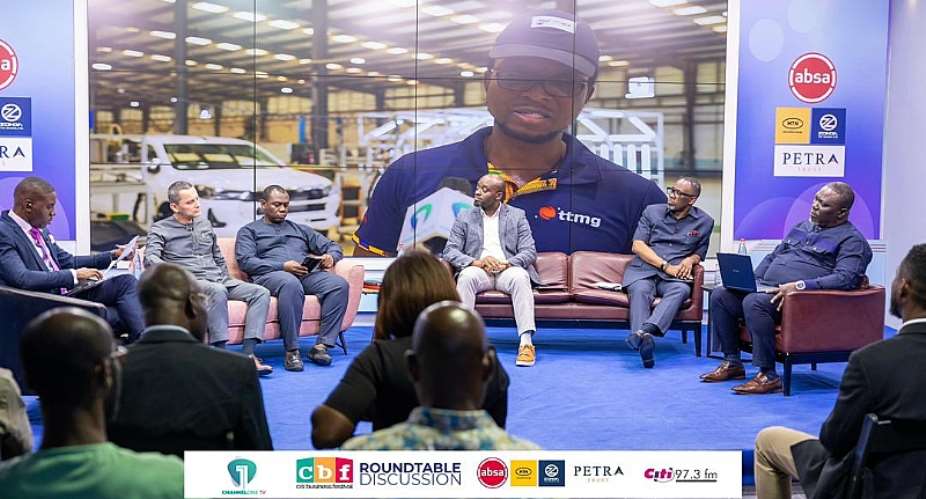
Ghana’s automotive industry is entering a critical policy phase, with government reviewing the Value Added Tax (VAT) exemption on locally assembled vehicles, while also advancing plans to deepen local component manufacturing and position the country as a regional automotive hub.
The developments emerged at the final roundtable discussion of the 2026 Citi Business Festival held on Thursday, June 25, on Channel One TV under the theme: “Driving Ghana Forward: The State of the Automotive Assembly Industry and Its Contribution to the Economy.”
The discussion brought together government officials, economists and industry executives to assess progress under Ghana’s automotive development policy and the next phase of industrialisation in the sector.
Head of Strategic Manufacturing at the Ministry of Trade, Agribusiness and Industry, Kwasi Ofori-Antwi, disclosed that government is reviewing the VAT exemption on locally assembled vehicles following concerns from industry players that its withdrawal has slowed production and affected competitiveness.
He explained that the initial suspension of the incentive followed an assessment by the Ministry of Finance.
“There was an assessment on the industry by the Ministry of Finance and the Ministry felt that the VAT which was to be enjoyed by consumers was not trickling down to industry so that was put on hold. The industry people have engaged the Ministry of Finance to that effect.”
He added that government is open to revisiting the policy in response to ongoing stakeholder engagement.
“Government didn’t want industry to hold on to that perception. So government will be reviewing that and we are very hopeful that it will be restored.”
Industry players have long argued that maintaining a 20 percent VAT on locally assembled vehicles undermines competitiveness against imported used and new vehicles, and risks slowing investment in assembly operations.
Beyond fiscal incentives, government says the next phase of the automotive agenda will focus on building domestic industrial capacity, particularly through engineering and component manufacturing.
Mr. Ofori-Antwi announced plans to establish an advanced automotive laboratory at Suame Magazine in the Ashanti Region, aimed at supporting metal alloying, metal analysis and component production.
He noted that Suame Magazine, one of West Africa’s largest informal industrial clusters, has significant untapped potential that could be integrated into Ghana’s formal automotive value chain.
“We have an artisanal industry which will be very important to our automotive industry. When we brought those who are helping us develop the policy and we took them to Suame Magazine, they were very amazed to see the potential that we had at Suame Magazine.”
He added: “So for Suame Magazine, we are looking at establishing an advanced laboratory for them so that it can help them with the alloying of their metals, metal analyses and also post-component manufacturing.”
The initiative is expected to bridge the gap between informal engineering clusters and formal automotive assembly plants, strengthening local sourcing and reducing dependence on imported components.
Further expansion of local manufacturing was highlighted by Team Lead of the Ghana Partnership for Jobs and Economic Transformation Programme (Ghana JET), Eugene T. Sangmortey, who disclosed that Ghana is expected to begin local production of industrial fasteners, including bolts, nuts and springs, by the third quarter of 2026.
The project, backed by Ghanaian private sector participation and international investors including the British International Investment (BII), is expected to supply multiple sectors, including automotive, mining, oil and gas, and construction.
Mr. Sangmortey also raised concerns about quality risks associated with uncertified imported components circulating in informal markets.
“We don’t know the integrity of some of those materials, and they can break apart when a vehicle is travelling at around 80 kilometres per hour. However, these products will be manufactured with the quality standards. They are going to produce and supply them to the mining, oil and gas, automotive, and other sectors.”
For his part, Economist, Professor Ebo Turkson argued that Ghana’s automotive strategy must go beyond assembly plants to include broader value chain development.
Professor Ebo Turkson said Ghana imported nearly three billion dollars’ worth of vehicles in 2025, stressing that even partial local substitution would significantly transform the economy.
He also noted that assembly plants are currently operating below capacity despite having the potential to meet national demand.
Chief Executive Officer of Volkswagen Ghana, Jeffrey Oppong Peprah, described Ghana’s automotive policy as one of the most visible on the continent, noting that it has attracted interest from investors and policymakers across Africa.
“I must say, our neighbours are always watching us. They have learned so much from what we are doing.”
He revealed that Ghana recently hosted delegates from 23 African countries under an AfCFTA and Afreximbank-supported engagement to study the country’s automotive framework.
“Twenty-three member states are all interested in our auto industry. Ghana is more like a model because of our policy. We have it all, so we need to cross the bar.”
He, however, cautioned that the policy remains in a “trial and error” phase and requires stronger implementation to achieve full impact.
The Chief Executive Officer of Japan Motors Ghana, Salem Kalmoni, said Ghana’s automotive assembly industry is highly competitive, with no single player holding monopoly power, a situation he believes is helping to drive down vehicle prices.
“There are 10 bona fide assemblies in Ghana, with 7 assembly plants. We are competitors; it’s not like there’s a monopoly,” Mr. Kalmoni added.
He maintained that the competitive environment has contributed to a notable reduction in vehicle prices, which he said ultimately benefits consumers.
“Our prices have come down significantly, and it has been passed on to the consumer,” he said.
Stakeholders agreed that Ghana’s next phase of automotive development will depend on policy consistency, restoration of investor confidence, and the ability to build a fully integrated ecosystem that links assembly plants with local suppliers, engineering clusters and allied industries.
As government weighs tax reforms and new industrial investments, the sector appears poised between consolidation and expansion, with the outcome likely to shape Ghana’s broader industrial transformation agenda.
The 2026 Citi Business Festival is powered by 97.3 Citi FM and Channel One TV in partnership with Absa Bank and sponsored by Absa Bank, MTN, Zonda Tec Ghana Limited and Petra Trust.
 Bolgatanga: Police arrest three for trafficking young girls into prostitution, f...
 GoldBod introduces new LBMA-based pricing regime for gold purchases
 'Politicians in the Fourth Republic have failed us on flooding' — Dr. Asah-Asant...
 One dead after diesel tanker bursts into flames at Asutuare Junction
 Mahama urges Ghanaians to match prayer with hard work for national development
 Fuel prices fall again as OMCs cut pump prices in July's first pricing window
 If the economy is doing so well, why burden Ghanaians with heavier tariff — Samm...
 Minority NPP summons Health Minister for briefing on post-flood disease risks
 Responsible citizenship and hard work surest path to national development — Maha...
 Our nation has made remarkable progress — Mahama
