




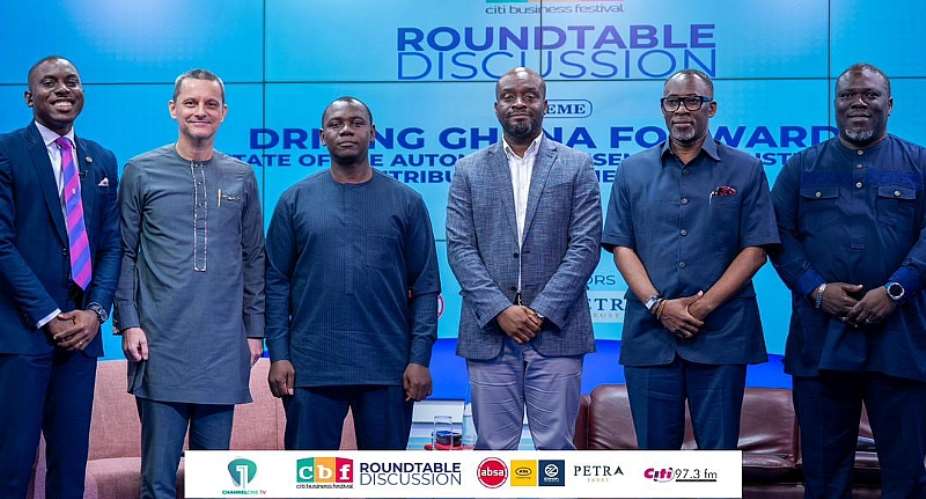
Speakers at the final roundtable discussion of the Citi Business Festival 2026 have highlighted the growing importance of Ghana’s automotive assembly industry, describing it as a key driver of industrialisation and a critical tool for reducing the country’s dependence on imported vehicles.
The discussion, held under the theme “Driving Ghana Forward: The State of the Automotive Assembly Industry and Its Contribution to the Economy,” brought together policymakers, industry leaders and development experts to assess the progress of Ghana’s automotive policy and its impact on the broader economy.
Speaking during the event, the Head of Strategic Manufacturing at the Ministry of Trade, Agribusiness and Industry, Kwasi Ofori-Antwi, said Ghana’s progress under the automotive development policy introduced in 2019 should be viewed within the context of the industry’s relatively short lifespan.
According to him, while several of the policy’s objectives are yet to be fully realised, the industry has made significant strides within a few years of implementation.
“Compared to where some leading automotive manufacturing countries were at a similar stage of development, Ghana has made considerable progress,” he noted, adding that the industry remains a work in progress but is moving in the right direction.
Ofori-Antwi stressed that the policy has established a framework to support industrialisation, job creation, value addition and skills development, while helping to bridge the gap between academia and industry.
The Chief Executive Officer of Japan Motors Ghana, Salem Kalmoni, attributed part of the sector’s success to the increasing level of competition among vehicle assemblers operating in the country.
According to him, Ghana currently has ten licensed automotive assemblers and seven assembly plants, creating a competitive environment that is benefiting consumers through lower vehicle prices.
“There is no monopoly in the industry. Assemblers are competing with one another, and that competition is helping to bring vehicle prices down,” he said.
Kalmoni argued that resistance to the automotive assembly programme largely comes from used vehicle dealers and vehicle importers who now face growing competition from locally assembled vehicles.
Economist Professor Ebo Turkson described the industry as one with enormous potential to significantly reduce vehicle imports, although he cautioned that its local value chain remains relatively shallow.
He noted that the presence of about six Original Equipment Manufacturers (OEMs) in Ghana should not be underestimated, describing it as a major achievement for a developing economy.
“A strong foundation has been established, but the depth remains shallow. The kind of structural transformation Ghana seeks through the automotive industry will take time,” he stated.
Also speaking at the event, Team Lead at Ghana JET, Eugene T. Sangmortey, described the automotive industry as one of the country’s most promising growth sectors, capable of accelerating industrialisation and economic transformation.
He commended the government for the speed with which the automotive policy moved from conception to implementation, describing it as one of the fastest industrial policies to progress from incubation to execution.
Meanwhile, the Chief Executive Officer of Volkswagen Ghana, Jeffrey Oppong Peprah, described the current automotive policy as a significant improvement on previous frameworks dating back to the late 1960s. However, he maintained that stronger implementation measures would be required to unlock the sector’s full potential.
The discussions underscored growing optimism about the future of Ghana’s automotive assembly industry, with stakeholders agreeing that while challenges remain, the sector is laying the foundation for long-term industrial development, employment creation and import substitution.
The Citi Business Festival has become one of Ghana’s leading business advocacy and thought-leadership platforms, bringing together industry leaders, policymakers and entrepreneurs to discuss critical issues shaping the country’s economic future.
The 2026 edition is powered by 97.3 Citi FM and Channel One Television in partnership with Absa Bank Ghana and sponsored by Absa Bank Ghana, MTN Ghana, Zonda Tec Ghana Limited and Petra Trust.
 Bolgatanga: Police arrest three for trafficking young girls into prostitution, f...
 GoldBod introduces new LBMA-based pricing regime for gold purchases
 'Politicians in the Fourth Republic have failed us on flooding' — Dr. Asah-Asant...
 One dead after diesel tanker bursts into flames at Asutuare Junction
 Mahama urges Ghanaians to match prayer with hard work for national development
 Fuel prices fall again as OMCs cut pump prices in July's first pricing window
 If the economy is doing so well, why burden Ghanaians with heavier tariff — Samm...
 Minority NPP summons Health Minister for briefing on post-flood disease risks
 Responsible citizenship and hard work surest path to national development — Maha...
 Our nation has made remarkable progress — Mahama
