




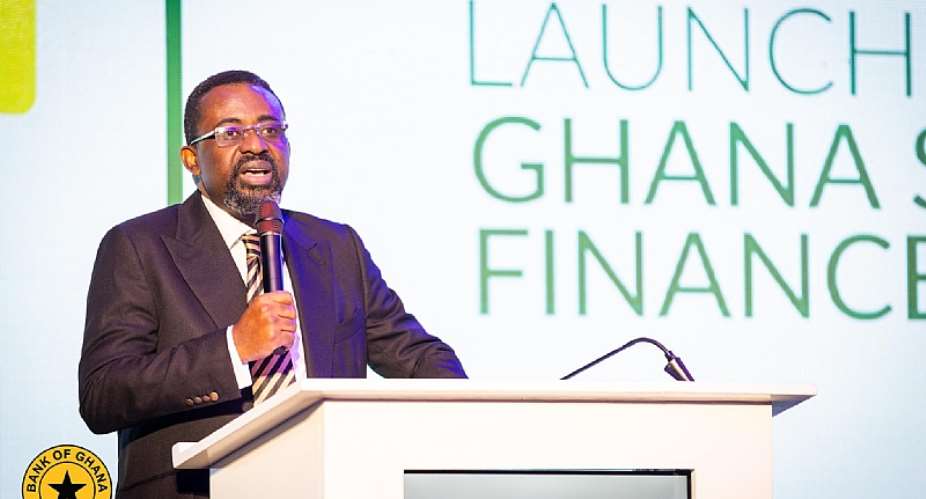
Ghana's banking industry has achieved an average compliance rate of 73 percent with the Sustainable Banking Principles as of September 2025, highlighting significant progress in integrating environmental and social risk management into financial sector operations.
Speaking at the launch of the Sustainable Finance Roadmap in Accra, Governor of the Bank of Ghana, Dr Johnson Pandit Asiama, described the achievement as the result of nearly a decade of sustained efforts to mainstream sustainability within the country's financial system.
“In 2021, with the support of the International Finance Corporation and the Swiss Secretariat for Economic Affairs, we built a standardised framework to measure compliance, and that compliance has risen steadily, reaching an industry average of 73 per cent as at September 2025,” he said.
Dr Asiama traced the origins of the Bank of Ghana's sustainability agenda to 2015, when it established a multi-stakeholder committee made up of the central bank, the Ghana Association of Banks and the Environmental Protection Agency. The committee later developed into the Sustainable Banking Principles Steering Committee.
The collaboration led to the introduction of the Sustainable Banking Principles in 2019, supported by sector-specific guidance notes designed to help financial institutions manage environmental and social risks, encourage green investments and align financing decisions with Ghana's national development priorities.
According to the Governor, all 23 commercial bank chief executives voluntarily signed on to the framework, committing their institutions to incorporate sustainability into corporate governance, risk management processes and core business operations.
“This unified commitment marked a turning point, signalling the readiness of Ghana's banking sector to embrace sustainability not as an obligation, but as a strategic imperative,” Dr Asiama said.
He explained that the introduction of a standardised compliance assessment framework in 2021, developed with support from the International Finance Corporation and the Swiss Secretariat for Economic Affairs, has enabled the central bank to consistently monitor implementation across the industry. Since then, compliance has continued to improve, reaching an industry average of 73 percent by September 2025.
The Governor also highlighted another milestone in the Bank of Ghana's sustainability agenda, noting that the central bank launched its four-year Strategic Plan on Sustainability and Climate-Related Risks for the 2024 to 2028 period. The strategy is intended to deepen existing reforms while strengthening the capacity of financial institutions to identify, assess and manage climate-related financial risks.
He said the newly launched Sustainable Finance Roadmap represents the next phase of Ghana's sustainability agenda by establishing, for the first time, a unified framework to coordinate sustainability initiatives across the banking, insurance, securities, and pensions sectors.
Dr Asiama said the steady progress achieved over the years reflects a shift in the financial sector's approach to sustainability, which has evolved from a regulatory requirement into a strategic priority capable of attracting green investment, strengthening institutional resilience and supporting Ghana's long-term economic development.

 GoldBod’s gains must be weighed against full cost to Ghana – Prof. Bokpin
 ‘Afenyo-Markin’s smear campaign against me is about extortion’ – Sammy Gyamfi
 August 22: Cedi sells at GHS12.30 on forex market, GHS11.13 on BoG interbank
 There is a deliberate smear campaign against GoldBod from Minority – Sammy Gyamf...
 ‘If GoldBod wants credit, it must accept blame for losses’ – Dr Owusu Sarkodie
 Akosombo control system to be restored next month – Energy Minister
 ‘Temporary Akosombo system not very robust’ – Energy Minister on recent power ou...
 Mike Ocquaye Jr reacts to Adwoa Safo’s reported return to NPP Dome-Kwabenya race
 Foreign Affairs Ministry urges Tijjaniya pilgrims to Senegal to travel by air ov...
 Bono Police Arrest 36‑Year‑Old in GH¢1.1M Fake Gold Deal; Hunt for Three Others ...

